The award-winning aquascapes you see on competition sites rest on a surprisingly small set of design principles, most of them borrowed from landscape painting and Japanese gardens. The ideas are intuitive once explained, and mastering just four of them turns an ordinary tank into one that makes guests stop and ask how you did it. The rest of aquascaping theory is helpful, but optional, until those four are second nature.
The three classic styles
Before arranging anything, decide what you are aiming for. A clear style choice prevents the muddled look that comes from borrowing a little from each.
Nature aquarium
The dominant modern style, pioneered by Takashi Amano and inspired by terrestrial landscapes such as riverbanks, forests, and mountainsides. It is asymmetric and focal-point driven, using driftwood and stone as the primary structure, with plants chosen to evoke a place rather than to show botanical variety.
Dutch style
Plant-focused and hardscape-free, the Dutch style arranges contrasting plant species in tight terraces, almost like garden beds. It is the horticultural extreme of the hobby and demands heavy CO2, strong light, and constant pruning. Stunning, but high-maintenance.
Iwagumi
A stone-focused, minimalist style using three to seven rocks and typically a single carpeting plant. It looks simple and is brutally hard to execute well, which is why it is the most attempted and least successfully finished style in the hobby.
Principle 1: The rule of thirds
Mentally divide the tank into three horizontal and three vertical bands, like a tic-tac-toe grid. The four points where those lines intersect are the strongest visual positions in the layout. Place your main focal element, the tallest driftwood, the largest stone, or the densest plant cluster, at one of those intersections rather than dead center. Centered compositions read as static and lifeless.
Principle 2: The golden ratio
The golden ratio, roughly 1.618 to 1, appears throughout nature and feels instinctively right to the eye. On a standard 24-inch tank, that means placing the main focal point about 38 percent of the way along the length, near 23 cm from one end, with a secondary point toward the opposite third. The result is an off-center composition that reads as balanced without being symmetric.
Principle 3: Foreground, midground, background
Think in three depth zones, each with a job:
- Foreground: short carpeting plants or open fine substrate across the front quarter of the tank. Resist planting anything tall here, which visually flattens the scape.
- Midground: medium-height plants and the main hardscape focal point. This is where the eye rests longest.
- Background: tall stem plants or driftwood that create depth and frame the midground.
Principle 4: Negative space
This is the hardest principle for beginners to accept. Empty space is part of the design, not a failure to finish it. A typical first tank crams plants and decor across 95 percent of the substrate, while a well-composed scape often leaves 30 to 50 percent open. Negative space creates depth, suggests scale, gives fish room to swim where you can see them, and lets the plants you do have actually be noticed.
Choosing hardscape
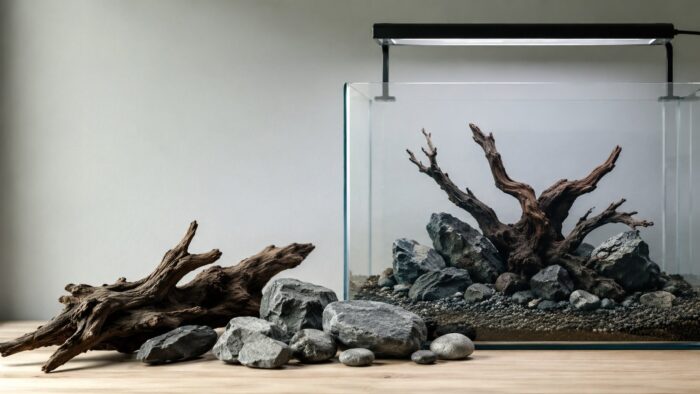
Stone
- Seiryu stone: blue-gray and rugged, the classic Iwagumi material, though it slightly raises water hardness.
- Dragon stone: porous, warm beige, with dramatic shapes, and chemically inert.
- Manten stone: smooth and black for a modern look.
- Frodo stone: light and layered, scaling well from nano to large tanks.
Make one stone the clear focal point and let the others support it. Group rocks in odd numbers, three, five, or seven, give the largest the prime position, and angle the smaller ones toward it.
Driftwood
- Spider wood: fine branching, ideal for attaching moss.
- Manzanita: strong horizontal lines, a nature-aquarium staple.
- Mopani: dense, dark, sinks immediately, but can leach tannins.
- Malaysian driftwood: heavy, sinks well, mid-tone color.
Pre-soak new driftwood for one to two weeks to release tannins, which tint water harmlessly, and to ensure it sinks rather than floating loose.
Layout habits that flatten a scape
- Symmetry. A central tall plant flanked by matching arrangements looks static.
- Even numbers. Two stones or two pieces of wood make the eye keep comparing them; use odd numbers.
- Too many plant species. Fifteen kinds look chaotic, while three to five repeated species look intentional.
- Filling every inch. Leave room for the eye to rest.
- Hardscape that breaks the surface. Wood that pokes above the water dwarfs everything else.
Creating the illusion of depth
A glass box is shallow, often only 12 to 18 inches front to back, yet the best scapes feel deep. A few tricks create that illusion in even a small tank.
- Slope the substrate upward toward the back, so the rear sits noticeably higher than the front.
- Place larger hardscape and coarser-leaved plants in front, with smaller pieces and finer textures behind, mimicking how distance shrinks detail.
- Use a single open path of fine substrate winding from front to back to suggest a trail receding into the distance.
- Keep the brightest colors in the midground, where the eye naturally settles.
Tools that earn their place
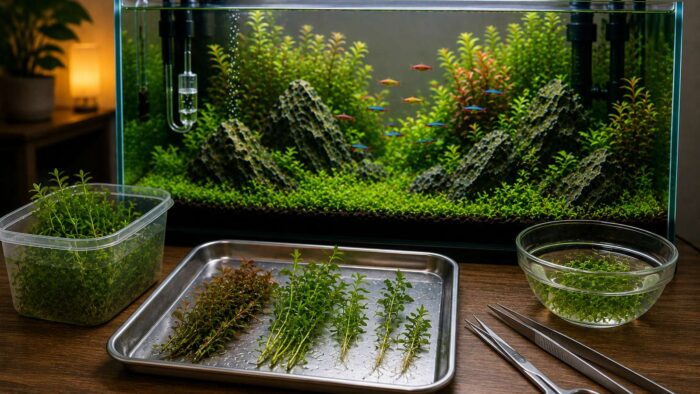
- Long aquascaping tweezers, 10 to 12 inches, for planting without dunking your whole arm.
- Curved trimming scissors for shaping carpets.
- A spray bottle to keep plants moist during a dry start before flooding.
- A glass scraper or razor for algae; magnetic cleaners can scratch acrylic.
Where to find inspiration
Studying the best work shortens your learning curve. The IAPLC, run from Japan, is the gold standard contest, the AGA International Aquascaping Contest publishes strong galleries each year, and European studios like Green Aqua and Tropica produce excellent educational material. Pair what you see there with sturdy, forgiving species from the list of plants for low-light tanks and the right base from the guide to choosing aquarium substrate.
Let the hardscape carry the composition
Most beginner tanks become intermediate tanks the day their owner stops trying to fill every gap. Build the hardscape first, photograph it before adding water, and live with it for a day. If the bare layout looks compelling on its own, the planted version often will too.
Aquascaping questions about layout and depth
Do I need expensive stone and wood?
No. Composition matters far more than material. A single well-placed piece of inexpensive wood beats a pile of premium stone arranged carelessly.
Can I aquascape a tank that already has fish?
Yes, though it is easier to design before stocking. Work in stages, keep your filter running, and avoid uprooting everything at once.
How do I keep my scape from looking messy after a few months?
Regular pruning and choosing slow growers in key spots keep a layout readable. Fast growers fill in quickly but blur the composition if left untrimmed.
Strong layouts start with space and proportion
Pick one style, use odd numbers of stones or wood, place your focal points at golden-ratio positions, leave deliberate negative space, and repeat three to five plant species rather than collecting many. Those habits alone separate a tank that looks arranged from one that looks designed.