A planted tank without injected CO2 or a high-end light still works beautifully, as long as you choose the right species. The elaborate Dutch-style and contest aquascapes you see online are not the only path to a lush tank. Many of the most attractive display tanks rely on slow-growing, low-demand plants that thrive on ordinary equipment. These are the species that earn a place in a first planted tank.
What “low light” actually means
The hobby measures usable light as PAR, or photosynthetically active radiation. Low light generally means under 30 PAR at substrate level. Most stock aquarium LEDs deliver somewhere between 30 and 50 PAR, which is plenty for the plants below but not enough for the demanding red and carpeting species featured in competition tanks.
A simple practical test: if your tank still uses the LED it came with, with no upgrade, no CO2, and no specialty substrate, you have a low-tech, low-light tank and should plant accordingly.
The plants that thrive
1. Java moss
Essentially indestructible. Tie it to driftwood with fishing line or attach it with super-glue gel and it anchors itself within weeks. It survives in tanks where everything else has failed and makes excellent cover for fry.
2. Java fern
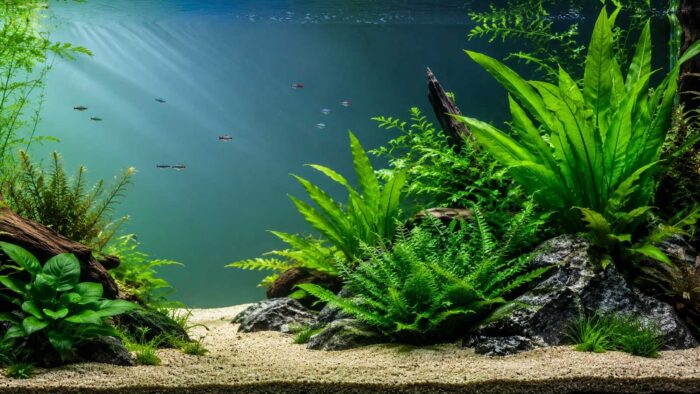
Distinctive lance-shaped leaves grow from a thick rhizome that must stay above the substrate, or it rots. Attach it to rock or wood instead of burying it. Varieties include standard, Windelov, narrow leaf, and trident.
3. Anubias
Like Java fern, anubias grows from a rhizome that cannot be buried. Its thick, waxy, dark green leaves are ignored by algae and most herbivorous fish, making it possibly the most beginner-proof plant in the hobby. Sizes range from nana petite to the large barteri.
4. Cryptocoryne species
Substrate-rooted and low to medium height, the crypts include the common wendtii, the tall ribbed balansae, and the small parva. They famously melt when first transplanted, dissolving their leaves before regrowing over the following weeks, so do not panic when it happens.
5. Bucephalandra
A slow-growing rhizome plant with striking blue-green leaves. It actually prefers low light, since bright light encourages algae on its slow-growing leaves. Attach it to hardscape like anubias.
6. Vallisneria
A tall ribbon-leaf background plant that spreads by runners, turning one plant into a dozen within months. Best in tanks of 20 gallons or larger. Common species include italica, americana, and the twisted spiralis.
7. Amazon sword
A classic centerpiece with large leaves that can reach 18 inches in mature plants. It is a heavy root feeder, so use root tabs or a nutrient-rich substrate.
8. Hornwort
A fast-growing bushy plant, floated or loosely planted, that absorbs ammonia and nitrate aggressively, which makes it useful during cycling. It sheds needles and needs weekly cleanup.
9. Water sprite
Lacy, fast-growing, and happy planted or floating. It provides shade and cover for shy fish and is one of the best ammonia absorbers for a new tank.
10. Marimo moss balls
Technically a colony of algae rather than a plant, but treated as one in aquascaping. Roll them gently every few weeks to keep their shape. They are nearly impossible to kill and look excellent in nano shrimp tanks.
What will not work in low light
- Most red plants, which need high light to develop their color.
- Carpeting plants such as HC Cuba, Monte Carlo, and dwarf hairgrass, which melt or grow tall instead of carpeting.
- Many Hygrophila species, which grow but stay leggy and sparse.
How to plant and arrange them
Technique matters as much as species choice in a low-tech tank. A few habits make the difference between plants that establish and plants that float loose or rot.
- Rhizome plants such as anubias, Java fern, and bucephalandra should be tied or glued to wood and rock, never buried. Their rhizome must breathe.
- Stem and rosette plants such as swords and crypts go into the substrate, with the crown, where leaves meet roots, sitting just above the gravel line.
- Plant in groups rather than scattering single stems, which reads as cluttered and grows in patchy.
- Place tall background plants like vallisneria at the back and rear corners, and keep the front open so the tank looks deeper.
If you want a more deliberate, designed look once the plants fill in, the composition rules in the guide to aquascaping layout principles apply just as well to a low-tech tank.
Lighting and the photoperiod
More light is not better in a low-tech tank. Running the light eight hours or more, or placing the tank near a window, hands a head start to algae rather than your slow-growing plants. Six to eight hours on a simple timer is plenty for the species here, and a consistent schedule beats a long, irregular one. If you ever notice algae creeping onto leaves, shortening the photoperiod is usually the first and most effective fix.
Benefits and limitations of a low-tech planted tank
The benefits are real: lower cost, far less maintenance, no CO2 equipment to manage, and a strong buffer against algae problems because healthy plants outcompete algae for nutrients. The trade-off is patience and palette. Growth is slow, so a freshly planted tank looks sparse for weeks, and you give up the vivid reds and tight carpets that only high light and CO2 can produce.
Where low-light setups usually go wrong
- Burying the rhizome of anubias or Java fern, which causes rot.
- Running the light 12 hours a day, which feeds algae rather than plants.
- Panicking and removing crypts when they melt after transplanting.
- Skipping root tabs for heavy feeders like Amazon sword.
A restrained low-light setup is easier to balance
A low-light tank rewards restraint. Choose three to five species, give them time to settle, and keep the photoperiod modest, around six to eight hours. If you later want vivid reds or a tight foreground carpet, that is the point at which to weigh whether you need CO2 injection and the higher light that comes with it.
Low-light plant questions
Do low-light plants still need fertilizer?
Most benefit from a modest all-in-one liquid fertilizer, and root feeders like swords and crypts appreciate root tabs. They simply need less than high-light tanks.
Can I grow these in plain gravel?
Yes. Rhizome and floating plants do not need special substrate at all, and root feeders manage in gravel with root tabs added.
Why are my plant leaves turning clear or yellow?
Usually a nutrient shortfall or, in new tanks, the normal melt-and-regrow phase. Stable conditions and a little fertilizer typically resolve it.
Low-light success comes from suitable plants
You do not need expensive lighting or pressurized CO2 to keep a green, thriving tank. Anchor your scape with anubias, Java fern, and crypts, add a fast grower like hornwort to soak up nutrients, keep the light period sensible, and let the plants establish at their own pace.