Many aquarium illnesses begin with environmental stress, poor water quality, injury, or a pathogen introduced with new livestock. Similar symptoms can have different causes, so treatment should begin with observation and water testing rather than a medication chosen from appearance alone.
This guide explains common warning signs, the information worth recording, and the point at which isolation or specialist help is safer than trial-and-error treatment.
Start with diagnosis, not medication
Before using any treatment, work through these checks:
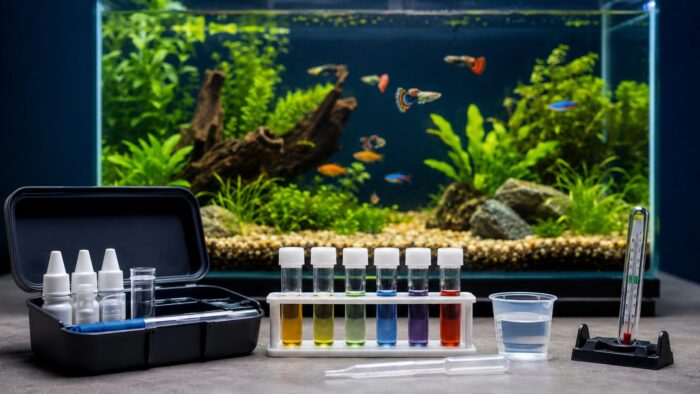
- Test the water. Detectable ammonia or nitrite, a major temperature change, low oxygen, or a sudden shift in pH can create disease-like signs and weaken fish.
- Review recent events. New fish, transport, aggression, filter maintenance, equipment failure, and missed water changes can narrow the cause.
- Record the symptoms. Photograph spots or lesions, note appetite and breathing, and observe whether one fish or the whole tank is affected.
- Separate urgent cases. A hospital tank can protect other livestock and allows treatment without exposing plants, invertebrates, or the display filter.
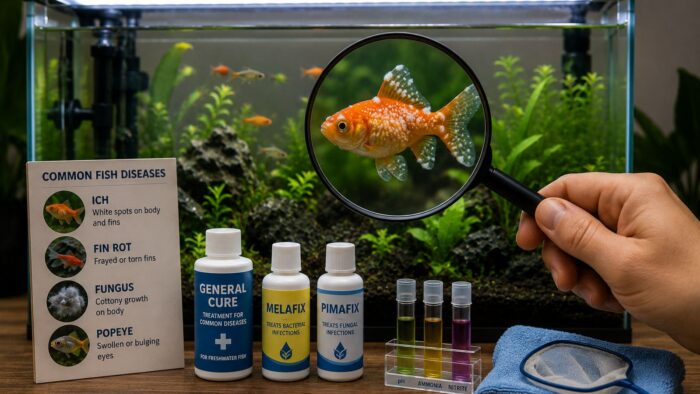
| Condition | Key visible signs | Usual cause | First response |
|---|---|---|---|
| Ich (white spot) | Distinct white spots like salt grains; flashing against decor | Parasite, usually stress-triggered | Raise temperature gradually, treat whole tank, extend course past visible spots |
| Velvet | Fine gold or rust dust sheen; rapid gill movement | Parasite; often fatal if missed | Dim the tank, treat promptly, review water quality |
| Fin rot | Ragged, receding, whitened fin edges | Bacterial, follows poor water or injury | Correct water quality first; medicate only if it progresses |
| Fungus | White cotton-like tufts on body or mouth | Secondary infection at an injury site | Improve water quality, treat the wound, isolate if spreading |
| Dropsy | Swollen body, scales standing out like a pinecone | Organ failure, often bacterial | Poor prognosis; isolate, keep water pristine, seek advice |
| Pop-eye | One or both eyes protruding | Injury or bacterial infection | Clean water; check for physical damage |
| Swim bladder problems | Floating, sinking, swimming at an angle | Diet, constipation, or infection | Fast briefly, feed soaked or blanched food, review diet |
| Columnaris | Grey or white saddle patches, frayed mouth | Bacterial; spreads fast in warm water | Lower temperature, act quickly, isolate affected fish |
Ich, or white spot disease
Freshwater ich is caused by Ichthyophthirius multifiliis. White spots, flashing, clamped fins, and rapid breathing are common signs, but similar symptoms can occur with other parasites or water-quality problems.
Safer treatment approach
Confirm that the pattern is consistent with ich, improve oxygenation, and use a treatment labelled for the affected species and water type. The parasite has stages that are not all vulnerable at the same time, so complete the full labelled course even when visible spots disappear. This is the mechanism rather than a rule of thumb: University of Florida IFAS guidance notes that only the free-swimming tomite stage is susceptible to chemical treatment, and that the cycle completes in about 48 hours at 75-79 °F – so warm water needs a minimum of three treatments two to three days apart, while cooler water needs at least five treatments three to five days apart. The Merck Veterinary Manual puts the same point more bluntly: while encysted, the parasite is refractory to chemical treatment. Temperature and salt are not universal remedies; some fish, plants, and invertebrates tolerate them poorly, and combining products can be dangerous.
Fin rot
Frayed fins can result from poor water, aggression, sharp decor, transport injury, or bacterial infection. Correct measurable water-quality problems and remove the source of physical damage first.
If tissue continues to recede, the fin base becomes red or ulcerated, or the fish stops eating, isolate the fish and obtain a more specific diagnosis. Use only a properly labelled antibacterial treatment when the evidence supports a bacterial cause.
Velvet disease
Velvet can cause a fine gold or rust-coloured dust, clamped fins, scratching, and rapid breathing. Marine velvet in particular can progress quickly and may not be obvious until breathing is affected.
Move affected fish to an appropriate hospital system, increase aeration, and seek prompt species-specific treatment guidance. Copper or other antiparasitic treatments require accurate concentration control and cannot be used safely in a reef display with corals or invertebrates – the IFAS fact sheet on Amyloodinium specifies copper held at 0.2 mg/L free Cu2+ for up to three weeks, and states that this “will kill all invertebrates present in the system”.
Dropsy
Dropsy describes swelling and raised scales rather than one disease. Possible causes include organ damage, severe bacterial infection, fluid imbalance, or chronic environmental stress. Once the pinecone appearance is present, the condition is serious.
Isolate the fish, check water quality, keep conditions stable, and seek an aquatic veterinarian or experienced aquatic-health professional. Avoid choosing an antibiotic solely from the appearance because the underlying cause may not be bacterial.
Pop-eye
One or both eyes may protrude after injury, infection, poor water quality, or gas supersaturation. A single affected eye can follow trauma, while both eyes can point to a systemic or environmental problem, but neither pattern confirms a diagnosis by itself.
Correct water problems, remove sharp decor or aggression, and obtain help if swelling worsens, the eye becomes cloudy or bloody, or several fish are affected.
Fungus
Cotton-like growth often colonises tissue already damaged by injury, poor water, or another infection. Some bacterial conditions can look similar, especially around the mouth or gills.
Improve the environment, isolate the fish when practical, and use a labelled antifungal only after the appearance and likely cause have been checked. Fast-spreading lesions or breathing difficulty need prompt specialist assessment.
Bloat and swim bladder problems
Abdominal swelling or loss of buoyancy can be related to overfeeding, constipation, body shape, infection, organ disease, injury, or water quality. It is especially risky to assume every floating fish needs the same food remedy.
Check the water, stop adding rich treats, and observe faeces, appetite, swelling, and posture. A short feeding pause may help a healthy adult fish after obvious overfeeding, but persistent swelling, pineconing, inability to feed, or worsening balance needs a more specific diagnosis.
The feeding guide explains portion control and species-appropriate diets.
Columnaris
Columnaris is a bacterial disease that can produce pale patches, mouth erosion, frayed fins, or a saddle-shaped lesion. It can resemble fungus and may progress quickly, especially when fish are stressed or water quality is poor.
Isolate affected fish, improve oxygenation and water quality, and obtain a confirmed diagnosis before using antibacterial medication. Avoid raising temperature automatically, because warmer water can accelerate some strains.
Marine tanks face a different set of pathogens that move considerably faster than their freshwater equivalents, covered separately in the guide to marine fish diseases.
Quarantine: prevention beats treatment
A separate, cycled quarantine tank allows new fish to settle and be observed before they enter the display. A period of several weeks is common, but the appropriate length depends on species, source, symptoms, and local disease risk.
Use dedicated nets and siphons, monitor ammonia closely, and treat only when signs or a professional recommendation justify it. The quarantine guide covers the setup and routine.
Diagnosis is one part of a broader picture, and the hub guide to aquarium fish health covers the early warning signs that appear before any of these diseases become visible.
Treatment errors that make things worse
- Medicating before testing the water or documenting the symptoms.
- Stopping a labelled parasite treatment early because visible spots disappeared.
- Combining medications without checking active ingredients and species sensitivity.
- Using copper in a display that contains invertebrates or porous material intended for a future reef.
- Treating the visible lesion while leaving crowding, aggression, low oxygen, or dirty water unchanged.
Questions about symptoms and treatment choices
Should I treat the whole tank or a hospital tank?
The correct location depends on the pathogen and the system. A hospital tank is useful for individual treatment and protects plants or invertebrates, while a contagious parasite may require a display-wide management plan because free-living stages remain in the tank. Confirm the diagnosis before deciding.
Are “all-in-one” remedies a good idea?
Broad combination products can mask which problem you actually have. Identify first, then choose a targeted treatment.
When a fish needs a confirmed diagnosis
Fish symptoms overlap, and the wrong medication can delay the correct response or harm sensitive species. Seek an aquatic veterinarian or experienced aquatic-animal professional when several fish decline quickly, breathing becomes laboured, lesions spread, or the cause remains unclear. Use only products labelled for the species and system, and follow local rules.
Clean water and correct diagnosis come first
Test the water first, identify the disease before medicating, and quarantine every new fish. The combination of clean, stable water and species-appropriate treatment saves more fish than any single bottle on the store shelf.
Sources
The life-cycle timings, treatment intervals and copper figures above come from these published references.
- Francis-Floyd, R. and Reed, P. Ichthyophthirius multifiliis (White Spot) Infections in Fish, CIR920. University of Florida IFAS Extension, March 1991, revised May 2009. Fact sheet (PDF) – only free-swimming tomites are susceptible to treatment; the cycle completes in roughly 48 hours at 75-79 °F; treatment counts and intervals by water temperature.
- Parasitic Diseases of Fish. Merck Veterinary Manual. Reference article – encysted parasite stages are refractory to chemical treatment, which is why a course must outlast the visible spots.
- Reed, P. and Francis-Floyd, R. Amyloodinium Infections of Marine Fish, VM-90. University of Florida College of Veterinary Medicine, Florida Cooperative Extension Service, June 1994. Fact sheet (PDF) – therapeutic copper concentration, treatment duration, and its effect on invertebrates.