Most fish problems are water problems in disguise. A fish that suddenly stops eating, hides, or gasps at the surface is far more often reacting to its water chemistry than to a mysterious disease. Learning to read a handful of water parameters turns guesswork into diagnosis, letting you catch trouble before it becomes a fish kill. This guide explains each key parameter in plain terms, the numbers to aim for, and how to keep them stable.
None of this requires a chemistry background. A handful of inexpensive tests and a basic grasp of what each reading means is enough to keep your fish safe. The aim is not to obsess over perfect numbers but to recognize when something has drifted out of a healthy range so you can act before your fish pay the price.
Why parameters matter more than any product
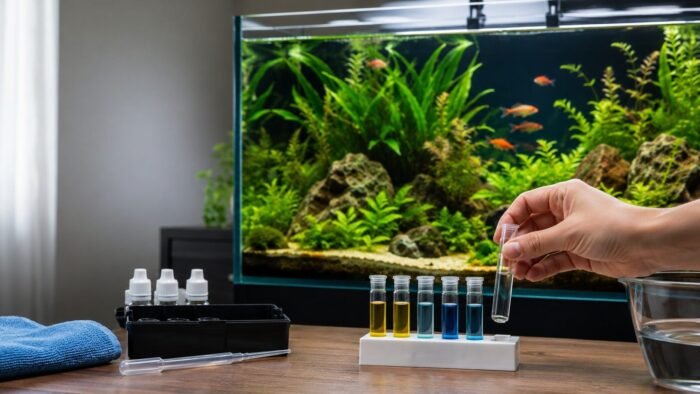
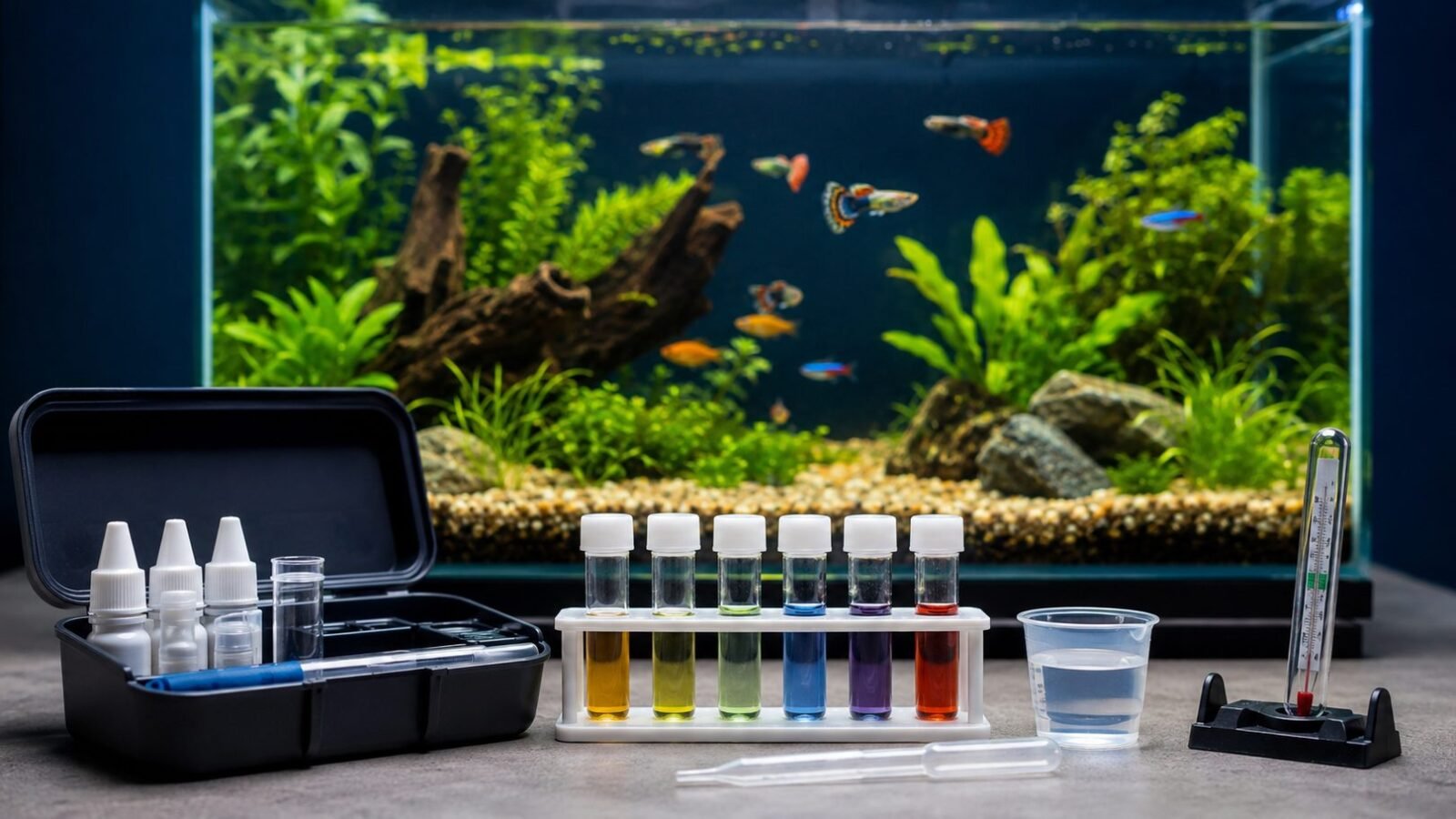
Fish live submerged in their environment, breathing and absorbing whatever is dissolved in the water. Small shifts that would be trivial to a land animal can be lethal to a fish. That is why experienced keepers test water first whenever something looks wrong, as emphasized in our disease guide. A reliable liquid test kit is one of the most valuable tools you can own.
The nitrogen trio: ammonia, nitrite, nitrate
These three are the heart of water quality and the product of the nitrogen cycle.
Ammonia
Produced constantly by fish and decaying matter, ammonia is highly toxic. In a healthy, cycled tank it should read zero. Any detectable ammonia signals a problem, often an uncycled tank, overstocking, or overfeeding.
Nitrite
The intermediate product of the cycle, also toxic, and also targeted at zero in an established tank. A nitrite reading usually means the cycle is incomplete or has been disrupted.
Nitrate
The relatively harmless end product, which accumulates over time. Keep it below 40 ppm for most fish and below 20 ppm for sensitive species. The main tool for controlling nitrate is the regular water change.
pH: acidity and alkalinity
pH measures how acidic or alkaline the water is on a scale from 0 to 14, with 7 neutral. Most community fish do well between 6.5 and 7.5, but the exact number matters less than stability. A steady pH that is slightly off is far safer than one that swings around. Avoid chasing a perfect pH with chemicals, which often causes the very instability you are trying to prevent.
GH and KH: hardness and buffering
- General hardness, GH, measures dissolved minerals like calcium and magnesium. Different fish prefer soft or hard water, though many adapt to a moderate range.
- Carbonate hardness, KH, measures the water’s buffering capacity, its ability to resist pH swings. Low KH lets pH crash easily, which is a common cause of stalled cycles and sudden parameter swings.
Knowing your tap water’s GH and KH explains a lot about how your tank behaves and which fish will thrive in it.
Temperature
Temperature is a parameter too, and stability matters as much as the number. Most tropical fish want 76 to 80°F, while cold-water fish like goldfish prefer cooler water. Rapid temperature changes stress fish and can trigger disease, which is why new water should always be matched to the tank during maintenance.
How and when to test
- Use a quality liquid test kit rather than strips for accuracy, especially during cycling.
- Test ammonia, nitrite, and nitrate frequently while cycling and after any major change.
- In an established tank, a periodic check plus testing whenever something looks off is usually enough.
- Always test before assuming a fish is sick and reaching for medication.
Fixing common parameter problems
Knowing the numbers is only useful if you know how to correct them. Here is how to respond to the most common readings:
- Ammonia or nitrite above zero: do an immediate water change, stop feeding for a day or two, and check whether the tank is fully cycled or overstocked.
- High nitrate: increase the frequency or size of water changes and review feeding and stocking.
- Falling or unstable pH: check KH, since low buffering lets pH crash; a partial water change usually helps.
- Temperature swings: confirm the heater is working and the tank is away from drafts, vents, and sunlight.
In almost every case, a water change is the first and safest corrective step while you investigate the underlying cause.
Tap water and what else is in it
Beyond the core parameters, tap water can carry chlorine, chloramine, and sometimes heavy metals, all of which a water conditioner neutralizes. Chloramine in particular is important because it does not gas off on its own and will harm both fish and beneficial bacteria if untreated. Some municipal water also contains phosphate or nitrate already, which can feed algae, so testing your tap water itself occasionally is worthwhile. For sensitive fish or reef tanks, many keepers move to RO or RODI water to start from a clean, known baseline.
Target ranges at a glance
- Ammonia and nitrite: should remain undetectable in a mature aquarium.
- Nitrate: keep it low and stable for the species you maintain; sensitive fish and reefs usually need tighter control.
- pH, GH, and KH: choose livestock suited to the source water and prioritise stability over repeated chemical correction.
- Temperature: use the species’ natural range and minimise daily swings.
Common mistakes
- Relying on test strips for critical readings during cycling.
- Chasing a textbook pH with chemicals and causing swings.
- Ignoring nitrate because it is “less toxic,” then letting it climb too high.
- Testing only after fish are already sick rather than as routine monitoring.
Test the water before treating the fish
Water-quality problems are a common cause of abnormal behaviour, so testing is a sensible first response when a fish looks unwell. Correcting a measurable environmental problem can remove stress, but normal readings do not rule out injury, parasites, or infection.
Questions about testing and parameter changes
Do I really need a test kit?
Yes, especially while cycling and troubleshooting. A liquid master kit pays for itself by preventing avoidable losses.
Should I adjust my pH?
Usually not. Most fish adapt to a stable local pH. Chasing a specific number with chemicals tends to cause harmful swings.
How high can nitrate go before it is a problem?
Keep it under 40 ppm for hardy fish and under 20 ppm for sensitive species. Regular water changes are the fix.
How often should I test an established tank?
Once a tank is mature and stable, a routine check every couple of weeks plus a test whenever something looks off is usually enough. During cycling, after adding fish, or while troubleshooting, test far more frequently.
Stable trends matter more than perfect numbers
Keep ammonia and nitrite at zero, nitrate low, pH and temperature stable, and your water hardness in a range your fish tolerate. Test with a quality liquid kit, especially during cycling and troubleshooting, and you will solve most fish problems before they ever become emergencies.