If there is one habit that separates thriving tanks from struggling ones, it is the routine water change. No filter, plant, or gadget removes nitrate and dissolved organics the way fresh water does. Yet water changes are also where beginners make their most damaging mistakes, from shocking fish with cold tap water to accidentally wiping out their bacterial colony. Done correctly, a water change takes 15 to 30 minutes and quietly prevents most of the problems that send new keepers searching for answers.
Think of a water change less as cleaning and more as renewal. You are exporting the invisible buildup of nitrate and dissolved waste that no equipment removes, and importing fresh minerals your fish and plants steadily consume. Once you see it that way, the routine stops feeling optional and starts feeling like the heartbeat of a healthy tank.
Why water changes matter
Even a fully cycled tank steadily accumulates nitrate, phosphate, and organic compounds that no biological filter removes. Over weeks these build up, stressing fish, fueling algae, and slowly lowering pH as buffering capacity is used up. A water change is simply dilution: remove a portion of the old, loaded water and replace it with clean, conditioned water, resetting those levels before they reach harmful concentrations.
How much and how often
There is no single correct schedule, but these starting points suit most tanks:
- Standard community tank: 25 to 30 percent weekly.
- Lightly stocked or heavily planted tank: 20 to 25 percent every week or two.
- Heavily stocked, large fish, or breeding tanks: 30 to 50 percent weekly, sometimes more.
- Nano tanks under 10 gallons: smaller but more frequent changes, since parameters swing fast.
Consistency matters more than size. A reliable weekly 25 percent change beats an occasional, dramatic 80 percent one, which can shock fish with a sudden shift in chemistry.
What you need
- A gravel vacuum, or siphon, sized to your tank.
- A clean bucket used only for the aquarium, never for cleaning products.
- A water conditioner, or dechlorinator, to neutralize chlorine and chloramine.
- A thermometer to match the new water’s temperature.
Step by step
- Unplug the heater and filter if the water level will drop below them, to avoid running them dry.
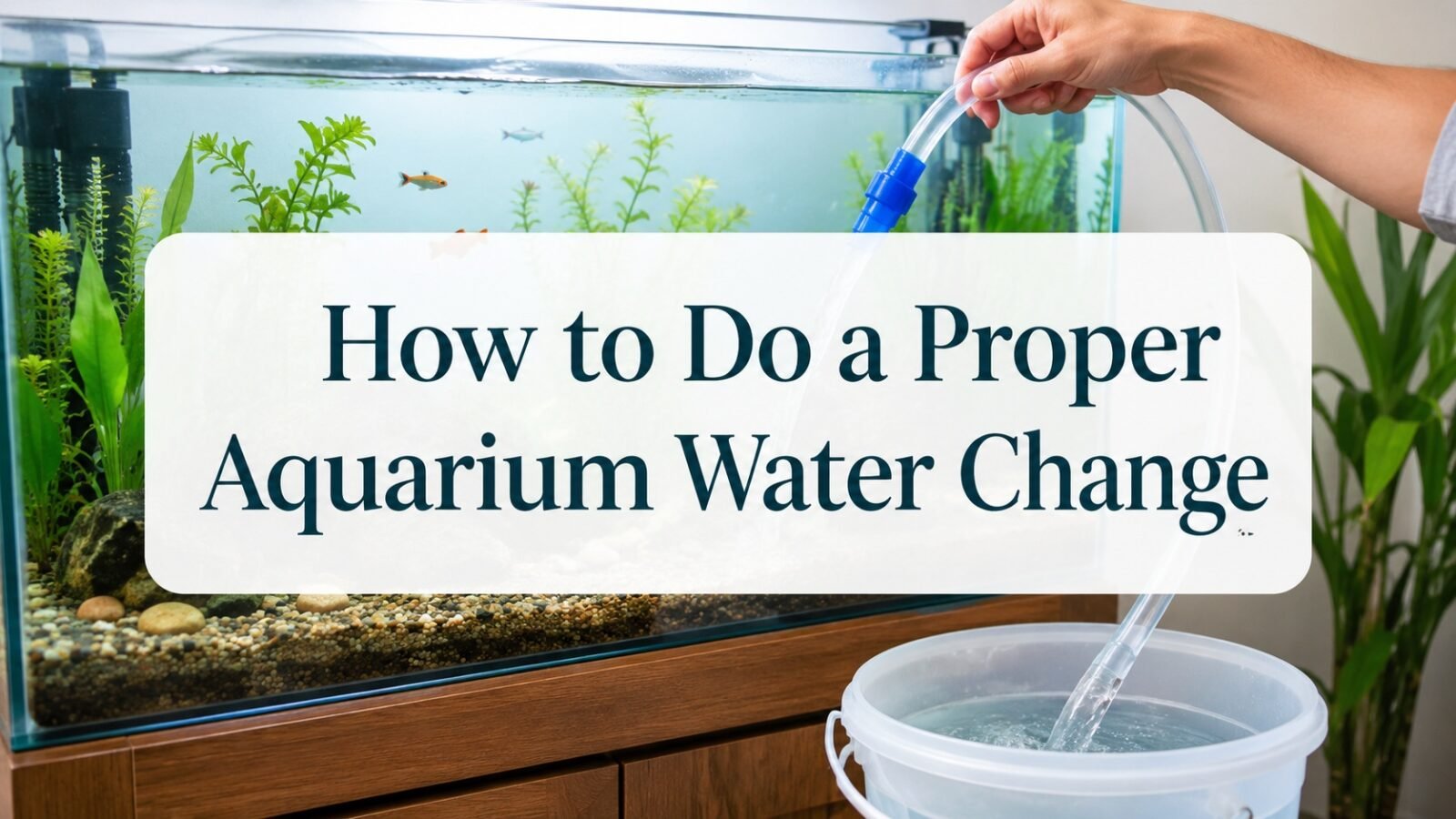
- Start the siphon and vacuum the substrate, working in sections to lift out trapped waste while draining the planned volume.
- Stop once you have removed the target percentage; there is no need to drain the whole tank.
- Prepare replacement water at a temperature close to the tank’s, then add the correct dose of conditioner.
- Pour the new water in gently, ideally onto a plate or your hand to avoid disturbing the substrate and plants.
- Plug the heater and filter back in and confirm both are running normally.
The mistakes that cause trouble
- Forgetting the dechlorinator. Chlorine and chloramine harm fish and kill the beneficial bacteria in your filter.
- Using cold or hot tap water without matching temperature, which shocks fish.
- Rinsing filter media in tap water during the change. Always rinse it in the old tank water you just removed, a point covered in the guide to aquarium filtration.
- Changing far too much at once, swinging the chemistry and stressing the whole tank.
- Scrubbing every surface clean, which removes beneficial bacteria along with the algae.
Tools that make it easier
The right gear turns water changes from a chore into a quick routine. A few options are worth knowing about:
- A standard gravel vacuum and bucket works for any tank and costs very little.
- A faucet-connected changer, such as a Python or Aqueon system, drains and refills directly through a hose, which is a major time-saver on tanks over 40 gallons where carrying buckets becomes impractical.
- A dedicated pump or powerhead with tubing can speed draining on larger tanks.
- A second thermometer in your mixing bucket helps you match temperature before refilling.
For faucet-fed systems, remember that water still needs dechlorinating. Dosing conditioner for the full tank volume as you refill is the common approach.
Special cases
Different tanks have different water-change needs:
- Planted tanks: steady, moderate changes help keep nutrients and CO2 stable, since big swings can trigger algae.
- Reef tanks: use RO or RODI saltwater mixed to the same salinity and temperature as the tank, never plain tap water.
- Fry and shrimp tanks: change small amounts gently and slowly, as tiny animals are sensitive to rapid shifts and can be sucked up by an unguarded siphon.
- Newly cycled tanks: a large change before adding fish lowers the nitrate that built up during cycling.
Matching temperature and chemistry
New water should land within a degree or two of the tank temperature. For most tap water, treating it with conditioner is enough, but if your tap water differs sharply in pH or hardness from your tank, large changes can cause swings. Knowing your numbers, as explained in the overview of aquarium water parameters, tells you whether you can change a lot at once or should stick to smaller, gradual changes.
Benefits and limitations
The benefits are hard to overstate: lower nitrate, fewer algae problems, replenished minerals, and visibly healthier fish. The limitation is that water changes are maintenance, not a cure. They will not fix overstocking, chronic overfeeding, or an undersized filter; they only manage the symptoms those problems create. Pair regular changes with sensible stocking and feeding for the best results.
Make maintenance easy enough to repeat
A water-change routine works best when it is simple enough to repeat. Keep the siphon, bucket, conditioner, and towels together, choose a regular day, and use the same sequence each time. The routine also becomes a useful weekly observation point for appetite, breathing, fins, and unusual behaviour.
Water-change questions beginners ask
Can I do a water change too often?
For most tanks, frequent small changes are beneficial. The main risk is doing large changes with water that differs sharply from your tank in temperature or chemistry.
Do I need to remove the fish?
No. As long as the water level stays above the fish and you refill gently with matched water, the fish stay in the tank throughout.
Is tap water safe?
Conditioned tap water is fine for most freshwater fish. Some sensitive species or reef tanks need RO or RODI water instead.
Should I clean the filter during a water change?
It is convenient to do both at once, but only when the filter actually needs it, roughly monthly. Rinse the media in the old tank water you just siphoned out, never under the tap, so you preserve the beneficial bacteria.
Consistent water changes keep problems small
Vacuum the substrate, remove 25 to 30 percent of the water weekly, refill with temperature-matched and conditioned water, and never rinse biological media in tap water. That short routine does more for fish health than any product on the shelf.