Filter choice matters far less than filter capacity and proper maintenance. A well-kept thirty-dollar hang-on-back filter will outperform a neglected three-hundred-dollar canister every time. Most of the brand wars online are essentially theological. What actually matters is whether the unit moves enough water and offers enough surface area for beneficial bacteria. This guide explains what each filter type does, where each one shines, and how to maintain any of them.
The three jobs of filtration
Every filter, regardless of type, performs some mix of three functions.
Mechanical filtration
Physically traps debris, uneaten food, waste, and plant matter, in foam, floss, or sponge. On its own it does nothing for ammonia or chemistry; it simply keeps the water clear and stops debris from rotting in the open tank.
Biological filtration
The most important function. It provides surface area for the nitrifying bacteria that drive the nitrogen cycle, converting ammonia to nitrite to nitrate. Sponge, ceramic rings, bio-balls, and lava rock all work. A properly cycled biological filter is the difference between a healthy tank and a fish kill.
Chemical filtration
Removes dissolved substances by adsorption, using activated carbon, GFO, Purigen, or ion-exchange resins. It is useful in specific situations rather than always. Carbon pulls out some medications, tannins, and odors, but most established freshwater tanks do not need it running continuously.
Hang-on-back filters
The default beginner filter hangs on the back of the tank, draws water up through media, and returns it over a small waterfall.
- Best for 10 to 55 gallon tanks, beginner setups, and anyone who values easy maintenance.
- Pros: inexpensive at $25 to $80, simple to clean, and the return adds helpful surface agitation for gas exchange.
- Cons: limited media capacity, visible from the side, and no control over flow direction.
For brands that hold up, the AquaClear line is the long-running benchmark with a refillable media basket, the Marineland Penguin adds biological surface area with its Bio-Wheel, and the Seachem Tidal offers strong media volume for the price.
Canister filters
A sealed external canister holds stacked media trays. Tubes pull water from the tank, push it through layers of mechanical, biological, and chemical media, and return it through a spray bar or nozzle.
- Best for tanks 40 gallons and up, planted tanks where controlled flow preserves CO2, and setups where you want the filter hidden.
- Pros: large media capacity, near-silent operation, adjustable flow, and the ability to hide it in a stand.
- Cons: expensive at $100 to $400, more involved to clean, and a seal failure can drain water onto your floor.
Reliable brands include Fluval, the time-tested Eheim Classic, the maintenance-friendly Oase BioMaster with its built-in prefilter, and the budget-friendly SunSun.
Sumps
A sump is a second, smaller tank below or beside the display. Water gravity-drains down, passes through baffled chambers for mechanical and biological filtration and sometimes a skimmer, then is pumped back up.
- Best for saltwater and reef tanks, large freshwater tanks over 75 gallons, and anyone who wants heaters and other gear hidden below the display.
- Pros: the largest filtration capacity available, extra total water volume for more stable parameters, and equipment kept out of sight.
- Cons: requires a drilled tank or overflow, is the most expensive option, and adds plumbing complexity.
Sumps are effectively standard on the reef tanks covered in our reef setup guide.
Internal and sponge filters
Submerged inside the tank, sponge filters powered by an air pump are the cheapest and most reliable biological filter available. Their gentle flow makes them ideal for fry tanks, hospital tanks, and shrimp tanks where stronger filters would suck up small life.
Filter media basics
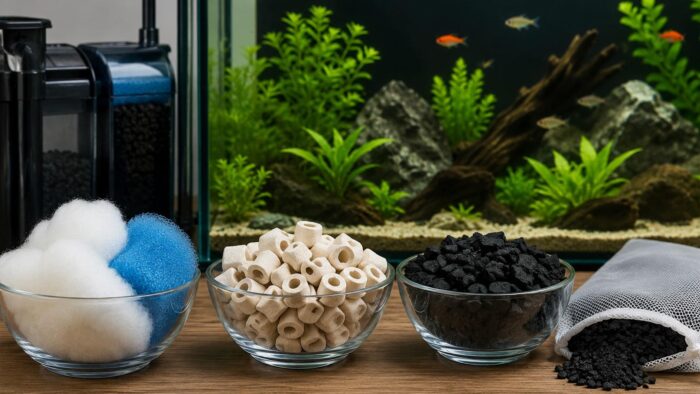
- Filter floss or poly fiber: fine mechanical media, replaced when clogged.
- Sponge and foam blocks: coarse mechanical plus biological; rinse, do not replace.
- Ceramic rings and bio-media: biological; rinse occasionally and only replace if crumbling.
- Activated carbon: chemical, effective for about four weeks before it becomes biological media.
- Purigen: chemical, removes organics, and can be regenerated with bleach.
The single rule of filter maintenance
Never rinse biological media in tap water. Chlorine and chloramine kill the bacteria you spent weeks growing. Rinse all media in old tank water during a water change, replace floss-type media only when clogged, and leave biological media alone unless it physically breaks down.
Filtration is one of four systems a tank depends on, and the hub guide to aquarium equipment and maintenance covers how the others should be sized alongside it.
Flow rate guidelines
- Freshwater community: 4 to 6 times tank volume per hour.
- Planted tank: 3 to 5 times, lower for CO2-injected setups.
- Cichlid or heavy bioload: 6 to 10 times.
- Saltwater fish-only: 5 to 10 times.
- Reef, sump and powerheads combined: 20 to 50 times.
Treat these as starting points and watch the fish. Long-finned species dislike strong flow, while river-dwelling cichlids enjoy it.
A quick way to choose
If the options feel overwhelming, this short decision path covers most situations:
- Tank under 40 gallons, freshwater, want simplicity: an oversized hang-on-back filter.
- 40 to 100 gallons, freshwater, want quiet operation or a planted tank: a canister.
- Any saltwater or reef tank, or a large freshwater tank over 75 gallons: a sump.
- Fry, shrimp, hospital, or quarantine tank: a sponge filter on an air pump.
When in doubt, buy one size up from what the box recommends. A filter rated for a larger tank simply gives you more biological surface area and more margin for error.
| Filter type | Best tank size | Strengths | Drawbacks |
|---|---|---|---|
| Sponge filter | Up to 20 gallons, fry and quarantine | Cheap, gentle, excellent biological media, no fry risk | No mechanical polish, needs an air pump, visible in tank |
| Internal filter | Up to 25 gallons | Inexpensive, simple, easy to fit | Takes up in-tank space, small media capacity |
| Hang-on-back | 10 to 55 gallons | Easy access, good flow, widely available | Cartridge designs waste money, some evaporation and noise |
| Canister | 40 gallons and up | Large media volume, quiet, hidden below tank | Expensive, slower to service, priming needed |
| Sump | 75 gallons and up, most reefs | Adds volume, hides equipment, highly flexible | Requires drilled tank or overflow, most complex to set up |
Common filter mistakes
- Replacing all media at once, which wipes out the bacterial colony.
- Cleaning too often; a filter only needs attention when flow noticeably drops.
- Buying “replace the cartridge” filters, whose disposable cartridges are sized to fail before bacteria mature.
- Undersizing the filter; a unit rated for your tank size is the minimum, not the optimum.
Biological stability comes before polished water
If you remember one thing, make it this: the filter is a home for bacteria first and a water polisher second. Buy one rated above your tank size, leave the biological media undisturbed, and rinse only in tank water. That covers most of filtration in practice.
Questions about filters and flow
How often should I clean my filter?
Only when flow drops noticeably, which for most setups is roughly monthly. Over-cleaning does more harm than good.
Do I need to run carbon all the time?
No. Most established freshwater tanks do fine without continuous carbon. Keep it on hand to remove medication or tannins when needed.
Can I run two filters on one tank?
Yes, and it adds redundancy plus media capacity. It also lets you clean one at a time without disturbing the whole colony.
Choose filtration you will maintain properly
For tanks under 55 gallons, an oversized hang-on-back filter does about 90 percent of what you need at a fraction of a canister’s cost. Above 55 gallons a canister becomes the better choice, and above 100 gallons or for any saltwater, consider a sump. Whatever you choose, leave the biological media alone, rinse only in tank water, and replace floss when it clogs.