If you ask experienced aquarists what kills the most beginner fish, almost none of them will say disease or bad luck. They will say the tank was never cycled. The pattern is depressingly common: a tank bought on Saturday, decor and water added Sunday, fish in by Monday, and dead fish by the end of the week from ammonia poisoning. The good news is that cycling is mostly waiting. It takes two to six weeks and very little daily effort, and getting it right once is the single highest-value skill a new fishkeeper can learn.
This guide explains what the nitrogen cycle actually is, walks through three ways to start it, and shows you how to confirm the cycle is genuinely complete before any fish go in.
What the nitrogen cycle actually is
Fish constantly release ammonia through their gills and waste. Ammonia is highly toxic. Concentrations as low as 0.5 ppm can kill sensitive species within days, and even smaller amounts cause gill damage and chronic stress. A mature aquarium handles this through two groups of beneficial bacteria working in sequence.
- Ammonia becomes nitrite. Bacteria in the Nitrosomonas group oxidize ammonia into nitrite. Nitrite is still toxic, only slightly less so than ammonia.
- Nitrite becomes nitrate. A second group, including Nitrobacter and related bacteria, converts nitrite into nitrate. Nitrate is far less harmful, and most fish tolerate up to around 40 ppm without obvious problems.
Cycling simply means growing established colonies of both bacteria in your filter and substrate before fish arrive. The bacteria are already present in the air and water around you. They only need a steady ammonia supply, oxygen, and time to multiply inside your system. Once they are abundant enough to process waste as fast as your fish produce it, the tank is cycled.
Method 1: Fishless cycling, the recommended route
In a fishless cycle you add a controlled dose of ammonia to an empty tank and let the bacteria build up before any animal is exposed to the system. There is no fish stress, the cycle is faster and more predictable, and you can dose generously to grow a large bacterial colony.
What you need
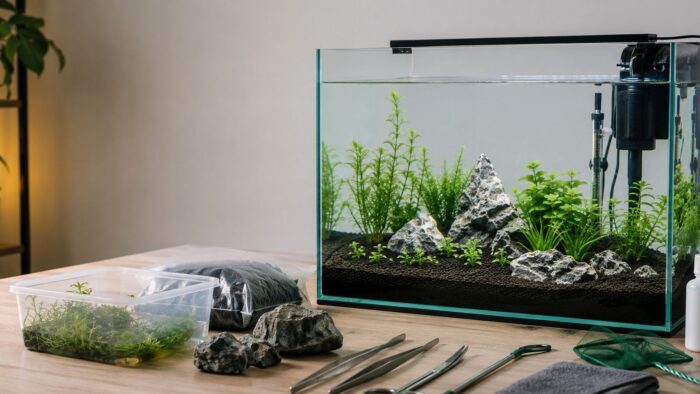
- A fully assembled tank with the filter running and the heater set to your target species temperature. Around 78°F suits most tropical freshwater fish.
- Pure ammonia, janitorial grade, with no surfactants, dyes, or fragrance. The label should read ammonium hydroxide with no other ingredients. Shake the bottle: if it foams, it contains additives and is unsuitable.
- A liquid test kit. The API Freshwater Master Test Kit is the standard reference. Paper test strips are too imprecise for cycling work.
The steps
- Dose ammonia to roughly 2 ppm. For typical 10 percent household ammonia this is about three to four drops per 10 gallons. Test afterward to confirm the level.
- Test daily, tracking ammonia, nitrite, and nitrate together.
- Within seven to fourteen days nitrite appears and ammonia begins to fall. This is the first colony taking hold.
- Each time ammonia reaches zero, dose it back up to 2 ppm to keep feeding the growing bacteria.
- Over the next two to four weeks nitrite also drops to zero and nitrate steadily climbs.
- When both ammonia and nitrite clear within 24 hours, the cycle is finished. Perform a large water change to lower nitrate, then begin adding fish.
Method 2: Fish-in cycling
This approach is relevant only when fish are already present and cannot be moved to a mature system. Stop adding livestock, feed sparingly, test ammonia and nitrite every day, and use conditioned, temperature-matched water changes whenever either compound is detectable. The size and frequency of each change should be based on the reading and the condition of the fish rather than an inch-per-gallon formula.
Some conditioners can temporarily bind certain forms of ammonia, but they do not replace water changes or an established biological filter. Follow the product label, maintain oxygenation, and continue testing until ammonia and nitrite remain at zero.
Method 3: A plant-heavy startup
Fast-growing plants can absorb part of the nitrogen released in a new aquarium, but they do not prove that the biological filter is mature. A plant-heavy start can reduce risk when the plants are actively growing, yet ammonia and nitrite still need to be tested before fish are added.
Use genuine plant mass rather than a few decorative stems, provide suitable light, and keep stocking conservative. Hardy species from the low-light plant guide can help without turning the setup into a high-tech project.
How to speed the cycle up
Three things reliably shorten the wait:
- Seed the filter with mature media. A handful of gravel or a piece of filter sponge from an established, healthy tank carries living bacteria and can advance the cycle by weeks.
- Use a quality bottled bacteria product. Results vary by brand, but Tetra SafeStart, Dr. Tim’s One and Only, and Fritz TurboStart have a reasonable track record. Many cheaper products do little.
- Raise the temperature. Bacterial reproduction roughly doubles for every 10°C rise above 20°C, so a cycle held at 84°F finishes faster than one at 74°F.
If the tank already has fish in it and the readings have started climbing, you are dealing with new tank syndrome, which needs a slightly different response from a planned fishless cycle.
Common cycling problems
Nitrite stays high for weeks
This is normal. The nitrite-consuming bacteria reproduce more slowly than the ammonia-consumers, so nitrite often lingers. Avoid adding more ammonia until both readings are clearly falling.
The cycle stalls
A stalled cycle is usually a pH crash. Heavy nitrification produces acid, and if pH falls below about 6.0 the bacteria slow dramatically. A modest water change resets the pH and restarts progress.
Cloudy water
A milky haze during cycling is a harmless bacterial bloom. It clears on its own within a few days and needs no intervention.
Cycling is step five of seven in the wider first aquarium setup process, and the steps either side of it matter almost as much.
What a finished cycle looks like
Run a final confirmation test. Dose ammonia to 2 ppm in the evening, then test the next morning. A cycled tank shows ammonia at 0 ppm, nitrite at 0 ppm, and a measurable nitrate reading, often 10 to 40 ppm. That full 24-hour clearance is the practical definition of a cycled aquarium. Do a 50 percent water change to drop the accumulated nitrate, then stock slowly, adding no more than a quarter of your planned fish in the first two weeks.
Mistakes to avoid
- Adding fish because nitrite or ammonia is “almost” at zero. Almost is not cycled.
- Rinsing filter media in tap water mid-cycle, which kills the colony you are trying to grow.
- Trusting strips over a liquid kit during the most chemistry-sensitive stage of a tank’s life.
- Dosing ammonia far above 2 ppm, which can actually inhibit the bacteria rather than feed them faster.
Patience is part of the biological setup
The hardest part of cycling is psychological, not technical. Staring at an empty tank for a month feels like wasted time, especially with eager kids or an impatient schedule. Reframe it: you are not waiting on nothing, you are building an invisible filter made of living bacteria. Once you understand that establishing stable water chemistry through regular water changes is what keeps fish alive, the patience comes naturally.
Questions about cycling a new tank
Can I cycle a tank in a weekend?
Not honestly. Bottled bacteria and seeded media can shorten the process, but a genuine, stable colony still needs time to grow large enough to handle a full bioload. Anyone promising a one-day cycle is usually selling something.
Do I need to feed the bacteria after the cycle finishes?
Your fish do that automatically once they are in. The key is to add livestock gradually so the colony can scale up to match the new waste load.
Will a water change ruin my cycle?
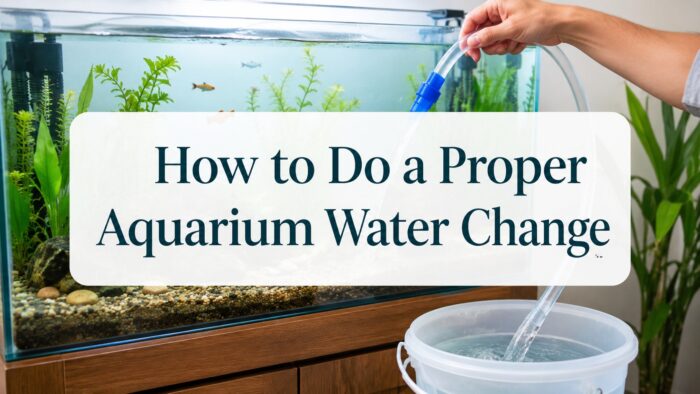
No. The bacteria live on surfaces, mainly your filter media and substrate, not floating in the water column. Routine water changes do not remove a meaningful number of them.
A cycled filter is the real starting point
Set up the tank, dose ammonia to about 2 ppm, and test daily. Wait the two to six weeks it takes for both ammonia and nitrite to clear within a single day, do a large water change, then add fish in small batches. Cycle once and do it properly, and you trade a frustrating month for years of healthy, stable fishkeeping.