The order you do things in matters more than the brand of gear you buy. Most failed first tanks come from rushing the sequence, not from cheap equipment. Build the system in the right order and it does most of the hard work for you. Skip a stage and you spend the next month fighting cloudy water and sick fish.
This guide walks through every step from empty glass to a stocked aquarium, in the order a careful hobbyist would actually follow.
Step 1: Choose the tank and where it goes
Bigger tanks are more forgiving, not less. Water volume dilutes mistakes, so a 20 gallon tank stays stable far longer than a 5 gallon one when you miss a feeding or add a fish too many. If space and budget allow, start at 20 gallons or above. the guide on choosing the right aquarium size breaks down the trade offs for each footprint.
Pick the spot before you fill anything. A full tank weighs roughly 10 pounds per gallon, so a 40 gallon setup pushes past 400 pounds. Place it on furniture rated for that load, away from direct sun, heating vents, and busy doorways. Once it holds water, you are not moving it.
Step 2: Gather the core equipment
You need fewer items than most shopping lists suggest. The essentials are simple.
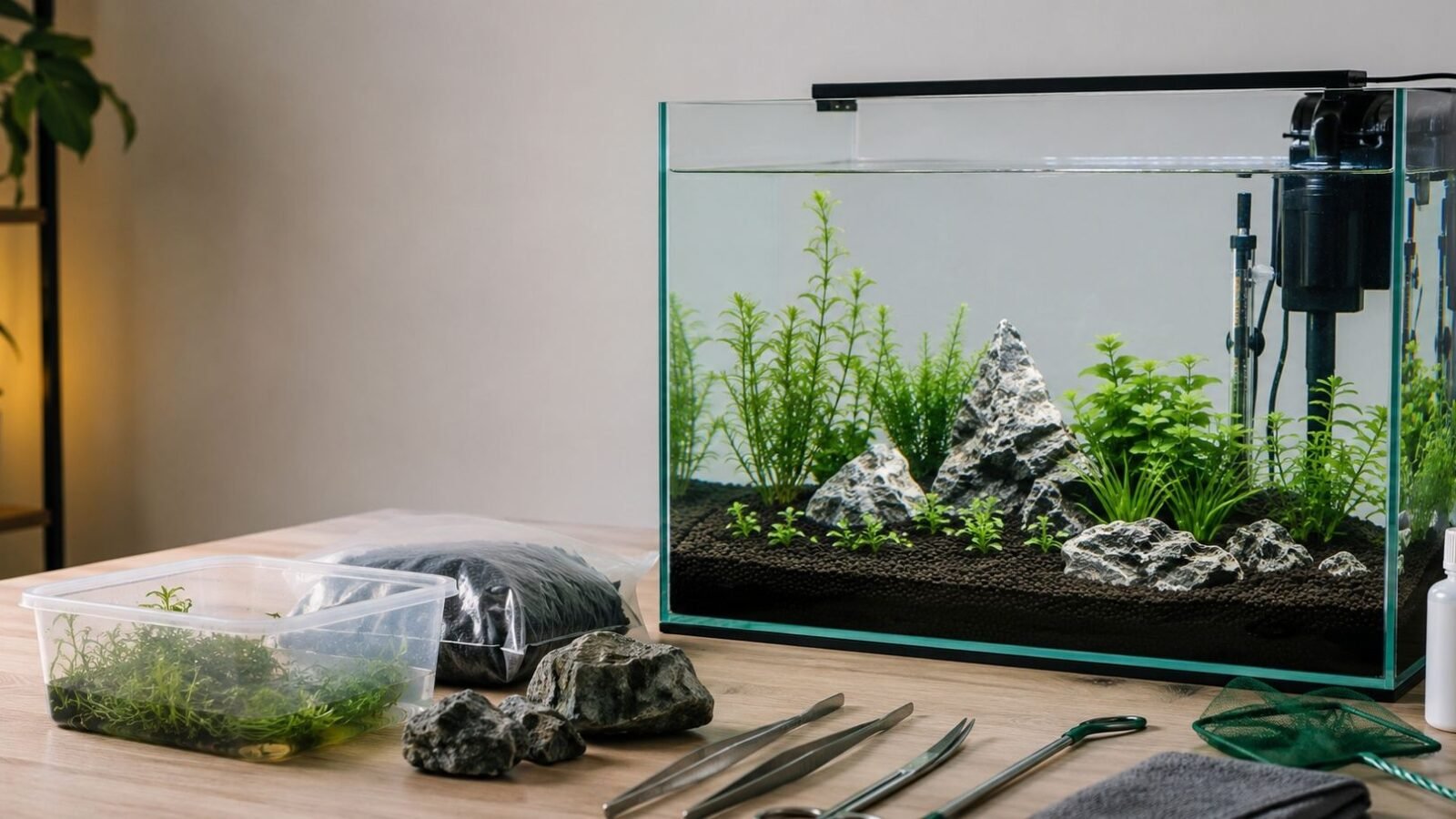
- A filter rated for your tank volume or slightly above. Our filtration guide compares hang on the back, canister, and sump styles.
- A heater sized to the tank, usually around 5 watts per gallon for tropical fish.
- A light that suits your plans. A basic LED works for a fish only tank. See our lighting guide if you want plants.
- Substrate, either inert gravel or a planted soil if you intend to grow plants.
- A liquid test kit, water conditioner, and a dedicated bucket and net.
Step 3: Rinse, position, and fill
Rinse gravel in plain water until it runs clear. Never use soap on anything that touches tank water. Add substrate first, then set your rocks and wood, then pour water onto a plate or your hand so the stream does not blast a crater in the gravel. Fill to a few inches below the rim while you work.
Step 4: Install and test the equipment
Mount the filter and heater, but leave the heater unplugged for 20 minutes so its thermostat adjusts to the water temperature. Plugging a cold heater into warm water, or the reverse, can crack the glass. Start the filter, confirm steady flow, set the heater near 78°F (26°C), and add a water conditioner to neutralize chlorine and chloramine from your tap.
Step 5: Cycle the tank before any fish
This is the stage beginners most want to skip, and skipping it kills more fish than anything else. Your filter needs a living colony of bacteria to turn toxic ammonia into nitrite and then into far safer nitrate. Growing that colony takes time. Follow our full walkthrough on how to cycle your first aquarium, and do not add fish until ammonia and nitrite both read zero.
Step 6: Add fish slowly
Once the tank is cycled, stock it in small batches with a week or two between additions. A flood of new fish creates more waste than a young bacterial colony can process. Begin with a few hardy individuals and build from there. the guide on how many fish you can keep shows how to calculate a safe number for your volume.
Step 7: Settle into a routine
The first month sets the tone. Feed lightly once a day, test the water twice a week, and change 20 to 25 percent of the volume each week using our water change method. Keep a short log of your readings. Trends in those numbers warn you what the tank needs before the fish show any stress.
A basic logbook reveals patterns early
A basic notebook or spreadsheet is often more useful than another gadget. Record the date, temperature, ammonia, nitrite, nitrate, water changes, and any livestock changes. Trends are easier to recognise when the readings are written down instead of remembered during a problem.
Match the animal to the system before buying
Research adult size, social behaviour, temperature, water chemistry, and diet before buying any fish. A tank should be stocked for the animals’ mature needs rather than the empty space visible on the first day.
First-aquarium setup questions
How long does it take to set up an aquarium?
The physical setup takes an afternoon. The cycle that makes it safe for fish takes two to six weeks. Plan for the wait rather than rushing it.
Can I add fish the same day I fill the tank?
No. A brand new tank has no bacteria to handle waste, so ammonia climbs fast and burns the fish. Cycle first, then stock gradually.
Do I really need a test kit?
Yes. A liquid test kit is the only reliable way to know whether your water is safe. It is the cheapest insurance you can buy for a tank full of living animals.
Set up slowly and let the cycle finish
A successful aquarium is a sequence, not a shopping spree. Choose a forgiving size, install the basics, cycle the system fully, then add fish slowly while you watch your numbers. Get the order right and the tank rewards you with clear water and healthy fish for years.