The belief that bottom fish live on leftovers has slowly starved countless catfish and loaches. Corydoras, plecos, and loaches are not a cleanup crew, and they will not get enough from the scraps other fish miss. Bottom dwellers need their own food, delivered to the floor of the tank where they can actually reach it.
Feeding the bottom of a tank takes a little more thought than sprinkling flakes on the surface, but it is simple once you know the tricks. Our corydoras guide covers one popular group in detail.
The leftovers myth
Bottom dwellers were sold for years as tank cleaners, and the label persists. In reality, the food that drifts down is rarely enough, and faster fish above usually grab most of it first. A bottom fish kept this way slowly loses weight and condition, often with a sunken belly, even though the tank looks well fed. These fish need a diet of their own.
What bottom dwellers actually need
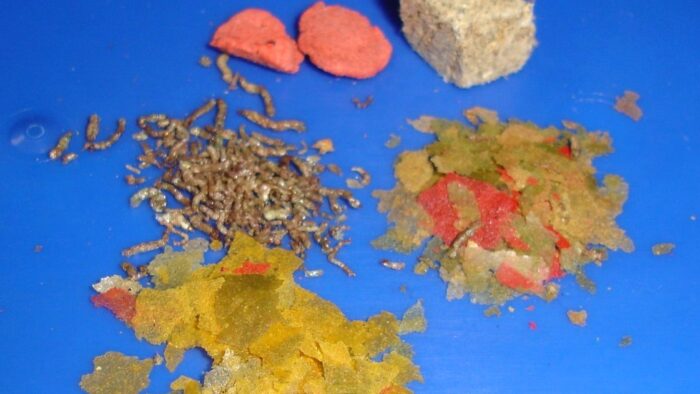
Most need food that sinks and stays down long enough to be found by smell and touch. Reach for sinking pellets, algae or shrimp wafers, and frozen foods like bloodworms that settle to the bottom. the guide to fish food types compares the sinking options. Match the food to the fish, since a carnivorous catfish and a grazing pleco want different things.

Getting food to the bottom in a community tank
The challenge is competition from the fish above. A few simple methods solve it.
- Feed after lights out. Many bottom dwellers are most active in the dark, when the daytime fish have settled and the food is left alone.
- Target a spot. Drop sinking food in one corner so it concentrates where the bottom fish forage, rather than scattering it.
- Distract the top. Feed the upper level fish at one end, then drop sinking food at the other while they are busy.
Feeding algae eaters
This is a common misunderstanding. Most algae eaters, including many plecos, do not get enough from the algae in a clean tank, and a tank with enough algae to feed them is usually a tank with an algae problem. Supplement them with algae wafers and fresh vegetables. Relying on algae alone leaves them hungry, and it ties their diet to the very thing you are trying to control, as the guide on why your aquarium has algae explains.
Vegetables for grazers
Many bottom grazers relish fresh vegetables. Blanched zucchini, cucumber, and shelled peas are favorites. Soften them briefly in hot water, weigh them down with a fork or a vegetable clip, and remove any uneaten pieces within a day before they foul the water. This adds fiber and variety that dried food alone cannot match.
Common bottom dwellers and their diets
- Corydoras catfish. Omnivores that want sinking pellets and frozen foods, not leftovers.
- Plecos. Many are grazers needing algae wafers and vegetables, while some also take protein. Research your exact species.
- Loaches. Active omnivores that enjoy sinking foods and, for some, snails and frozen treats.
Overfeeding still applies
Targeting food to the bottom does not mean piling it on. Excess sinking food rots just as surface food does, raising waste and fouling the substrate. Feed small amounts, watch that the fish find it, and remove anything uneaten. the guide on how often to feed applies to the bottom of the tank too.
Make sure food reaches the fish below
Fish that feed near the substrate can be missed even when food is added every day. Use sinking food suited to the species, feed where the fish can reach it, and observe body condition over time. A clean tank does not guarantee that a pleco, loach, or catfish is receiving enough food.
Confirm every bottom feeder is actually eating
Confirm that each bottom-dwelling fish reaches suitable food. Watch feeding after lights dim when necessary, check body condition, and adjust for shy individuals. A sunken abdomen, reduced activity, or repeated competition at feeding time can indicate that the routine is not reaching every fish.
What each common bottom dweller actually eats
The category ‘bottom feeder’ groups together animals with completely different diets, which is precisely why so many of them slowly starve in community tanks. A wood-rasping panaque and a carnivorous kuhli loach have almost nothing in common nutritionally.
| Species | True diet | What to feed | Common mistake |
|---|---|---|---|
| Corydoras | Omnivore, invertebrate-leaning | Sinking pellets, frozen bloodworm, tablets | Assuming they live on scraps |
| Bristlenose pleco | Omnivore with wood requirement | Algae wafers, courgette, real driftwood | No driftwood provided; wood aids their digestion |
| Common pleco | Omnivore, increasingly carnivorous with age | Wafers, vegetables, occasional protein | Bought small for a tank that cannot hold an 18-inch adult |
| Otocinclus | Specialist grazer on soft green algae and biofilm | Blanched courgette, established biofilm, quality wafers | Added to a brand-new tank with nothing to graze |
| Kuhli loach | Carnivore, micro-invertebrate feeder | Sinking pellets, frozen foods, live blackworm | Fed only algae wafers, which they largely ignore |
| Yoyo and clown loach | Omnivore, snail predator | Sinking pellets, frozen food, snails | Underfed because they hide at feeding time |
| Siamese algae eater | Omnivore that eats algae when young | Wafers plus general tank food | Expected to keep eating algae as an adult |
| Nerite snail | Algae and biofilm grazer | Established algae, wafers when it runs out | Kept in a spotless tank with nothing left to graze |
| Amano shrimp | Omnivore scavenger | Wafers, blanched vegetables, biofilm | Outcompeted by fast fish at feeding time |
The otocinclus entry causes more losses than any other on this list. These fish are grazers adapted to continuous feeding on soft biofilm, they have very small energy reserves, and a new tank with clean glass offers them nothing. Adding them to a tank under six months old, or to a tank so well maintained that no biofilm develops, is a common and avoidable cause of gradual starvation.
Making sure the food actually arrives
Getting appropriate food into the tank is only half the problem. In a busy community tank, fast mid-water fish routinely intercept sinking food before it lands, and the bottom dwellers you bought the food for never see it.
Feeding after lights out is the single most effective technique. Drop sinking wafers or pellets ten to fifteen minutes after the aquarium light goes off, once the mid-water fish have settled. Most bottom-dwelling species are naturally crepuscular or nocturnal and become far more active at exactly this point.
Distraction feeding is the second option and works well in daylight. Feed a floating food at one end of the tank, wait until the community fish commit to it, then drop sinking food at the opposite end. Ten seconds of head start is usually enough.
A feeding dish solves the problem of food vanishing into gravel. A shallow ceramic or glass dish set into the substrate keeps pellets visible and accessible, stops them decomposing out of reach, and makes it far easier to see whether anything went uneaten.
Where a particularly timid animal is losing out consistently, a length of rigid tubing used as a feeding pipe delivers food directly to a specific spot, such as the cave a bristlenose occupies. It looks fussy, but for a single valuable or shy fish it is more reliable than hoping.
Whichever method you use, check the result rather than assuming. Look at the tank ten minutes after a bottom feeding to confirm food was found, and look at the fish themselves weekly. Body condition is the honest measure of whether your feeding strategy is working.
Questions about feeding fish on the bottom
Do bottom feeders eat fish waste?
No. They forage for food on the substrate but do not consume fish waste. You still need a filter and regular water changes.
Can plecos survive on algae alone?
Most cannot. Supplement them with algae wafers and vegetables, since a tank rarely grows enough algae to feed a pleco fully.
How do I stop other fish eating the bottom food?
Feed after lights out, target one spot, or distract the upper fish at the far end while sinking food settles where the bottom dwellers forage.
How do I feed bottom dwellers without fouling the water?
Portion precisely and remove anything uneaten after about two hours. Sinking wafers are designed to hold together, so an untouched wafer can be siphoned out intact. The common error is dropping several wafers because the fish are hidden, then leaving them all in overnight.
Do algae eaters mean I do not need to clean the glass?
No. Algae eaters graze soft films but ignore tougher green spot algae and cannot reach corners or equipment. They also produce waste of their own, so adding one to solve an algae problem adds bioload without addressing the light and nutrient imbalance causing the algae.
Bottom feeders need food designed to reach them
Bottom dwellers need their own sinking food, not leftovers. Use pellets, wafers, frozen foods, and fresh vegetables, deliver them to the floor after lights out or in a targeted spot, and supplement algae eaters properly. Feed small amounts and confirm the fish are eating. Drop the cleanup crew myth and your bottom fish thrive.
Featured image: Corydoras pair with eggs — Photo: Nate Wessel (CC BY-SA 4.0), via Wikimedia Commons.