Feeding is the aquarium task performed most often and thought about least. It is also the origin of a large share of aquarium problems, because everything that goes into a tank as food eventually becomes waste in the water, and because different species have genuinely different nutritional requirements that a single tub of flake cannot meet.
This guide is the hub for feeding on the site. It covers how much and how often, how to match food to species, what a good food actually contains, and the specific situations that need a different approach.
How much and how often
The two-minute rule is the standard guidance and holds up well: offer only as much as is consumed within roughly two minutes, then net out anything left. It works because it self-adjusts to the actual population rather than to an abstract measure.
Frequency depends on life stage and species. Adult community fish do well on one or two small feedings a day. Juveniles need two or three because they cannot store energy. Fry need three to five small feedings. Large predatory fish need considerably less than daily as adults, and feeding them daily is the main cause of obesity in pet oscars and similar species. The full breakdown by fish type is in the guide to how often to feed aquarium fish.
Two small feedings generally beat one large one for the same total quantity. Smaller portions are consumed more completely, less food reaches the substrate, and fish digest more efficiently. It also makes overfeeding easier to spot, since a portion that is too large is visible immediately.
A weekly fasting day benefits most adult community fish by allowing the digestive tract to clear, and reduces the waste load slightly. It is not appropriate for fry, juveniles, herbivores that graze continuously, or fish recovering from illness.
Matching food to the fish
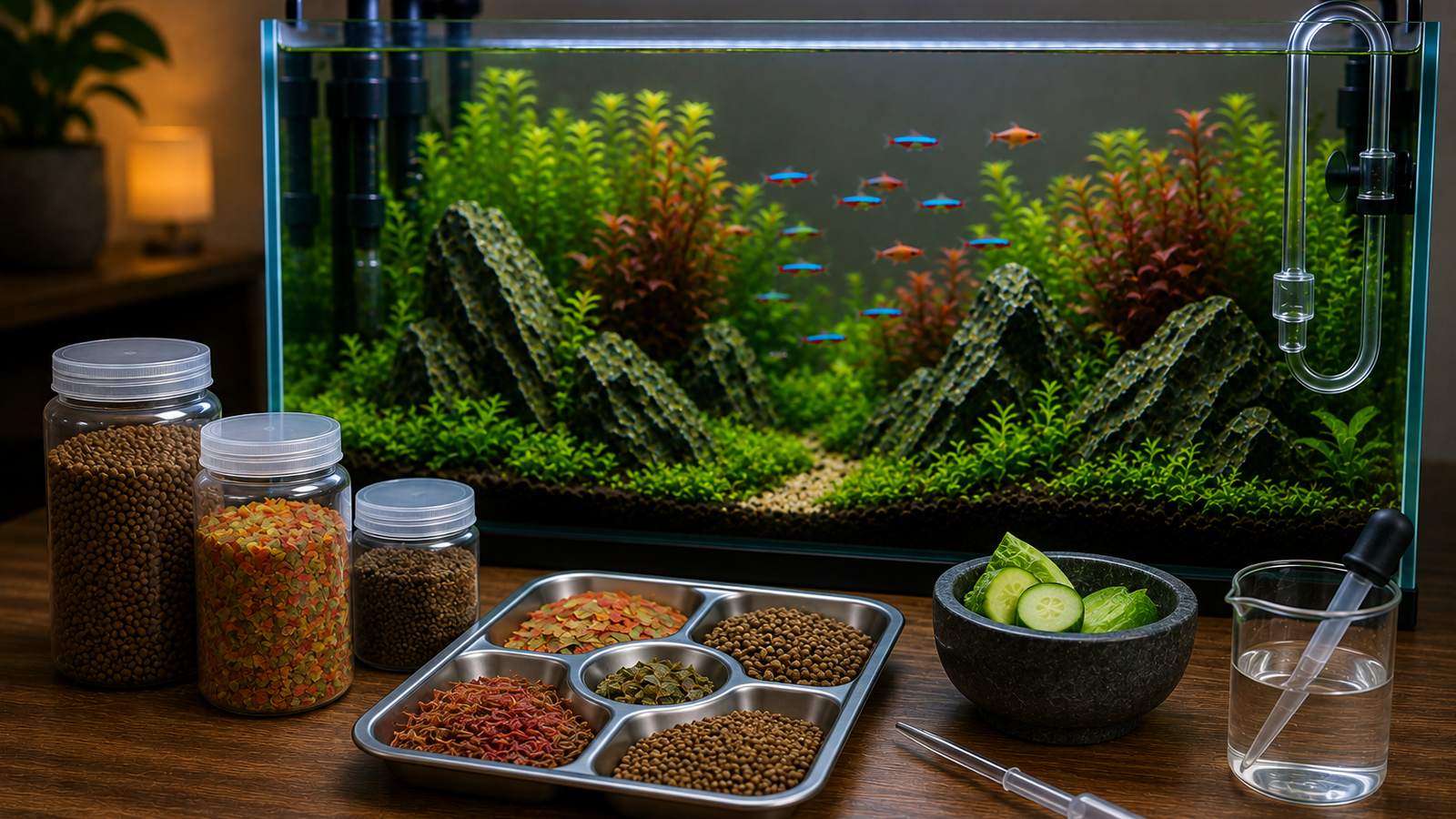
The most common feeding error after overfeeding is assuming one food suits everything in the tank. A surface-feeding hatchetfish, a mid-water tetra, a bottom-grubbing corydoras and a wood-rasping pleco have different mouths, different digestive systems and different feeding positions.
| Feeding group | Examples | Food format | Dietary emphasis |
|---|---|---|---|
| Surface feeders | Hatchetfish, bettas, gouramis | Floating flake or pellet | Omnivore to carnivore |
| Mid-water community fish | Tetras, rasboras, barbs, danios | Slow-sinking flake or micro pellet | Omnivore |
| Bottom omnivores | Corydoras, loaches | Sinking pellet or tablet, fed after lights out | Omnivore, invertebrate-leaning |
| Grazing herbivores | Plecos, otocinclus, some tangs | Algae wafers, blanched vegetables, driftwood | Plant matter, continuous access |
| Predatory fish | Oscars, large cichlids, pufferfish | Large pellets, whole frozen foods | High protein, fed less frequently |
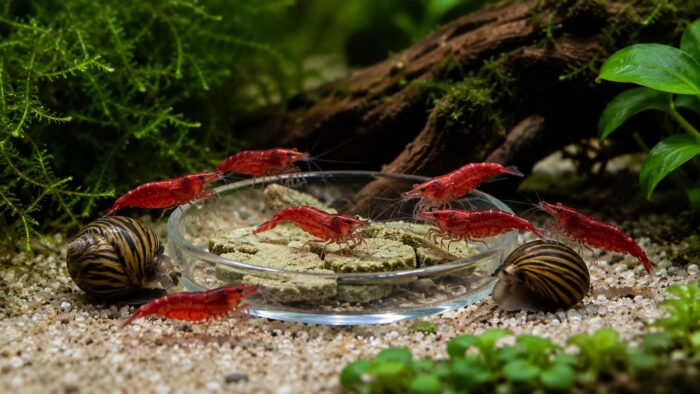
| Invertebrates | Shrimp, snails | Small wafers, biofilm, blanched vegetables | Detritus and biofilm; very small portions |
| Marine fish | Clownfish, gobies, tangs | Marine pellets, frozen mysis, algae sheets | Varies; tangs need substantial algae |
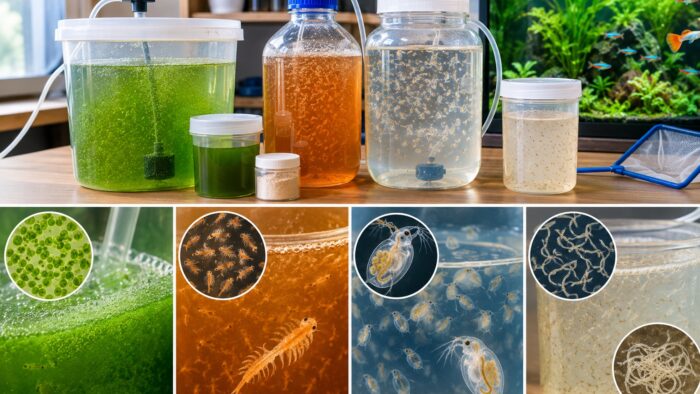
| Fry | All species | Powdered food, baby brine shrimp, infusoria | Frequent small feeds, high protein |
The practical implication is that a community tank usually needs two or three foods rather than one. A staple for the mid-water fish, a sinking food for the bottom group fed separately after lights out, and a vegetable option for any grazers. The guide to feeding bottom dwellers and algae eaters covers making sure sinking food actually reaches its target in a busy tank.
Choosing a quality food
Aquarium food labelling is loosely regulated, but a few markers reliably distinguish good products.
Look at the first three ingredients, listed by weight. A quality food leads with a named protein: whole herring, krill meal, black soldier fly larvae, or spirulina for herbivores. A food leading with wheat flour, corn or unspecified fish meal is mostly binder and cheap protein, and fish digest very little of it. Undigested filler passes straight through and becomes waste in the water, which is why cheap food and algae problems often appear together.
Match protein level to the species. Carnivores do well on 45 percent or more. Herbivores need substantially less protein and much more plant matter, and feeding them a carnivore formula causes long-term digestive and liver problems.
Buy small containers. Dry food loses vitamin content within a few months of opening, and a large tub that lasts a year is substantially depleted long before it is finished. Store it sealed, cool and dark.
The full comparison of formats, including which foods suit which situations and how long each keeps, is in the guide to best fish food types.
Why overfeeding causes so much damage
Overfeeding is the most consequential routine error in the hobby, and its effects are indirect enough that people rarely connect them to the cause.
Uneaten food decomposes into ammonia, which the biological filter must process. A tank fed twice what it needs generates twice the ammonia, which in a marginally filtered tank means detectable ammonia and stressed fish.
Ammonia becomes nitrate, so overfeeding shows up as a nitrate level climbing faster than water changes can clear. Since nitrate ultimately derives from food, a nitrate reading rising week over week without any change in stocking almost always means portions have crept upward.
Excess nutrients feed algae directly. Persistent algae problems in an otherwise well-lit, well-maintained tank frequently trace to feeding rather than to lighting.
And the fish themselves suffer. Chronic overfeeding causes fatty liver disease, obesity and shortened lifespan, particularly in larger cichlids and goldfish. A fish with a visibly rounded belly hours after feeding, that is not gravid, is being overfed.
The tank tells you honestly. Uneaten food visible on the substrate ten minutes after feeding means the portion is too large. In a correctly fed tank the base stays clean between weekly vacuums.
Special situations
Several circumstances need a different approach from the daily routine.
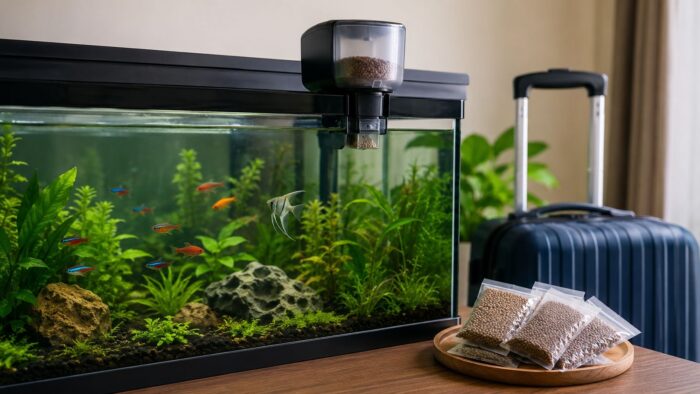
Holidays and absences are covered in the guide to feeding fish while on vacation. The short version is that healthy adult fish tolerate a week without food far better than they tolerate an overfeeding accident, and the risk in vacation feeding comes almost entirely from food entering the tank rather than from withholding it.
Invertebrates need far less food than people expect. Shrimp and snails graze continuously on biofilm in a mature tank, and heavy feeding causes planaria, hydra and bacterial blooms. The guide to feeding aquarium shrimp and snails covers portions.
Sick or recovering fish should usually be fed lightly rather than generously. A fish that is not eating does not benefit from food sitting in the tank fouling the water, and many illnesses are accompanied by digestive problems.
Newly added fish frequently refuse food for a few days. This is normal, and the correct response is to feed a small amount and remove what is not taken, rather than escalating to tempt them.
Fish that are chronically thin in an otherwise well-fed tank are usually losing at feeding time rather than being underfed overall. Watch feeding directly rather than assuming, and consider target feeding or feeding at a different time.
Feeding questions
How do I know if I am overfeeding?
Three signs. Food visible on the substrate ten minutes after feeding, nitrate climbing faster week over week without a stocking change, and fish with rounded bellies hours after eating. Any of the three means reducing portions.
Can fish go a week without food?
Healthy adult community fish generally can, and do so with far less risk than an overfeeding accident during an absence. Fry, juveniles and continuous grazers are exceptions and need arrangements made.
Is it better to feed once or twice a day?
Twice, in smaller portions, for most adult community fish. Consumption is more complete, less food reaches the substrate, and digestion is more efficient. The total quantity should be the same either way.
Do I need to feed different foods to different fish?
In most community tanks, yes. A single staple leaves bottom dwellers and grazers underfed while everything else eats well. Two or three foods, fed appropriately, covers most communities without much extra effort.
Should I feed live food?
It is excellent for conditioning and for triggering breeding, and many wild-caught fish accept it when they refuse prepared food. The main caution is disease risk from unreliable sources, which is why culturing your own is safer than buying from a shop tank.
Feed for the fish you have, in portions the tank can absorb
Good feeding practice comes down to three things: portions small enough that nothing reaches the substrate, food formats matched to where each species feeds, and quality staples with a named protein leading the ingredient list.
Everything that goes into the tank as food eventually becomes waste in the water, which is why restraint at the feeding lid prevents more problems than almost any other habit. The detailed guides linked above cover frequency, food types and the specific situations that need a different approach.