Aquarium fertiliser is sold in an intimidating variety of bottles, and the marketing rarely explains what any of them contain or why you would need one rather than another. Underneath, the requirements are simple and the same for every planted tank: a set of macronutrients, a set of micronutrients, and a delivery method that suits the plants you keep.
This guide covers what plants need, which nutrients your tank already supplies, and how to build a dosing routine that matches your setup rather than someone else’s.
What plants actually need
Aquatic plants need the same elements as terrestrial plants, in broadly the same proportions. The difference is that they take up nutrients through both roots and leaves, which affects how those nutrients are best delivered.
| Nutrient | Type | Role | Usual source in a stocked tank | Deficiency sign |
|---|---|---|---|---|
| Nitrogen (as nitrate) | Macro | Leaf growth and protein synthesis | Fish waste; usually adequate | Old leaves yellow uniformly |
| Phosphorus (as phosphate) | Macro | Energy transfer and root growth | Fish food and waste; usually adequate | Stunted growth, dark old leaves |
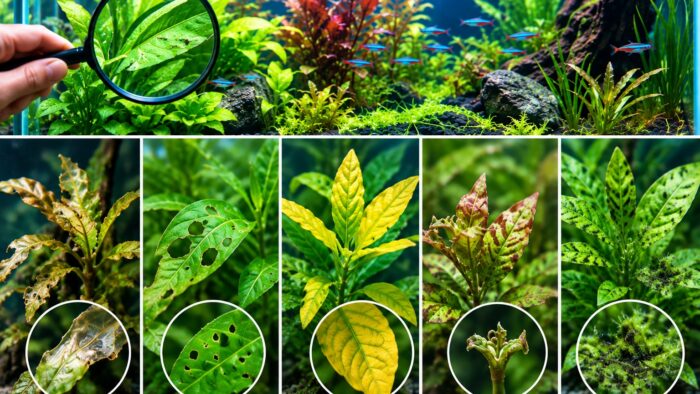
| Potassium | Macro | Enzyme function and water regulation | Almost none from fish waste | Pinholes in older leaves |
| Magnesium | Macro | Central atom in chlorophyll | Tap water if moderately hard | Yellowing between veins on old leaves |
| Calcium | Macro | Cell wall structure | Tap water if moderately hard | Twisted, stunted new growth |
| Iron | Micro | Chlorophyll production | Very little; usually needs dosing | Pale new growth, poor red colouration |
| Manganese, boron, zinc, copper | Micro | Various enzyme functions | Trace amounts in tap water | Distorted new growth |
| Carbon | Macro | The bulk of plant tissue | Dissolved CO2 from respiration | Slow growth despite adequate nutrients |
Two rows in that table explain most planted tank fertilising decisions. Potassium comes from essentially nothing in a normal aquarium, which is why potassium deficiency is the most common single deficiency in fish-stocked planted tanks. And carbon is needed in the largest quantity of all, which is why CO2 injection produces such dramatic results despite carbon not appearing on any fertiliser label.
Liquid, root tabs, or both
Delivery method matters because different plants feed differently, and using the wrong one wastes both money and effort.
Water column dosing with a liquid fertiliser suits stem plants, floating plants, mosses and rhizome plants such as anubias, java fern and bucephalandra. These species take up most of their nutrients through their leaves, and rhizome plants have roots that anchor rather than feed.
Root tabs suit heavy root feeders: amazon swords, cryptocorynes, vallisneria and most bulb plants. These species develop substantial root systems and draw a large proportion of their nutrition from the substrate. A sword in inert gravel with liquid dosing alone will usually underperform a sword with a root tab beneath it.
Nutrient substrate such as aquasoil serves the same purpose as root tabs but throughout the substrate and from the beginning. It depletes over one to three years, after which root tabs become useful again, which is a common and easily missed cause of gradual decline in mature scapes.
Most planted tanks end up using both methods, because most planted tanks contain both types of plant. A comprehensive liquid fertiliser dosed to the water column, plus root tabs pushed under the root feeders every three to four months, covers almost every low- to medium-tech setup.
Choosing a dosing approach
There are three broadly sensible approaches, and the right one depends on how much light and carbon the tank has.
An all-in-one comprehensive fertiliser is the simplest and suits most low-tech and medium-tech tanks. One bottle contains macro and micro nutrients, dosed to the label a few times a week. It is less precise than separate dosing but adequate for tanks that are not pushing growth rates.
Separate macro and micro dosing gives more control and is worth it in higher-light tanks where growth is faster and deficiencies appear sooner. Dosing macros and micros on alternate days is a common practice, largely because iron and phosphate can bind together when concentrated, though in a well-mixed tank this matters less than it is sometimes claimed to.
The Estimative Index approach dosages generously and relies on large weekly water changes to reset accumulated nutrients, on the principle that a slight excess is harmless while a shortage is not. It suits high-light, CO2-injected tanks and requires the discipline of a genuine 50 percent weekly change. It is unnecessarily heavy for a low-tech tank.
Whichever approach you choose, start at the lower end and adjust based on new growth over three to four week intervals. Plants respond slowly, and frequent adjustment makes diagnosis impossible. The symptom-based diagnostic table in the guide to aquarium plant problems is the reference for interpreting what you see.
The relationship between light, carbon and fertiliser
The single most useful concept in planted tank keeping is that these three must be balanced, and that light sets the pace for the other two.
Light drives photosynthesis, which determines how fast plants grow, which determines how much carbon and how many nutrients they consume. Increase light and you increase demand for everything else. If carbon or nutrients cannot keep up, plants stall while the surplus light remains available, and algae exploits it.
This is why adding more fertiliser to an algae problem usually makes it worse, and why reducing light usually resolves problems that appear to be deficiencies. The cheapest and most effective adjustment in a struggling planted tank is almost always to reduce the photoperiod or the intensity.
It also explains why low-tech tanks are so forgiving. With moderate light and no injected carbon, growth is slow, demand is low, and modest fertilising is sufficient. Problems appear when someone adds a powerful light to a low-tech tank without changing anything else.
The practical hierarchy for a struggling planted tank is therefore: check light is not excessive, check carbon is adequate and stable, then check nutrients. Most people work that list backwards and start by buying fertiliser.
For matching light output to plant type, the guide to aquarium lighting covers the ranges, and CO2 in planted aquariums covers when carbon supplementation is justified.
Fertiliser and livestock safety
Fertilisers are generally safe at label doses, but a few points matter, particularly in tanks with invertebrates.
Copper is present in trace amounts in most comprehensive fertilisers because plants require it. At label doses this is safe for shrimp, and millions of shrimp tanks are dosed routinely without problems. Substantial overdosing is a genuine risk, however, and shrimp keepers should dose conservatively and avoid stacking multiple products containing copper.
Liquid carbon products, based on glutaraldehyde compounds, are not fertilisers and deserve separate caution. They are effective algaecides at higher doses, which is why they are often recommended for spot-treating algae, but they harm sensitive plants such as vallisneria and mosses, and they are toxic to shrimp at above-label concentrations. Use them at label dose or not at all.
Nitrate-containing fertilisers should be dosed with awareness of the tank’s existing nitrate level. In a heavily stocked tank, nitrogen is usually already sufficient, and adding more contributes to the nitrate load that water changes are meant to remove. Test before assuming a nitrogen shortage.
Store fertilisers sealed and out of light, and note that opened bottles do degrade, particularly iron-containing micro products, which oxidise over time. A bottle that has been open for two years may be doing considerably less than the label suggests.
Aquarium fertiliser questions
Do I need fertiliser if I have fish?
Usually yes. Fish waste supplies nitrogen and phosphorus but almost no potassium and very little iron or trace elements. Potassium deficiency, showing as pinholes in older leaves, is extremely common in tanks fertilised only by fish.
Will fertiliser cause algae?
Not by itself. Algae is driven by light exceeding what plants can use, and a nutrient shortfall makes it worse by stalling plant growth. Tanks dosed generously with balanced fertiliser and appropriate light typically have less algae than under-dosed ones, not more.
How often should I dose?
Follow the product label as a starting point, which is usually two or three times a week for comprehensive liquids. Root tabs typically last three to four months. Adjust based on new growth over three to four week intervals rather than reacting weekly.
Are root tabs necessary if I use aquasoil?
Not initially. Aquasoil supplies substrate nutrients for one to three years depending on the product and plant load. As it depletes, root feeders begin to underperform, and adding root tabs at that point is far cheaper than replacing the substrate.
Is liquid carbon a substitute for CO2 injection?
Not equivalent. Liquid carbon products provide a small amount of usable carbon and have a genuine algaecidal effect, but they do not approach the growth results of injected CO2. They are a reasonable supplement in a low-tech tank and not a replacement in a high-tech one.
Match nutrients to the light you actually have
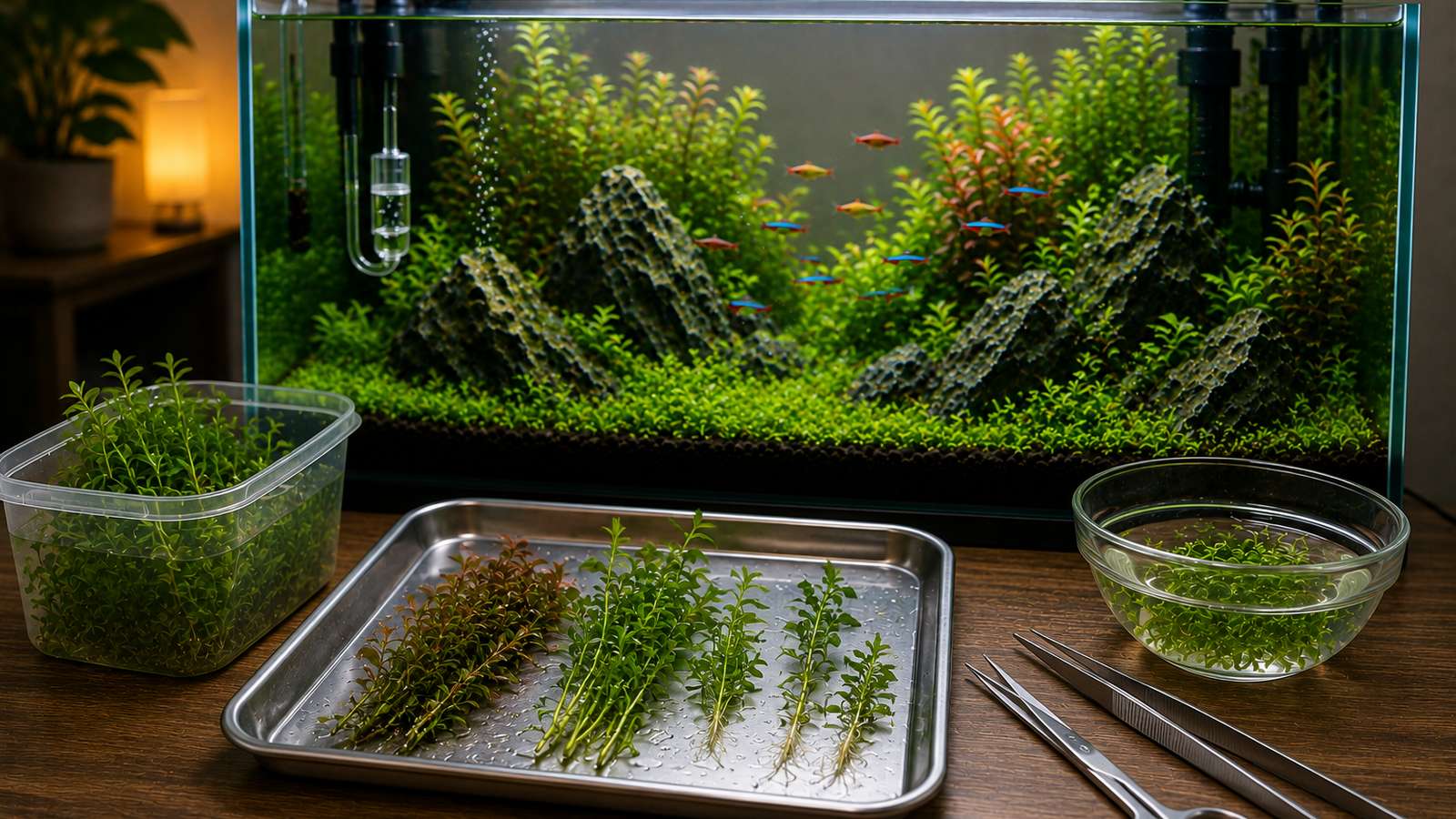
A workable fertilising routine for most planted tanks is straightforward: a comprehensive liquid fertiliser dosed to the water column two or three times a week, plus root tabs under heavy root feeders every few months, adjusted based on new growth.
The larger point is that fertiliser is one of three linked variables. If plants struggle persistently across several nutrients, the imbalance is usually light running ahead of what carbon and nutrients can support, and reducing light resolves more planted tank problems than any bottle does.