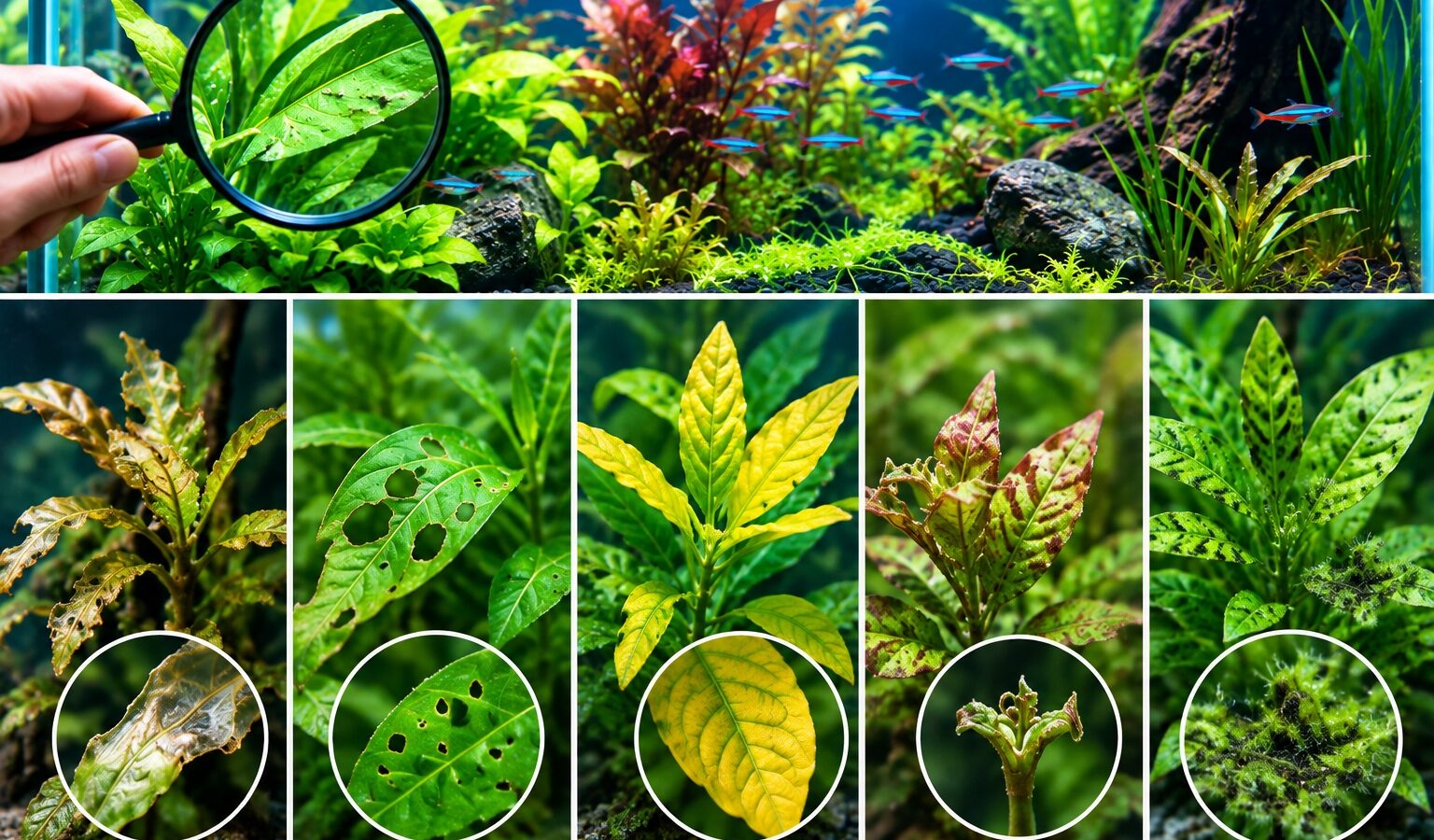
Aquarium plants communicate their problems fairly precisely, but only if you know which part of the plant to look at. The same yellow leaf means completely different things depending on whether it is old growth or new growth, and treating the wrong deficiency wastes weeks.
This guide works by symptom rather than by nutrient, because that is how the problem actually presents. Each section describes what you see, what usually causes it, and what to do.
The old growth versus new growth rule
This single distinction resolves most deficiency questions and is worth learning before anything else.
Some nutrients are mobile within the plant. When supply runs short, the plant strips them from older leaves and moves them to new growth, because new growth is more valuable. Nitrogen, phosphorus, potassium and magnesium all behave this way. Symptoms therefore appear on old leaves first while new growth continues to look healthy.
Other nutrients are immobile. Once incorporated into a leaf, they cannot be relocated. Iron, calcium, boron, manganese and sulphur behave this way. When supply runs short, existing leaves stay fine and new growth comes out damaged, pale or distorted.
So the first question when looking at a struggling plant is not which nutrient, but where the damage is. Old leaves affected with healthy new growth points to one group; damaged new growth with healthy old leaves points to the other. This halves the possibilities immediately.
Symptom reference table
Working from the visible symptom is faster than working from a nutrient list, since the symptom is what you actually have.
| Symptom | Where it appears | Usual cause | What to do |
|---|---|---|---|
| Leaves dissolving days after planting | Whole plant, especially crypts | Transplant shock, not a deficiency | Leave roots undisturbed; trim dead leaves; wait |
| Uniform yellowing from tips inward | Old leaves first | Nitrogen shortage | Add a complete fertiliser; check stocking is not too light |
| Pinholes in leaves | Old and middle leaves | Potassium shortage | Dose potassium or a complete fertiliser |
| Yellow between green veins | Old leaves first | Magnesium shortage | Check GH; dose magnesium if hardness is very low |
| Yellow between veins on new leaves | New growth | Iron or micronutrient shortage | Dose a comprehensive micro fertiliser |
| New leaves small, pale and distorted | New growth only | Micronutrient shortage or unstable CO2 | Micro fertiliser; check CO2 stability if injecting |
| Growth stunted, tips curled or twisted | New growth | Calcium shortage or very soft water | Check GH; remineralise if using RO water |
| Stems long and leggy with wide gaps | New growth | Insufficient light | Raise light output or move the plant higher |
| Algae growing directly on leaves | Older leaves worst | Excess light relative to plant uptake | Shorten photoperiod; increase plant mass |
| Holes with brown edges spreading | Old leaves | Advanced potassium shortage or decay | Trim affected leaves; dose potassium |
| Black or dark red tufts on leaf edges | Older leaves and hardscape | Black beard algae; unstable CO2 or excess light | Stabilise CO2, reduce light, trim affected leaves |
| Plant floating free after weeks | Whole plant | Roots rotted or never established | Check substrate depth; replant carefully |
Two entries in that table are not deficiencies and are frequently misdiagnosed as such. Melting after planting is a normal adjustment response, and algae on leaves is a light problem. Dosing fertiliser for either of them makes things worse, since the algae in particular will use the added nutrients.
Melting, and why cryptocorynes do it
Newly planted aquarium plants frequently lose most or all of their existing leaves within a fortnight. This alarms beginners and is usually fine.
The cause is that most aquarium plants are grown emersed, with roots in water and leaves in air, because this is faster and cheaper for nurseries. Emersed leaves have a different structure from submersed ones, and when the plant goes underwater, those leaves cannot function and are discarded. The plant then grows a new set adapted to submersed life.
Cryptocorynes are notorious for this, to the point that the phenomenon is called crypt melt. A crypt can lose every leaf and look completely dead, then regrow from the rootstock over several weeks. The important instruction is to leave the roots entirely alone. Pulling up a melted crypt to check on it is the most common reason it does not recover.
Melt can also be triggered in established plants by a sudden change: a large parameter shift, a move to a different position, or a substantial change in lighting. The response is the same, which is to remove the decaying leaves so they do not foul the water and otherwise leave the plant undisturbed.
Distinguish melt from rot by the roots. A melting plant has firm, pale roots and a healthy crown even with no leaves. A rotting plant has soft, brown, foul-smelling roots and will not recover. Rhizome plants like anubias and java fern rot when the rhizome is buried, which is the most common cause of genuine loss in those species.
Fixing the underlying imbalance
Individual deficiencies are worth correcting, but persistent recurring problems usually mean the tank’s overall balance is wrong rather than that one nutrient is missing.
The most common underlying issue is light exceeding what the rest of the system supports. Bright light drives fast growth, fast growth consumes nutrients and carbon quickly, and any shortfall shows up as deficiency symptoms and algae simultaneously. Reducing light is usually easier, cheaper and more effective than escalating everything else to match it.
The second most common is unstable CO2 in injected tanks. Plants adapt to a given CO2 level, and fluctuation causes more problems than a consistently moderate level. Black beard algae in particular is strongly associated with unstable carbon rather than with any nutrient.
The third is very soft water in tanks using RO or naturally soft supply. Plants need calcium and magnesium, and water with a GH near zero cannot supply them regardless of what fertiliser is dosed. Remineralising to a GH of around 4 to 6 resolves a category of problems that look like multiple simultaneous deficiencies.
Fertiliser strategy is covered in the guide to aquarium plant fertilizers and nutrients, and the interaction between light, carbon and nutrients is covered in the guide to aquascaping.
One practical note on diagnosis: change one variable at a time and give it three to four weeks. Plants respond slowly, and simultaneously adjusting light, fertiliser and CO2 makes it impossible to know what worked.
Plant problem questions
My plants melted completely. Are they dead?
Often not, particularly cryptocorynes and other rosette plants, which regrow from the rootstock over several weeks. Check the roots: firm and pale means the plant is alive, soft and brown means it is not. Leave melted plants undisturbed and remove only the decaying leaves.
Do I need fertiliser in a tank with fish?
Fish waste supplies nitrogen and phosphorus reasonably well but very little potassium, iron or trace elements. Most planted tanks benefit from a comprehensive fertiliser even when well stocked, and potassium deficiency in fish-only-fertilised tanks is extremely common.
Why do my plants grow well and then suddenly decline?
Usually a substrate that has exhausted its nutrients, a light that has degraded with age, or a change in the tank’s routine. Aquasoil depletes over one to three years, and LED output falls gradually. Both produce a slow decline that appears sudden once plants cross a threshold.
Should I remove leaves with algae on them?
Trim badly affected leaves, particularly on fast-growing plants where replacement is quick. On slow growers like anubias, gently wipe the leaves during a water change instead. Either way, address the light and nutrient balance, or the algae simply returns on the new growth.
How long should I wait before deciding a fertiliser is not working?
Three to four weeks. Existing damaged leaves do not repair, so the evidence is in new growth, and new growth takes time to appear. Judging after a few days leads to constant changes that make the situation impossible to diagnose.
Read the symptom location before choosing a treatment
Diagnosis in a planted tank starts with where the damage is. Old leaves affected with healthy new growth points to nitrogen, potassium or magnesium. Damaged new growth with healthy old leaves points to iron, calcium or trace elements. Melting after planting points to nothing at all except adjustment.
When problems keep recurring across different nutrients, the issue is usually the overall balance rather than any single element, and reducing light is more often the answer than adding more of everything else. Change one variable, wait three or four weeks, and judge by new growth.