Angelfish are among the most recognisable freshwater aquarium fish and among the most consistently mis-stocked. They are sold in shops at the size of a coin, placed in community tanks alongside small tetras, and reach six inches tall with a cichlid’s temperament and appetite.
None of this makes them a bad choice. A well-kept angelfish is striking, long-lived and genuinely interactive. It simply requires planning for the adult fish rather than the juvenile in the shop tank.
Angelfish tank requirements
The unusual thing about angelfish is that their body shape makes height a genuine requirement rather than a preference. A tall, laterally compressed fish in a shallow tank cannot orient normally, and long-finned varieties in particular need vertical space.
| Requirement | Recommendation | Notes |
|---|---|---|
| Adult size | 6 in long, up to 8 in tall with fins | Fin length varies by strain |
| Minimum tank height | 18 inches | Below this, tall varieties cannot orient properly |
| Minimum tank | 29 gallon tall for a pair, 55 gallon for a group | Footprint matters once territories form |
| Temperature | 76 to 84 F | Warmer end suits breeding |
| pH | 6.5 to 7.5 | Adapts well to neutral water |
| Hardness | 3 to 10 dGH | Prefers soft to moderate |
| Group size | 1, a bonded pair, or 5 or more | Groups of 2 to 4 lead to bullying |
| Lifespan | 8 to 10 years | A genuine long-term commitment |
| Diet | Quality cichlid pellets, frozen foods, some vegetable matter | Prone to bloat on rich diets |
Group size deserves emphasis because it is counterintuitive. A single angelfish is fine. A bonded pair is fine. Five or more spreads aggression across the group. But two, three or four juveniles almost always ends with one dominant fish relentlessly harassing the others as they mature, and this is one of the most common angelfish problems reported by keepers.
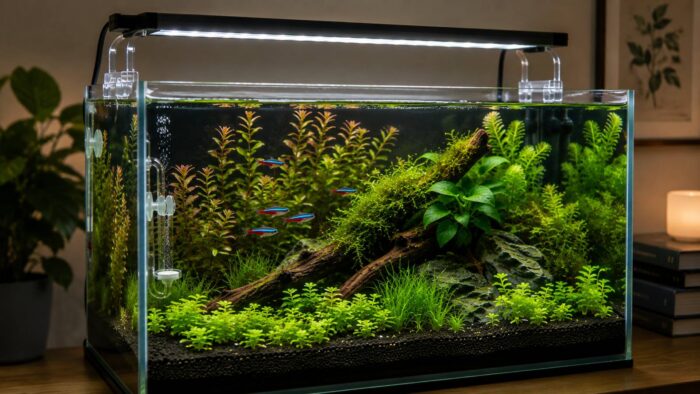
Set the tank up with tall plants, driftwood arranged vertically, and broken sightlines. Angelfish evolved among submerged tree roots and dense stems, and open, bare tanks leave them skittish. Vertical structure also helps break up territories once maturity arrives.
The tankmate problem
Angelfish are usually sold as community fish, and as juveniles that description holds. The difficulty is that the relationship changes as they grow, and it changes in two directions at once.
First, they become predators of small fish. An adult angelfish will eat neon tetras, small rasboras, guppy fry and shrimp. This is normal feeding behaviour, it appears only once the angel is large enough, and it cannot be prevented by feeding more. Neon tetras and angelfish is the single most common failed combination in the freshwater hobby.
Second, they become territorial, particularly once a pair forms. A spawning pair will claim a substantial portion of the tank and drive other fish away from it, sometimes aggressively enough to kill.
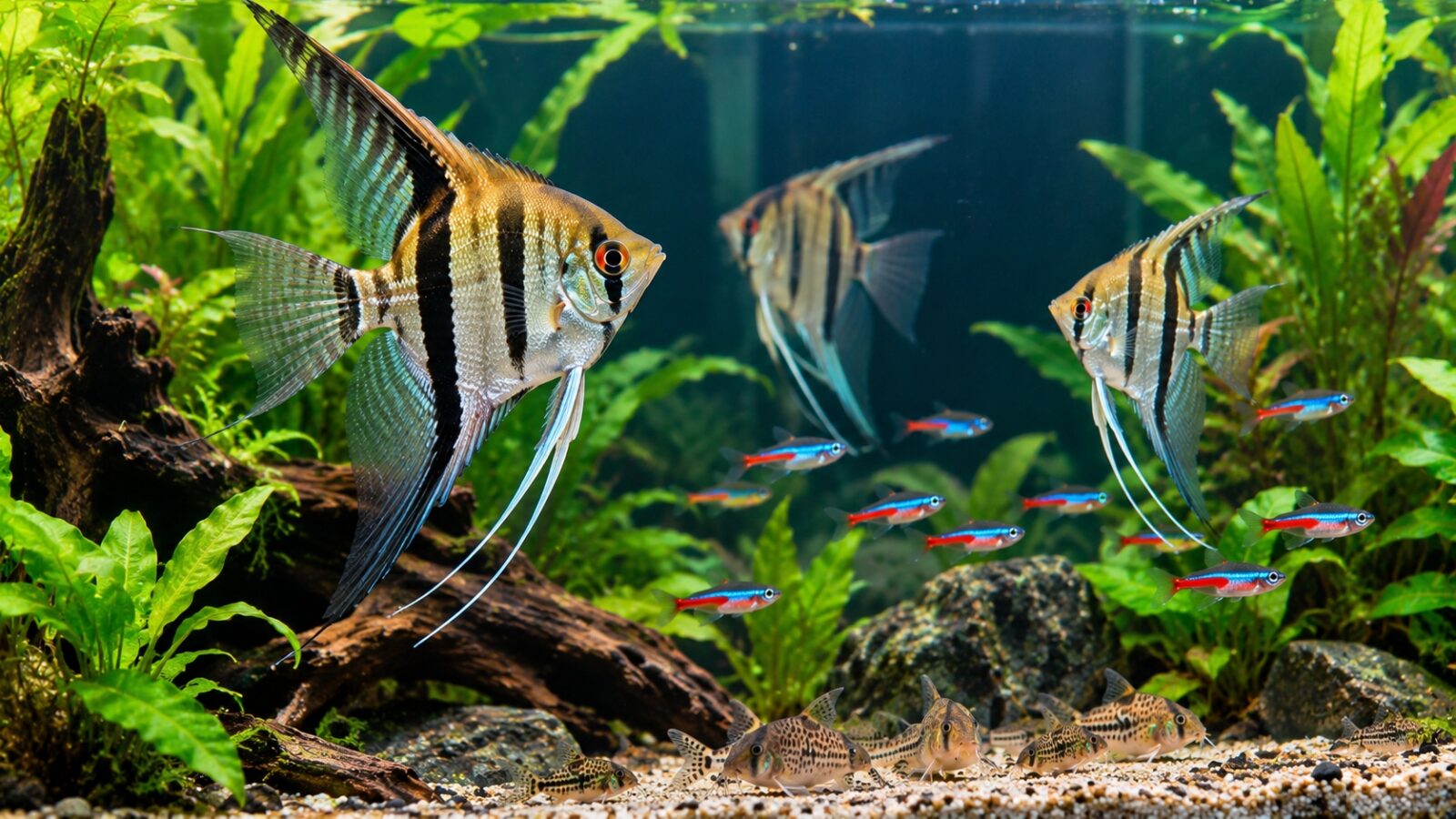
Workable tankmates therefore need to be too large to eat, fast enough or robust enough to avoid harassment, and tolerant of the same warm, soft water. Reliable options include larger tetras such as black skirt, congo and lemon tetras, rummynose tetras in large shoals, corydoras, bristlenose plecos, larger rasboras like scissortails, and peaceful barbs such as cherry barbs.
Poor choices include neon and ember tetras, guppies, shrimp, tiger barbs and serpae tetras which nip angelfish fins, and other territorial cichlids. The framework for judging these is in the guide to aquarium fish compatibility.
Managing aggression as they mature
Angelfish aggression is not random. It follows a predictable arc, and knowing the stages makes it far easier to manage.
Juveniles up to about three months are genuinely peaceful and shoal loosely. This is the stage most people buy at, and it gives a misleading impression of the adult fish.
Between three and eight months, a hierarchy forms. Individuals begin to establish rank, and in small groups this is where persistent bullying starts. If you are keeping a group, this is the point to watch closely and to add cover.
At eight to twelve months, pairs form. Two fish will begin cleaning a flat surface together and defending the area around it. Once this happens, the pair effectively owns that section of tank.
Once spawning begins, aggression peaks. A defending pair may claim most of a smaller tank, and other fish will be relentlessly driven off. In a 29-gallon this frequently means the other occupants have nowhere to retreat to.
Three interventions genuinely help. Increase vertical structure so fish can break line of sight. Ensure the tank is large enough that a claimed territory does not cover the whole footprint, which in practice means 55 gallons or more if you want a pair plus a community. And rearrange the hardscape when introducing new fish, which resets existing territorial boundaries.
Where a pair is making a community tank unliveable, the honest options are moving the pair to their own tank or moving the other fish out. Angelfish do not stop defending a spawning site because the tank is crowded.
Feeding and common health problems
Angelfish are omnivores with a carnivorous lean. A quality cichlid pellet sized for their mouth forms a good staple, supplemented with frozen bloodworm, brine shrimp and mysis two or three times a week, plus some vegetable content.
The main dietary risk is bloat. Angelfish are prone to digestive problems on consistently rich, protein-heavy diets, particularly with dry food that swells after being eaten. Soaking pellets before feeding, including vegetable matter, and running a weekly fasting day all reduce the incidence considerably.
Hexamita, sometimes called hole-in-the-head, appears as small pits on the head and along the lateral line, often with white stringy waste and progressive weight loss. It is associated with poor water quality, nutritional deficiency and chronic stress, and it is one of the more common angelfish-specific problems. Improving water quality and diet is the first response.
Fin damage is also common because of their trailing fins. Nipping tankmates are the usual cause; the guide to common aquarium diseases covers distinguishing fin rot from mechanical damage.
Angelfish are relatively sensitive to nitrate and benefit from more frequent water changes than average community fish. Following the routine in the guide to doing a proper water change, with an emphasis on consistency, prevents most chronic problems in the species.
Angelfish questions
Can angelfish live with neon tetras?
Only temporarily. Juvenile angelfish and neons coexist peacefully, sometimes for a year, and then the angels reach a size where a neon fits in their mouth. This is feeding behaviour and cannot be prevented. Choose larger tetras such as black skirt, lemon or congo tetras instead.
How many angelfish should I keep together?
One, a bonded pair, or five or more. Groups of two to four almost always produce a dominant fish that relentlessly harasses the rest as they mature. Larger groups spread aggression, but they need a correspondingly larger tank.
What size tank does a single angelfish need?
A 29-gallon tall is a realistic minimum for one fish, with 18 inches of height being the important dimension. For a pair plus other fish, 55 gallons is more appropriate, mainly because territorial claims need somewhere for other fish to retreat from.
Why is my angelfish suddenly attacking the others?
Almost always maturity or spawning. A pair forming will claim territory and defend it against everything else in the tank. Check for two fish cleaning a flat surface together, which is the reliable sign. Adding vertical cover helps; a larger tank helps more.
How can I tell male from female angelfish?
Reliably only during spawning, when the female’s breeding tube is broader and blunter than the male’s narrower, pointed one. Body shape and forehead profile are frequently cited but are unreliable in practice. Most keepers simply raise a group and let a pair form naturally.
Plan for the adult cichlid, not the shop juvenile
Every common angelfish problem comes from the same source: stocking for the fish in the shop tank rather than the fish it becomes. At full size it is a six-inch, territorial cichlid that eats small fish and defends a spawning site.
Give it height, choose tankmates that are too large to be eaten and too robust to be bullied, keep one, a pair or five or more rather than a small group, and accept that a spawning pair may eventually need its own tank. On those terms an angelfish is an excellent long-term aquarium fish.