Reef lighting is the area where marketing and physics diverge most sharply. Fixtures are sold on wattage, channel count and app features, while the number that actually determines whether a coral lives is PAR at the coral’s position, which almost nobody measures.
The good news is that the underlying requirements are simple, and most corals tolerate a fairly wide band. What they do not tolerate is being moved abruptly from one light level to another, which is where most lighting-related losses actually come from.
Understanding PAR, PUR and why watts do not matter
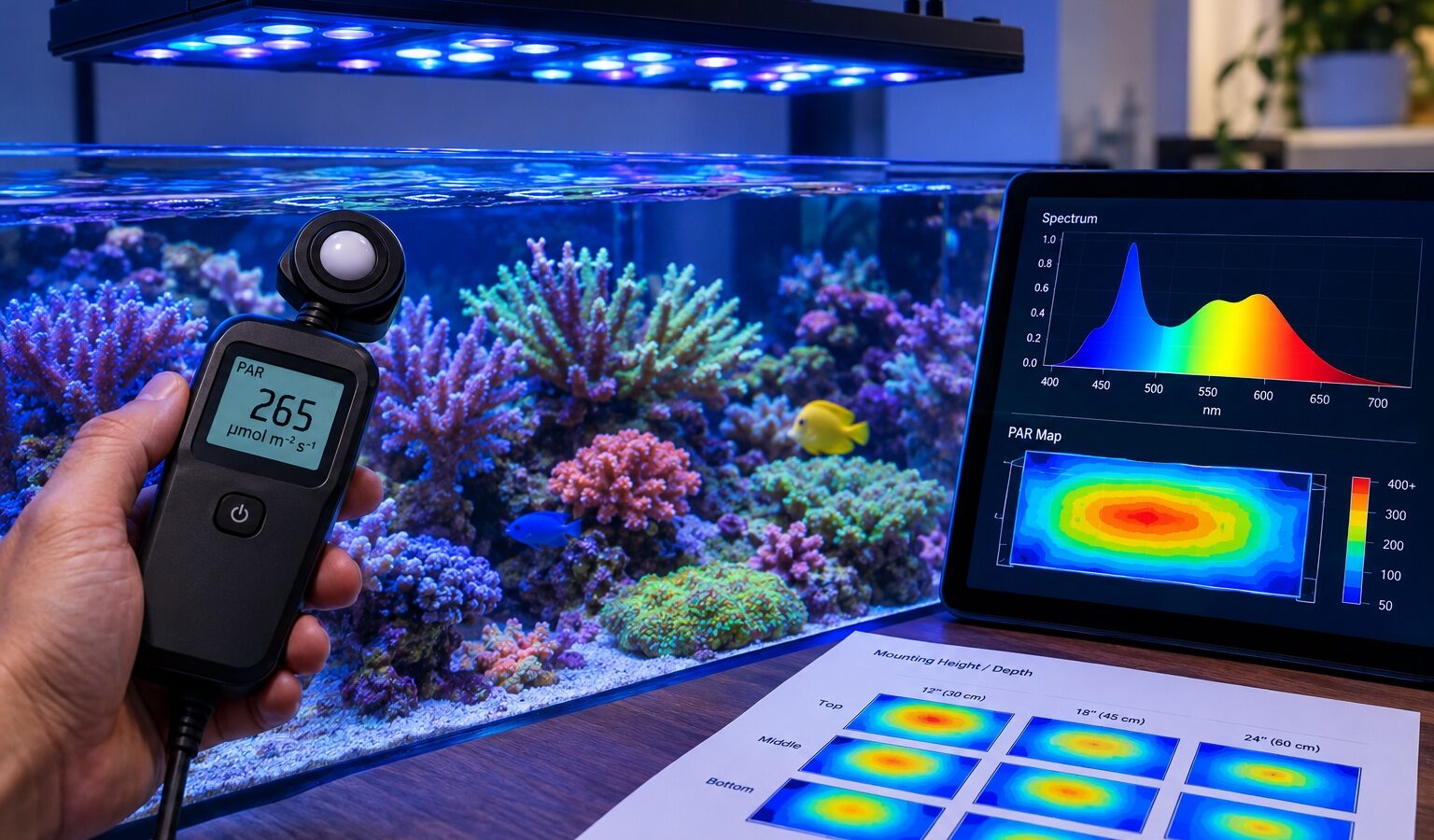
PAR stands for photosynthetically active radiation and measures the density of light photons in the 400 to 700 nanometre range, which is the range photosynthetic organisms can use. It is expressed as micromoles per square metre per second, and it is measured at a specific point in the tank rather than at the fixture.
This last point is why wattage is useless. A 150-watt fixture mounted high over a deep tank may deliver less usable light at the sand bed than a 90-watt fixture mounted close over a shallow one. Light falls off sharply with distance and is absorbed by water, so the only meaningful figure is PAR where the coral actually sits.
Lumens are worse still, because the lumen scale is weighted to human eye sensitivity, which peaks in green and yellow. Corals use blue heavily and green very little. A fixture optimised for lumens is optimised for looking bright to people.
PUR, photosynthetically usable radiation, refines PAR by accounting for which wavelengths coral symbionts actually absorb most efficiently. It is a useful concept but is not standardly measured, so PAR remains the practical working number.
Most hobbyists do not own a PAR meter, and buying one for a single tank is hard to justify. Two alternatives work well: many local reef clubs lend meters, and most reputable fixture manufacturers publish PAR maps showing output at various depths and mounting heights for their own products.
How much light different corals need
Coral light requirements vary considerably, and placement is the main tool for matching them, since a single fixture produces a wide range of PAR values across a tank.
| Coral type | PAR range | Typical placement | Signs of too much light | Signs of too little |
|---|---|---|---|---|
| Mushrooms | 30 to 80 | Sand bed, shaded rock | Shrinking, detaching and relocating | Stretching, thinning tissue |
| Zoanthids | 75 to 150 | Low to mid rock | Closed polyps, bleaching | Stretched stalks, dull colour |
| Green star polyps | 50 to 200 | Anywhere; very tolerant | Rare | Slow spread |
| Leather corals | 75 to 200 | Mid rock | Persistent retraction | Elongated, pale polyps |
| Duncan and candy cane | 75 to 150 | Sand or low rock | Tissue recession | Reduced polyp extension |
| Hammer, torch, frogspawn | 100 to 200 | Mid rock, well spaced | Bleaching, retracted polyps | Stretched, reaching polyps |
| Acropora and other SPS | 200 to 400 | Upper rock | Rapid tissue loss, stark white | Browning, stalled growth |
| Non-photosynthetic corals | Any | Shaded | Not applicable | Not applicable; require feeding |
Two symptoms in that table are worth distinguishing carefully. Bleaching, where a coral turns stark white, means the coral has expelled its symbiotic algae under stress and is a genuine emergency. Browning, where a coral darkens and loses colour, means the opposite: the coral is producing more pigment to capture insufficient light. Both are colour changes, and they call for opposite responses.
Spectrum and what the channels actually do
Modern reef fixtures split output across multiple colour channels, and the settings genuinely matter, though not in the way most interfaces suggest.
Blue and royal blue, roughly 400 to 480 nanometres, do most of the biological work. Water absorbs red wavelengths within a few metres, so corals evolved under predominantly blue light and their symbionts are most efficient there. Blue light also excites the fluorescent proteins that produce the colours reef keepers value, which is why reef tanks look most striking under heavily blue-weighted light.
Violet and ultraviolet-adjacent wavelengths around 400 to 420 nanometres enhance fluorescence further and appear to influence pigment production, though the evidence is less settled than marketing suggests.
White light contributes to overall PAR and makes the tank look natural to human eyes, but it is largely for the viewer rather than the coral. Many keepers run a blue-heavy spectrum with a modest white component, which corals handle well and which shows fluorescence.
Green and red channels contribute little for corals and are mainly aesthetic. Excess of either can favour algae growth without benefiting coral.
The practical approach is to set a blue-dominant spectrum, keep white moderate, and then adjust intensity rather than colour when corals respond poorly. Chasing spectrum settings is a common time sink; intensity and placement account for far more of the outcome.
Setting a reef photoperiod
Eight to ten hours of main lighting suits most reef tanks. Longer photoperiods do not meaningfully increase coral growth, because photosynthesis saturates, but they do give algae more opportunity.
A ramp is worth using if the fixture supports it. Instantaneous full output causes visible stress responses in corals and startles fish. A thirty to sixty minute ramp up and down at each end, with the main intensity period in the middle, mimics natural conditions and costs nothing.
Many keepers add a blue-only period before and after the main photoperiod. This extends the viewing window, shows fluorescence, and adds very little total PAR, so it does not meaningfully feed algae.
Timing the main period for when you are actually home is entirely reasonable. Corals do not care which hours they receive light, only that the schedule is consistent. A photoperiod running from midday to evening is common and works well.
Consistency matters more than the specific schedule. Changing the photoperiod frequently, or leaving lights on late occasionally, produces the same kind of instability that causes problems elsewhere in reef keeping. Put the fixture on a schedule and leave it alone.
The general principles here mirror freshwater practice, covered in the guide to aquarium lighting, though the intensity requirements are substantially higher.
Acclimating corals to a new light
This is where most lighting-related coral losses actually occur. A coral moved from a dim shop tank, or a tank that gets a new fixture, can bleach within days even though the new light level is entirely appropriate for that species.
For new corals, use placement rather than dimming. Put frags on the sand bed or low on the rockwork, well below their eventual position, and move them up a few inches every one to two weeks over about a month. This gives the symbiotic algae time to adjust their density and pigmentation.
For a new fixture over an established tank, reduce intensity to roughly half of the intended setting and raise it over four to six weeks. Increasing by about ten percent a week is a reasonable pace, and pausing if any coral pales is more important than hitting a schedule.
Watch for the early indicators rather than waiting for obvious bleaching. Tissue paler than at purchase, polyps staying retracted through the middle of the day, and a brown coral lightening noticeably all indicate too much light too fast. Move the coral lower immediately; recovery is usually complete if you act within the first week.
One additional caution applies when replacing an old fixture. Ageing LEDs lose output slowly, and corals acclimate to the declining level without anyone noticing. Installing a new fixture at the same nominal settings can therefore represent a large real increase in PAR. Treat any fixture replacement as a full re-acclimation.
Reef lighting questions
Do I need a PAR meter?
It is useful but not essential. Manufacturer PAR maps for your specific fixture at your mounting height cover most needs, and many reef clubs lend meters. If you keep SPS corals, where the acceptable band is narrower, a meter becomes considerably more valuable.
How high should I mount my light?
Most fixtures are designed for six to ten inches above the water, and manufacturer guidance is worth following since PAR maps assume a specific height. Mounting higher spreads light more evenly but reduces intensity sharply; mounting lower increases intensity and creates hot spots directly beneath.
Can I keep corals under a freshwater plant light?
Generally no. Plant lights are weighted toward red and produce far less blue than corals need, and most lack the intensity required at reef depths. Some low-light softies survive under them, but the results are poor and the tank looks wrong.
Why did my coral turn brown after I moved it?
Browning indicates insufficient light. The coral is increasing pigment density to capture more of it, which darkens the tissue and masks fluorescence. Move it higher gradually, a few inches at a time, and colour usually returns over several weeks.
How long do reef LEDs last?
The diodes typically last several years but lose output gradually well before failing, often by ten to twenty percent over three to four years. Because corals acclimate to the decline, this is easy to miss. Treat any fixture replacement or major driver repair as requiring full light re-acclimation.
Match PAR to the coral and change it slowly
Reef lighting comes down to three decisions: enough PAR at the coral’s actual position for the species you keep, a blue-dominant spectrum, and a consistent eight to ten hour photoperiod with a ramp at each end.
The fourth and most important is pace. Corals adapt to a wide range of light levels but not to sudden changes, so every new coral and every new fixture needs four to six weeks of gradual acclimation. Get that right and most lighting problems never occur.