Live food is the most effective conditioning tool in fishkeeping and the most reliable way to get reluctant fish eating. It is also the main route by which parasites enter aquariums when bought from shop tanks, which is the central argument for culturing your own.
Home cultures are cheaper than they look, take up less space than people expect, and require a few minutes of attention every few days. This guide covers the four cultures worth starting with and how to keep them running.
Which culture to start with
Each culture suits a different purpose, and starting with the one that matches your actual need is more useful than trying all of them at once.
| Culture | Best for | Setup effort | Time to first harvest | Maintenance |
|---|---|---|---|---|
| Baby brine shrimp | Fry of almost any species, conditioning small fish | Low; needs a hatchery and air pump | 24 to 36 hours | New batch each time; no ongoing culture |
| Microworms | Very small fry, egg-layer fry | Very low; a tub and oatmeal | 1 to 2 weeks initially | Re-culture every 2 to 4 weeks |
| Vinegar eels | Extremely small fry needing food that stays alive | Very low; a bottle and apple cider vinegar | 3 to 4 weeks initially | Almost none; lasts months |
| Daphnia | Conditioning adults, roughage, natural feeding response | Moderate; needs a container with light | 2 to 4 weeks | Regular feeding; prone to crashes |
| Grindal worms | Larger fry and small adults | Low; a tub of moist substrate | 3 to 4 weeks | Feed every few days |
| Infusoria | Extremely small fry in the first days | Very low; a jar and plant matter | 3 to 7 days | Short-lived; culture as needed |
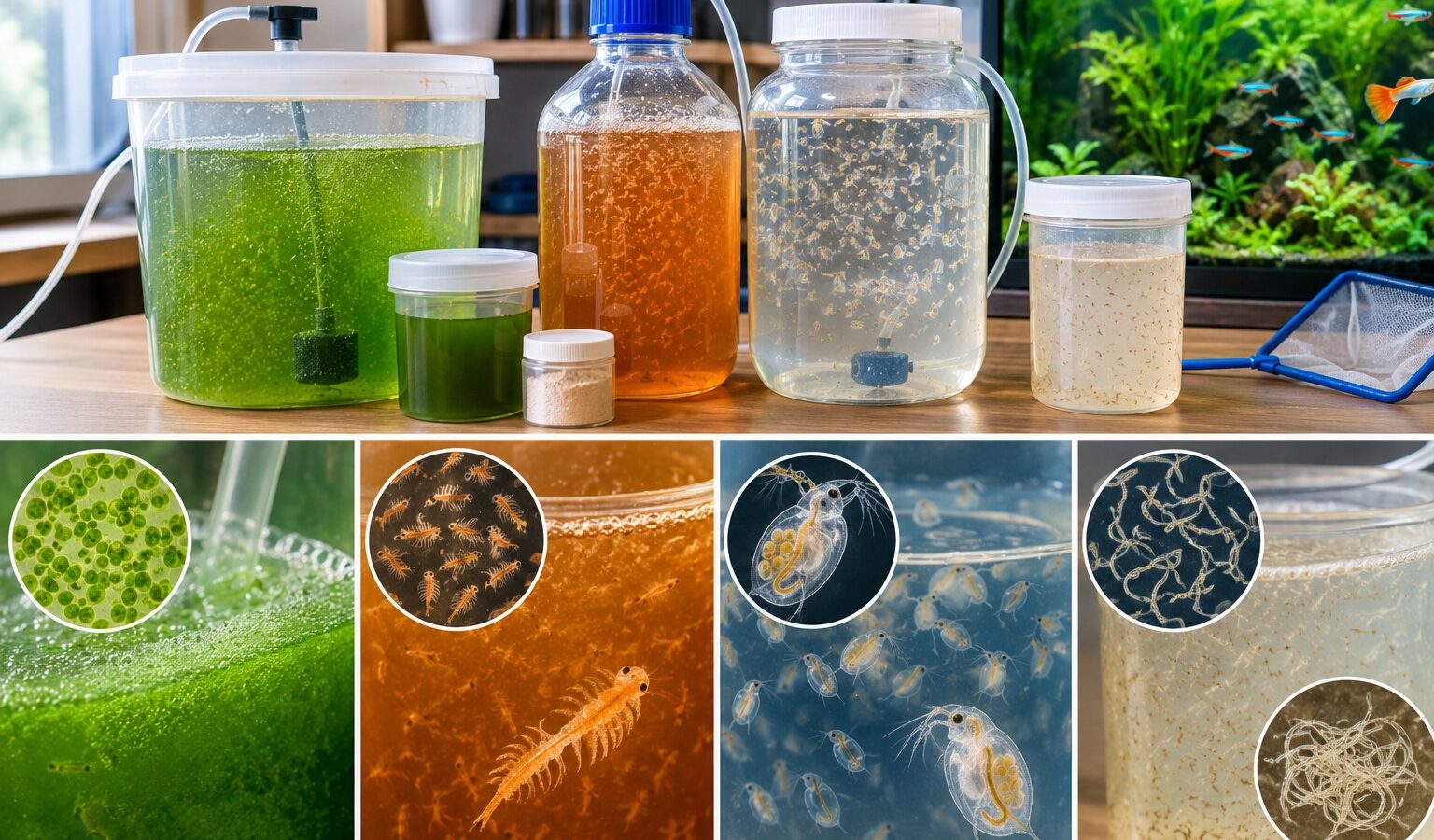
For most people the sensible starting point is baby brine shrimp, because it is the most nutritionally valuable, the most universally accepted, and does not require maintaining a permanent culture. Add microworms if you are raising fry too small for brine shrimp, and daphnia if the goal is conditioning adults.
Baby brine shrimp
Artemia cysts hatch into nauplii that are the standard first food for a huge range of fry, and adult fish take them enthusiastically as well. Newly hatched nauplii carry a yolk sac that makes them exceptionally nutritious for the first 24 hours.
The setup is a hatchery cone or a clear plastic bottle inverted, an air pump with rigid airline reaching the bottom, and a light. Fill with dechlorinated water, add non-iodised salt at roughly a tablespoon per litre, add a small measure of cysts, and run vigorous aeration at around 78 to 82 degrees Fahrenheit.
Hatching takes 24 to 36 hours. When done, switch off the air and wait several minutes. Empty shells float, unhatched cysts sink, and the orange nauplii gather in the middle, drawn toward a light held at the side. Draw them off with a pipette or turkey baster, strain through a fine net, and rinse in fresh water before feeding.
Rinsing matters. Feeding salt water into a freshwater tank repeatedly does no favours, and shells are indigestible and can cause problems in fry.
Running two hatcheries a day apart gives a continuous supply, which is the standard approach when raising a spawn. Feed nauplii within 24 hours of hatching, since they consume their yolk sac and lose much of their value after that.
Microworms and vinegar eels
These two are the low-effort cultures, and both suit fry too small for brine shrimp.
Microworms are cultured in a shallow lidded tub with a thin layer of cooked oatmeal or a similar starchy medium, a pinch of baker’s yeast, and a starter culture. Kept at room temperature, worms multiply within the medium and climb the container walls within a week or two. Harvest by wiping the walls with a finger or a cotton bud and rinsing into the tank.
Re-culture every two to four weeks into a fresh tub, since the medium sours. The characteristic sign that a culture is going over is a strong, unpleasant smell and worms failing to climb. Keep two tubs at different ages so one is always productive.
Vinegar eels are the most neglect-tolerant culture available. A bottle of apple cider vinegar diluted roughly half with water, a few slices of apple, and a starter culture will produce eels for months with no further attention. They are extremely small, they stay alive in the water column for a long time rather than sinking and dying, and they are ideal for fry that are too small even for microworms.
Harvesting vinegar eels takes a little technique: stuff a plug of filter wool in the bottle neck, top up with fresh water above the wool, and the eels migrate up through it into the clean water where they can be pipetted off.
Daphnia
Daphnia are small crustaceans that provide both nutrition and roughage, and they are excellent for conditioning adult fish. They also trigger a strong natural feeding response, which makes them useful for fish that ignore prepared food.
Culture them in a container of at least several litres, in a bright position but out of direct hot sun, with gentle or no aeration. Vigorous aeration damages them. Green water is the ideal food, and many keepers maintain a green water culture alongside; failing that, small amounts of yeast, spirulina powder or filtered pond water work.
The main difficulty with daphnia is that cultures crash, often without obvious cause. Overfeeding is the usual culprit, since uneaten food fouls the water quickly in a small container. Feed lightly, keeping the water slightly tinted rather than cloudy.
Harvest with a fine net every few days once the culture is established, taking no more than a third at a time so the population recovers. Always maintain a second container as insurance, because a crashed sole culture means starting over.
Wild-collected daphnia from ponds are free but carry the same risks as shop-bought live food, including hydra, planaria, dragonfly larvae and fish parasites. If collecting, take from water bodies with no fish in them, which substantially reduces the parasite risk.
Safety, hygiene and practicalities
Home culturing removes most of the disease risk associated with live food, but a few precautions still apply.
Never return unused live food from a tank back into the culture. Anything that has touched aquarium water can carry pathogens back into a clean culture.
Keep cultures away from the tanks themselves where practical, and use separate equipment for harvesting. A pipette used in both a culture and a display is a route for cross-contamination.
Rinse all live food in clean fresh water before feeding, particularly brine shrimp, which carry salt, and anything cultured in a medium such as oatmeal.
Feed live food as part of a varied diet rather than as a staple. Most cultured live foods are nutritionally incomplete on their own, and the standard approach is two or three live feeds a week alongside a quality prepared staple, as covered in the guide to best fish food types.
Finally, be realistic about smell and space. Microworm and grindal cultures have a distinctive yeasty odour, daphnia containers need light, and brine shrimp hatcheries need an air pump running. A cupboard or a shelf in a utility area works better than a living room.
Live food culture questions
Is live food from a shop safe?
It carries genuine risk. Live food held in shop systems can carry parasites, bacteria and pests from the tanks it was stored near, and it is a well-documented route for introducing disease. Home cultures avoid this almost entirely, which is the main reason to bother with them.
Can adult fish live on live food alone?
Not well. Most cultured live foods are nutritionally incomplete individually, and brine shrimp in particular lose much of their value once past the nauplius stage. Use live food as a supplement two or three times a week alongside a quality staple.
What is the easiest culture for a complete beginner?
Vinegar eels, which need almost no maintenance and last for months, or baby brine shrimp, which needs no permanent culture at all. Microworms are close behind. Daphnia are the most useful for adult fish but the most prone to crashing.
How do I know if a culture has crashed?
A strong sour or rotting smell, worms no longer climbing the container walls, or a daphnia culture going clear with no visible movement. Crashes are normal and expected, which is why a second backup culture kept separately is standard practice.
Can I collect live food from a local pond?
You can, and it is free, but it carries the same parasite risk as shop-bought live food plus the possibility of introducing predatory insect larvae. If collecting, choose water with no fish present, and be aware that collecting from protected sites is restricted in many areas.
Start one culture and keep a backup
Culturing live food is far less demanding than it appears, and it changes what is possible with conditioning, breeding and fry raising. Baby brine shrimp is the highest-value place to start, microworms and vinegar eels are the lowest-effort, and daphnia is the best for conditioning adults.
Whichever you start with, maintain a second culture from the beginning. Crashes happen to everyone, and a backup turns a setback into an inconvenience rather than the end of the project.