Saltwater fishkeeping has a reputation for difficulty that is partly earned and partly outdated. The chemistry is less forgiving than freshwater, the equipment is more involved, and mistakes cost more. But the fundamentals are not harder to understand, and modern equipment has removed much of what used to make marine tanks unreliable.
This guide is the hub for everything on the site about saltwater and reef aquariums. It covers what genuinely differs from freshwater, the order to do things in, and where each stage is covered in detail.
What actually differs from freshwater
Four things make marine tanks harder, and it is worth being precise about them, because the rest is broadly the same.
Salinity has to be measured and maintained. Water evaporates and salt does not, so the salinity of a marine tank rises continuously between top-ups. Freshwater keepers can ignore evaporation; marine keepers cannot. A refractometer and a habit of topping up with fresh, not salt, water solve this entirely.
Source water quality matters far more. Tap water carries phosphate, nitrate, silicate and metals that a freshwater tank largely absorbs without consequence. In a reef these drive persistent algae and unexplained parameter drift, which is why reverse osmosis water is treated as essential rather than optional.
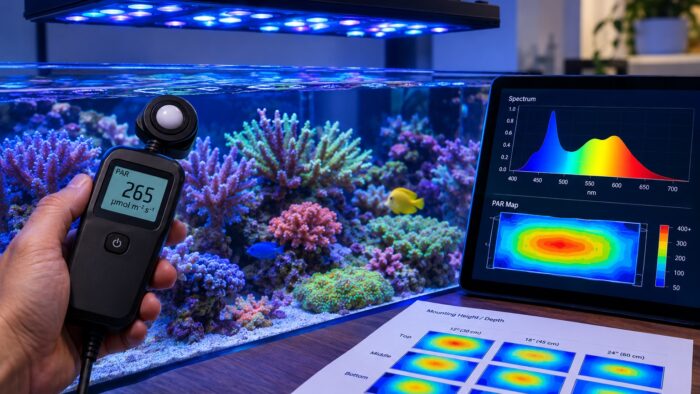
Lighting is a functional requirement rather than a viewing preference. Corals depend on symbiotic algae, and those algae need specific intensity and spectrum. A light that grows freshwater plants will not keep coral alive.
Livestock is more expensive and less replaceable. A mistake that costs a few pounds in freshwater costs considerably more in a reef, which changes how cautiously most people proceed.
Everything else, including the nitrogen cycle, the importance of water changes and the principles of stocking, works exactly as it does in freshwater. The cycling guide applies directly.
Choosing the tank and the type of system
Marine tanks come in three broad types, and the choice determines equipment, cost and difficulty far more than tank size does.
| System type | What it holds | Lighting | Difficulty | Realistic minimum size |
|---|---|---|---|---|
| Fish-only | Marine fish, live rock, no coral | Basic marine light | Easiest marine option | 30 gallons |
| Fish-only with live rock (FOWLR) | Fish plus substantial live rock filtration | Basic marine light | Easy | 40 gallons |
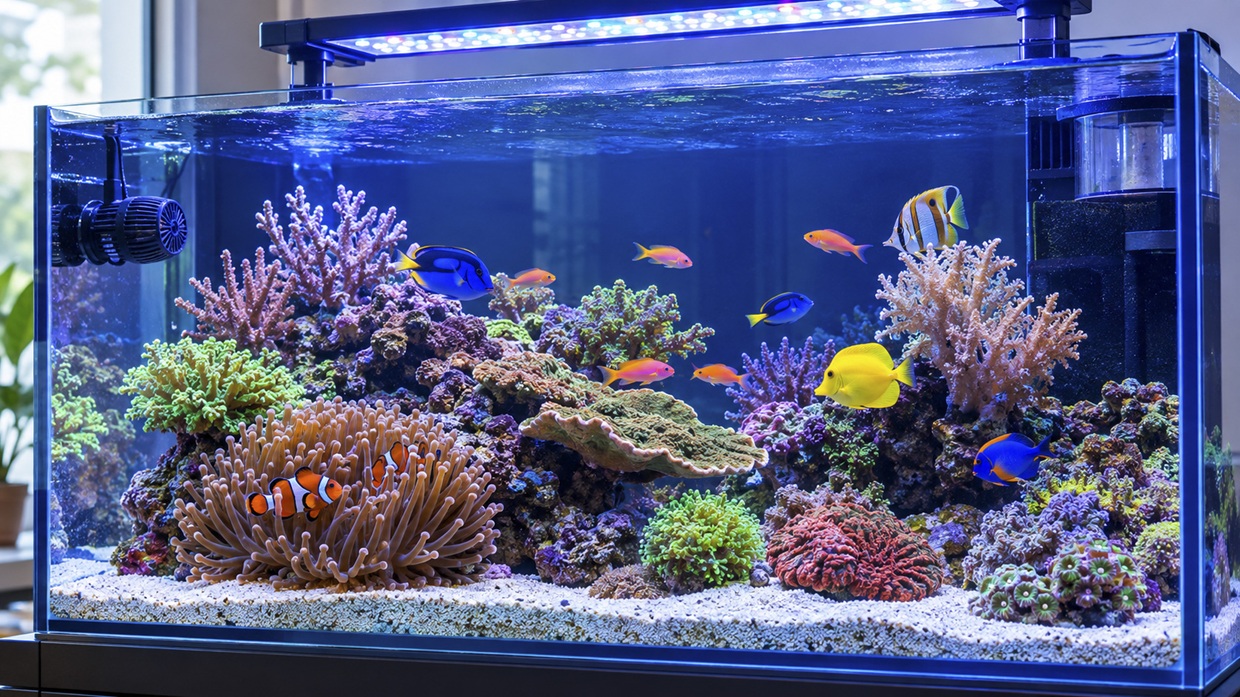
| Soft coral reef | Fish plus mushrooms, zoanthids, leathers | Moderate reef light | Moderate | 20 gallons, 40 preferred |
| Mixed reef | Soft corals plus hardy LPS | Good reef light | Moderate to demanding | 40 gallons |
| SPS-dominant reef | Small polyp stony corals | High-output reef light | Demanding | 50 gallons plus |
| Nano reef | Small volume, limited stocking | Reef light sized to depth | Deceptively difficult | 10 gallons, with discipline |
The common beginner error is starting with a nano reef because it looks affordable. Small volumes swing faster in temperature, salinity and chemistry, and there is no margin for a missed top-up. A 40-gallon tank costs more upfront and is substantially easier to keep alive.
The second common error is planning for SPS corals from the start. Almost nobody succeeds with small polyp stony corals in a first tank, and the equipment required is considerably more expensive. Starting fish-only or soft coral and upgrading later costs less overall than buying for a goal you are not ready for.
Equipment and setup
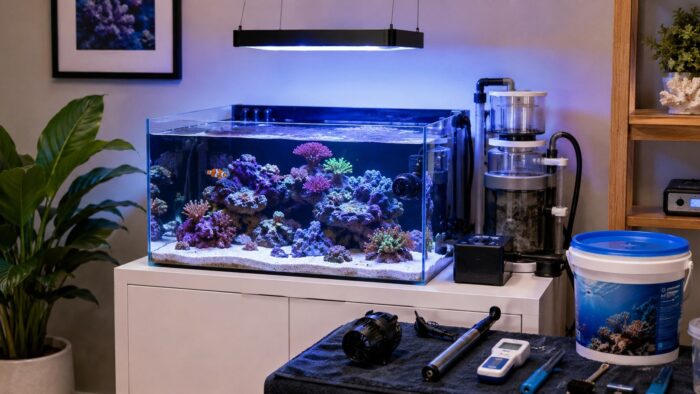
The genuine essentials are a tank and stand, reef-grade salt, reverse osmosis water, a heater, a powerhead for flow, live or dry rock, an appropriate light and accurate testing gear including a refractometer. Everything else is an upgrade.
The full breakdown of what each item does, what happens without it, and when to buy it is in the guide to saltwater aquarium equipment. The short version is that skimmers, reactors, dosing pumps and controllers are all solutions to specific measured problems, and buying them before you have the problem adds cost and points of failure.
Setup follows the same sequence as freshwater with one addition: mix and heat the saltwater in a separate container before it goes into the tank, never by adding dry salt to a filled aquarium. Mix for several hours with a powerhead, bring it to tank temperature, and check salinity with a refractometer rather than trusting the label ratio.
Rockwork should go directly on the base glass, not on sand, and should be stable enough that a fish cannot topple it. Leave gaps for flow and access. The full step-by-step build is covered in the guide to setting up your first reef tank.
Cycling and the order of livestock
A marine tank cycles the same way a freshwater one does. Ammonia becomes nitrite, nitrite becomes nitrate, and the process takes two to six weeks. Dry rock cycles more slowly than live rock because it carries no starter bacteria.
Once cycled, add livestock up a hardiness ladder rather than all at once. The typical sequence is cleanup crew first, then one or two hardy fish, then more fish spaced weeks apart, then soft corals once the tank has been stable for several months, and only then anything more demanding.
Quarantine matters more in saltwater than in freshwater for one specific reason: the most effective treatment for marine ich is copper, and copper is lethal to corals and invertebrates. A reef tank therefore cannot be treated, which means the display must never be exposed. Every fish should pass through a quarantine tank, as covered in the guide to quarantining new aquarium fish.
For which species to start with, the guide to best saltwater fish for beginners covers the reliable options and the ones that are routinely mis-sold. The guide to clownfish care covers the species most people start with, and best beginner corals covers first coral choices.
Maintaining a marine tank
Ongoing marine maintenance is more about measurement than labour. The weekly commitment is not much greater than a freshwater tank of the same size; the difference is that more parameters need watching.
| Frequency | Task |
|---|---|
| Daily | Top up evaporation with fresh RO water, check temperature, observe livestock |
| Weekly | 10 to 20 percent water change with pre-mixed, temperature-matched saltwater |
| Weekly | Test salinity, alkalinity, nitrate and phosphate; clean glass |
| Weekly | Empty and rinse the skimmer cup if running one |
| Fortnightly | Test calcium and magnesium in coral-keeping systems |
| Monthly | Clean powerhead and pump impellers, check flow, inspect equipment |
| Quarterly | Calibrate the refractometer, replace RO filters as needed |
The single habit that prevents most marine problems is topping up evaporation daily with fresh water. Salinity that drifts upward over a week affects every other parameter and stresses invertebrates far more than fish. An auto top-off unit is the one piece of automation worth buying early.
Target parameters and safe rates of change are covered in the guide to reef tank water parameters, and testing methods in the guide to aquarium water testing.
Saltwater aquarium questions
Is a saltwater tank much more expensive than freshwater?
The setup costs noticeably more, mainly because of lighting, rock, salt and testing equipment, and livestock is significantly more expensive. Running costs are similar apart from salt and RO water. The largest hidden cost is usually replacing equipment bought too cheaply at the start.
Can I use tap water if I treat it with a conditioner?
It is possible but not advisable. Conditioners neutralise chlorine but do nothing about phosphate, nitrate, silicate or metals, all of which drive algae and parameter problems in marine tanks. Reverse osmosis water is the single most effective purchase for avoiding persistent algae.
How long until I can add coral?
Give the tank at least two to three months of stable operation after cycling, with steady salinity, alkalinity and temperature. Corals fail in young tanks not because of any single parameter but because young tanks fluctuate. Start with soft corals once stability is proven.
Do I need a sump?
No. Plenty of successful reefs run on all-in-one tanks with back chambers, and nano reefs frequently have no sump. A sump adds volume, hides equipment and simplifies maintenance, which makes it worth having, but it is a convenience rather than a requirement.
What is the most common reason beginner marine tanks fail?
Moving too fast. Adding fish before the tank is cycled, adding coral before the tank is stable, and adding too many animals at once account for most failures. The second most common is inadequate source water, which causes months of algae problems that are hard to trace.
Build stability first and add complexity slowly
A successful marine tank is built in a specific order: a volume large enough to be forgiving, pure source water, reliable temperature and flow, accurate salinity measurement, then a full cycle, then livestock added gradually over months.
Almost every marine failure comes from compressing that timeline rather than from any technical difficulty. Start with the guide to setting up your first reef tank for the build sequence, and treat every stage as something that finishes when the tank says so rather than when you are ready to move on.