Clownfish have a reputation as the beginner fish that fits any marine tank, and like most reputations it is half true. An ocellaris pair genuinely can live well in a modest tank. The other half of the truth is that “modest” has a floor, and the fish sold alongside clownfish usually need far more than the clowns do.
The Real Minimum
For a single ocellaris or percula, 60 litres (about 15 gallons) is a defensible floor. For the pair that clownfish naturally want to be, 75 to 100 litres is the honest recommendation. The limit is not swimming space; clownfish are weak, wobbly swimmers that rarely stray from a home base. The limit is water stability. Salinity, temperature and nutrient swings all happen faster in small volumes, and marine fish forgive those swings far less than freshwater fish do. A larger tank is not a luxury for the fish so much as a margin of error for you.
Why Pairs Change the Math
Clownfish operate a strict hierarchy: the dominant fish becomes female, the subordinate stays male. In a cramped tank, that hierarchy turns into relentless bullying because the loser has nowhere to signal retreat. In 100 litres with decent rockwork, the same two fish settle into a stable pair within weeks. Never keep two in a tank so small the subordinate cannot get out of sight; and skip adding a third, which reliably ends badly in any home-sized tank.

You Do Not Need an Anemone
The anemone, not the clownfish, is the demanding partner in that famous photo. Anemones need intense lighting, pristine stable water and an established tank, which pushes the realistic setup toward 150+ litres and a confident keeper. Captive-bred clownfish live happily with no anemone at all, and most will host in torch corals, hammer corals or even a cave instead. Starting with clowns plus an anemone in a small new tank is the classic way to lose the anemone, then the tank. Our first reef tank guide sequences this properly.
Small Tank, Honest Checklist
If you are set on the smaller end, stack the deck: buy captive-bred ocellaris (hardier and already pair-friendly), run an auto top-off or mark a daily top-off line because evaporation swings salinity fastest in small tanks, keep up with small weekly water changes, and resist stocking beyond the pair plus perhaps one small goby. The equipment side of a stable small marine tank is covered in our saltwater equipment guide, and if you are still choosing fish, see the full list of beginner saltwater fish for companions that match small volumes.
Signs the Tank Is Too Small
Constant chasing that never settles, a subordinate fish pinned to a top corner with clamped fins, salinity that drifts noticeably between top-offs, and nitrate that climbs no matter how carefully you feed. Any of these in a nano setup is the tank talking. The fix is either fewer demands on the volume or more volume; there is no third option that works for long.
Can clownfish live in a 40-litre nano?
A single captive-bred ocellaris can survive in one run by an experienced keeper with disciplined top-offs and water changes. It is a poor first marine tank, and a pair in that volume is a bullying story waiting to happen. If 40 litres is the budget ceiling, a bigger secondhand tank usually costs less than the corals you will lose learning why volume matters.
Stocking Around the Pair in 75 to 100 Litres
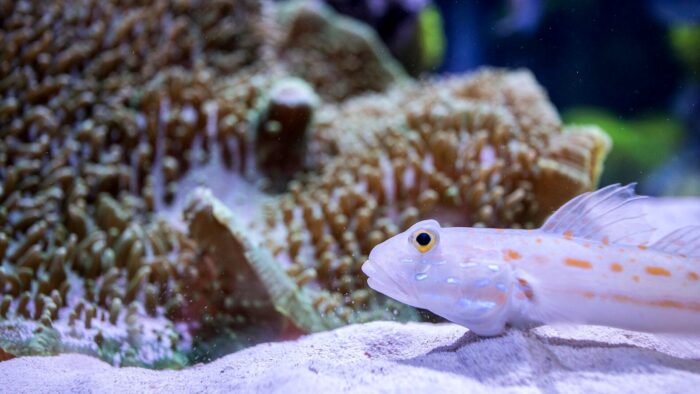
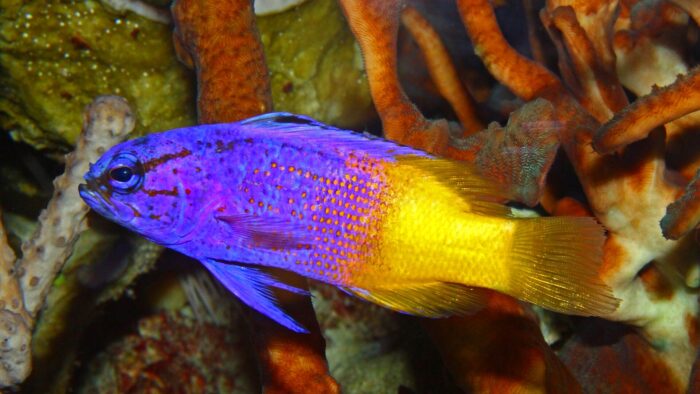
Once a clownfish pair is established, the right additions are fish that ignore the clowns’ territory and add motion elsewhere. Proven picks at this size: a royal gramma holding a rock cave, a watchman goby working the sand (with or without its pistol shrimp partner), a firefish hovering midwater, or a tailspot blenny grazing the rock. Add one fish at a time, quarantined, and always after the clowns have settled, since an established pair treats later arrivals as scenery while a new pair treats everything as a rival. The full shortlist with temperaments is in our beginner saltwater fish guide.
What not to add matters more: no second clownfish species (ocellaris and maroons will not negotiate), no damsels in a tank this size despite their price tag, and nothing that outgrows the volume on a promise to upgrade later. Three or four small fish total, including the pair, is a stocked 100-litre marine tank; the margin that number leaves is what keeps parameters flat between water changes, and flat parameters are what corals eventually require if the tank is headed that way via our beginner corals guide.
Do clownfish pairs need to be bought as a pair?
No. Buy two small juveniles together and the larger becomes female within months. Adding a small juvenile to a single established adult also works. The combination that fails is two adults of similar size, which is a fight, not a courtship.
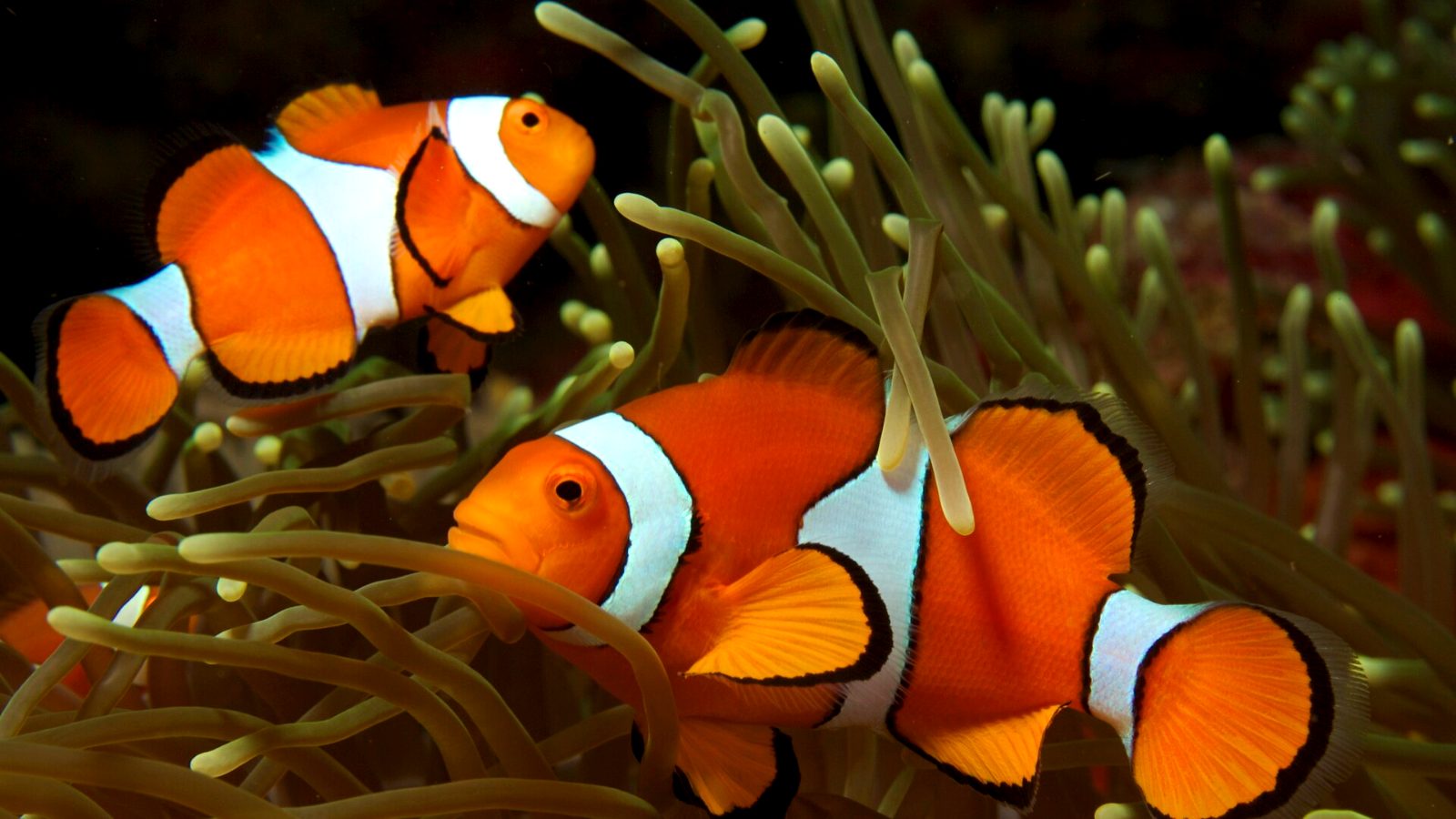
Featured image: Amphiprion ocellaris (Clown anemonefish) by Nick Hobgood. Photo: Nick Hobgood (CC BY-SA 3.0), via Wikimedia Commons.