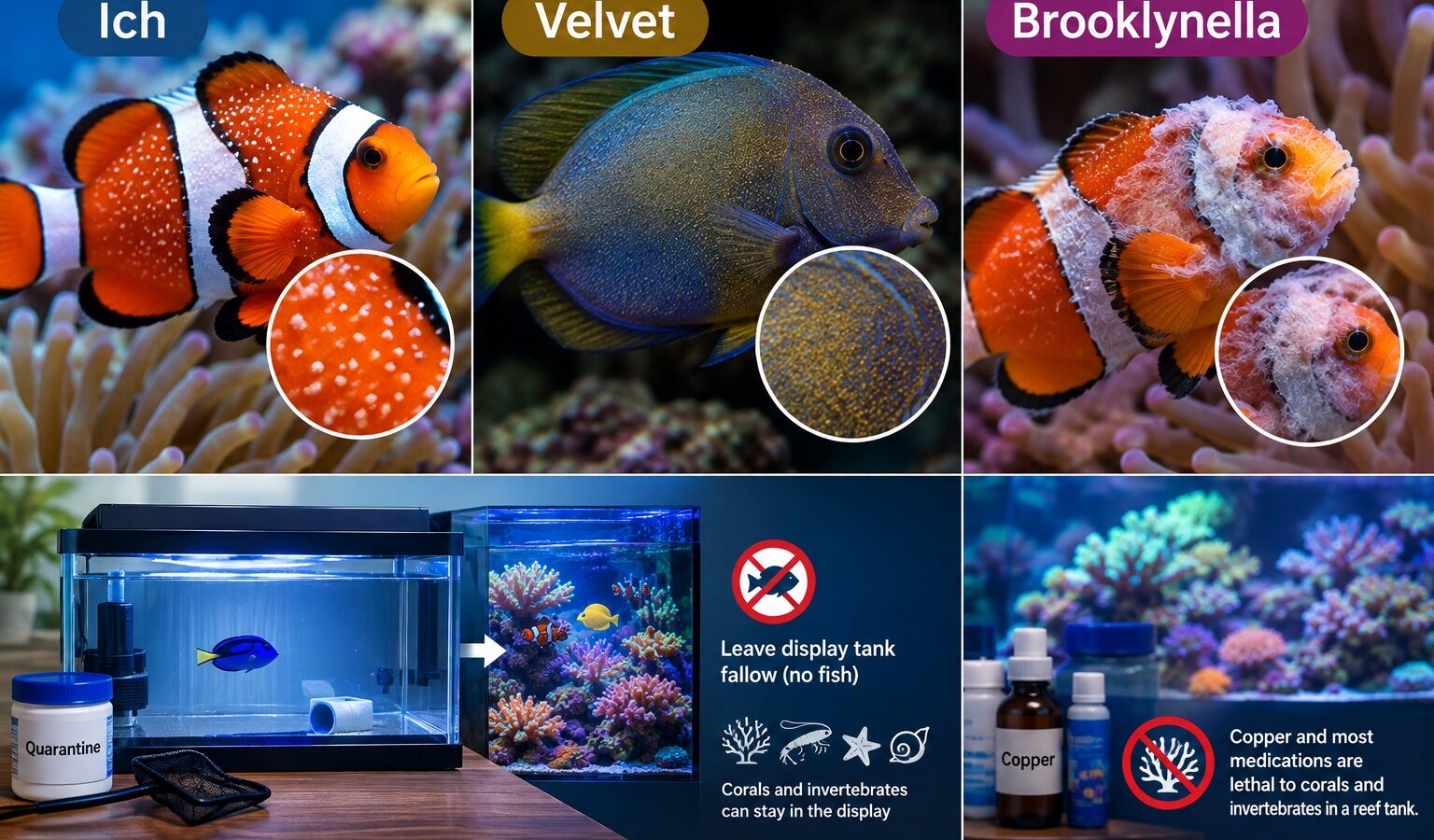
Marine fish disease differs from freshwater disease in one decisive way: the most effective treatments cannot be used in a reef tank. Copper and most therapeutic medications are lethal to corals, shrimp and other invertebrates, which means a display reef is effectively untreatable.
That single constraint shapes everything about marine disease management. Prevention through quarantine is not merely best practice, it is close to the only practice available. This guide covers identifying the three conditions that cause most marine losses and responding to each.
Telling the three apart
Rapid, accurate identification matters more in marine tanks than freshwater ones because the treatment windows are shorter and the wrong response wastes days you may not have.
| Disease | Appearance | Speed | Key distinguishing sign | Common source |
|---|---|---|---|---|
| Marine ich (Cryptocaryon) | Distinct white spots, roughly salt-grain sized | Days to weeks | Spots come and go in cycles as parasites drop off | New fish without quarantine |
| Velvet (Amyloodinium) | Fine gold or dusty sheen, best seen with a torch at an angle | 1 to 3 days, often fatal | Rapid breathing and heavy gill involvement before spots are visible | New fish; extremely contagious |
| Brooklynella | Excess white mucus, sloughing skin, faded patches | 2 to 5 days | Heavy slime coat rather than discrete spots | Wild-caught clownfish especially |
| Uronema | Red or bloody lesions, often on the flank | Days | Open sores rather than spots or dust | Chromis and damsels; stressed fish |
| Flukes | Flashing, cloudy eyes, rapid breathing, no visible spots | Weeks | Scratching without any visible parasite | New fish; very common |
| Bacterial infection | Fin erosion, cloudy patches, ulcers | Variable | Follows injury or poor water quality | Secondary to stress |
The distinction that matters most is between ich and velvet, because they demand different urgency. Ich produces spots you can count individually, like grains of salt scattered on the fish. Velvet produces a fine, even dusting that looks more like a gold or brown sheen and is often easiest to see by shining a torch at an oblique angle in a darkened room.
Velvet also attacks the gills first and heavily, so rapid breathing and gasping frequently appear before any visible coating. A fish breathing hard with no obvious spots should be treated as a possible velvet case rather than assumed healthy.
Brooklynella is the third common confusion. It produces neither spots nor dust but a heavy, sloughing white mucus, often starting around the head, and it is strongly associated with wild-caught clownfish, to the point that it is sometimes called clownfish disease.
Why reef tanks cannot be treated
Copper-based medications are the standard, reliable treatment for marine ich and velvet. Copper is also lethal to corals, shrimp, snails, starfish and most other invertebrates at therapeutic concentrations.
Worse, copper binds to rock and substrate and leaches back out for years afterwards. A reef tank dosed with copper is effectively permanently unsuitable for invertebrates, even after water changes – the IFAS fact sheet on Amyloodinium states plainly that copper treatment at therapeutic levels “will kill all invertebrates present in the system”. This is not a temporary constraint.
Several so-called reef-safe treatments are marketed for these conditions. Evidence for their effectiveness is weak, and relying on them frequently means losing fish while the parasite population continues cycling. They are best regarded as unproven rather than as an alternative to proper treatment.
This leaves two viable approaches when a reef display is infected. The first is to remove all fish to a separate hospital tank for treatment, and leave the display fallow, without any fish, for the parasite’s full life cycle. How long that takes is less fixed than hobby figures suggest. University of Florida IFAS guidance puts the Cryptocaryon life cycle at one to two weeks on average but with a range from six days to eleven weeks, advises a minimum of three to six weeks at 24-27 °C, and notes that seven to eleven weeks may be necessary because tomont development is unpredictable – so plan for the long end of that range, not the average. Velvet divides far faster, in as little as three to five days at 22-25 °C, and published guidance sets three weeks as a minimum. Invertebrates and corals remain in the display throughout, since they are not hosts.
The second is to treat only symptomatically and accept losses, which is what most keepers end up doing and which is why quarantine matters so much.
Setting up and using a quarantine system
A marine quarantine tank is simple and inexpensive relative to what it protects. A bare 10 or 20 gallon tank, a sponge filter kept seeded in the display sump, a heater, a lid and some PVC pipe for shelter is sufficient.
Bare-bottom is deliberate. Sand and rock absorb copper, making dosing unpredictable, and they harbour parasite cysts. A bare tank can be stripped and disinfected between fish.
Four to six weeks is the standard period. Two weeks catches only the fastest-appearing conditions and misses ich cycling. Six weeks with observation, or four weeks with prophylactic treatment, covers most scenarios.
Many marine keepers treat prophylactically rather than waiting for symptoms, since a fish that looks healthy may still carry parasites at low levels. A common protocol is a copper course at therapeutic concentration for the recommended duration, followed by an observation period. Others prefer tank transfer methods, which avoid medication entirely by moving fish between clean tanks on a schedule that outpaces the parasite life cycle.
Whichever approach you use, the general principles in the guide to quarantining new aquarium fish apply, with the addition that marine quarantine should use separate nets, buckets and equipment, since parasites transfer readily in a drop of water.
Responding to an outbreak
If disease appears in a display reef, the sequence matters and speed matters more with velvet than with ich.
- Identify the condition as precisely as possible. Use a torch at an angle in a dark room to distinguish dust from spots.
- Check water parameters immediately. Ammonia, nitrite, temperature and salinity problems both cause symptoms and trigger outbreaks.
- For velvet, act within hours. It can kill an entire tank in days. Move fish to a hospital tank and begin treatment.
- For ich, you have more time but not unlimited time. Decide between the fallow-tank approach and accepting losses, and start promptly either way.
- Increase aeration in the display. Gill damage is the immediate killer in both conditions, and higher dissolved oxygen buys time.
- Do not add new fish, and do not move fish between tanks except into quarantine or hospital.
- Feed well. Fish fighting a parasite lose condition quickly, and a well-fed fish survives longer.
- Keep the display fallow for the full period once fish are removed. Cutting it short is the most common reason outbreaks recur.
Temperature manipulation, which helps with freshwater ich, is not a reliable treatment for marine ich and can accelerate velvet. Do not rely on it.
Freshwater dips can provide temporary relief for flukes and some external parasites and are sometimes used before quarantine. They are a supportive measure, not a cure, and they are stressful, so they should be brief and carefully pH and temperature matched.
Prevention that actually works
Every experienced marine keeper converges on the same short list, because the alternatives do not work reliably.
Quarantine every fish, without exception, for four to six weeks. The single fish added straight to the display because it looked healthy is the origin of most outbreaks. This includes fish from tanks that appear disease-free, since carriers show no symptoms.
Buy captive-bred where possible. Captive-bred clownfish, gobies, dottybacks and cardinalfish carry far lower parasite loads than wild-caught stock and adapt better to aquarium conditions. This is particularly relevant for clownfish given the Brooklynella association.
Keep parameters stable. Nearly every marine parasite outbreak follows a stressor: a temperature swing, a salinity shift, aggression from a tankmate, or a move between tanks. Stable conditions are genuinely protective, as covered in the guide to reef tank water parameters.
Feed well and variedly. Fish in good condition resist infections that overwhelm underfed ones, and many marine fish are chronically underfed on a single dry food.
Avoid overstocking and aggression. A fish being harassed is a fish that will break first, and marine tanks are frequently stocked closer to capacity than freshwater ones. The guide to best saltwater fish for beginners covers building a stocking list that stays peaceful.
Marine disease questions
Can I treat marine ich in my reef tank with a reef-safe product?
The evidence for reef-safe ich treatments is weak, and relying on them commonly means losing fish while the parasite continues cycling. The reliable options are removing fish to a hospital tank for copper treatment while leaving the display fallow, or accepting losses. Neither is convenient, which is why quarantine is emphasised so heavily.
How long does a display tank need to stay fallow?
Longer than most people expect, and less precise than a single number implies. For marine ich, IFAS advises a minimum of three to six weeks at 24-27 °C and notes seven to eleven weeks may be needed, because the cycle can run anywhere from six days to eleven weeks. For velvet, three weeks is the published minimum, though the parasite divides in three to five days, so the risk is front-loaded. Corals and invertebrates stay in the tank throughout, since they are not hosts. Cutting the period short is the most common cause of recurrence.
Why did my fish get ich when nothing new was added?
Either the parasite was already present at low levels and a stressor allowed it to bloom, or something entered on a coral frag, a snail or in bagged water. Parasite cysts travel in water, so any addition to the tank is a potential route even when it is not a fish.
Are freshwater dips a cure?
No. They provide temporary relief from flukes and some external parasites by osmotic shock, which is useful before quarantine, but they do not clear ich or velvet from a fish and do nothing about the parasite population in the tank. Treat them as supportive.
Should I treat a fish that shows no symptoms?
Many marine keepers do treat prophylactically in quarantine, because carriers are common and asymptomatic. It is a reasonable approach given the difficulty of treating a display. The alternative is a longer observation period, which requires patience but avoids medicating healthy fish.
Quarantine is the treatment, because the display cannot be treated
Marine disease management is unusual in that the most important decision is made before any fish is sick. Because copper cannot be used in a reef, the display is effectively untreatable, and everything therefore depends on keeping parasites out in the first place.
Quarantine every fish for four to six weeks in a bare tank, buy captive-bred where available, keep parameters stable, and feed well. Learn to distinguish ich from velvet by their appearance and speed, because velvet gives you days rather than weeks. These habits prevent the great majority of marine losses.
Sources
These are the published references behind the life-cycle, fallow-period and copper figures above.
- Yanong, R. P. E. Cryptocaryon irritans Infections (Marine White Spot Disease) in Fish, FA164. University of Florida IFAS Extension, revised November 2012. Fact sheet (PDF) – life-cycle duration and range, fallow and treatment periods, free-copper concentrations of 0.15-0.20 mg/L, and the hyposalinity protocol at 15 g/L for 21-30 days.
- Reed, P. and Francis-Floyd, R. Amyloodinium Infections of Marine Fish, VM-90. University of Florida College of Veterinary Medicine, Florida Cooperative Extension Service, June 1994. Fact sheet (PDF) – reproductive division in three to five days at 22-25 °C, copper maintained at 0.2 mg/L free Cu2+ for up to three weeks, the statement that this “will kill all invertebrates present in the system”, and a three-week minimum quarantine for incoming fish.