Mollies, platies and swordtails are the fish most people are handed when they ask for something colourful, hardy and easy to keep. All three are livebearers, which means they give birth to free swimming young instead of laying eggs, and that one difference changes how you stock the tank, how fast the bioload grows and how long a quiet community stays quiet.
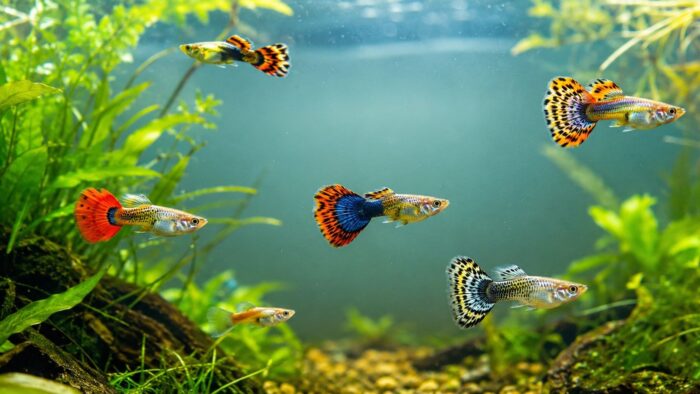
Their care overlaps heavily, so this guide covers the three together and flags the points where a molly needs something a platy does not. If you already keep guppies, much of this will feel familiar, because guppies sit in the same family and want the same mineral rich water.
What makes a livebearer different
Mollies, platies, swordtails, guppies and endlers all belong to the family Poeciliidae. The males carry a modified anal fin called a gonopodium, fertilisation happens internally, and the female carries the developing young for roughly 24 to 30 days before releasing fry that swim and feed straight away.
Two consequences matter more than the biology. The first is that fry arrive ready to compete for food, so a tank can go from stocked to overstocked in a couple of months. The second is that a female stores sperm, so a single mating at the shop can produce three or four more broods after she arrives in your tank. Buying a group of females only is not a guarantee of a fry free tank.
If you have kept guppies before, the breeding pattern will be identical. The difference with mollies and swordtails is adult size, which raises the tank size and filtration requirement.
Molly, platy and swordtail at a glance
The three species share a water profile but not a footprint. Size is where most stocking mistakes start, because a two inch platy and a six inch sailfin molly are sold in the same size bag.
| Species | Adult size | Minimum tank | Temperature | pH and hardness | Temperament notes |
|---|---|---|---|---|---|
| Platy | 2 to 2.5 inches | 15 gallons | 70 to 78 F | pH 7.0 to 8.2, 10 to 20 dGH | The easiest of the three. Peaceful, tolerant of a wide temperature range. |
| Swordtail | 4 to 5 inches including the sword | 20 to 29 gallons | 72 to 79 F | pH 7.0 to 8.2, 12 to 25 dGH | Males spar with each other. Strong jumpers, so a lid is not optional. |
| Common molly | 3 to 4 inches | 20 gallons | 75 to 82 F | pH 7.5 to 8.5, 15 to 30 dGH | Wants the hardest water of the three and the most vegetable matter in its diet. |
| Sailfin molly | 5 to 6 inches | 30 gallons | 75 to 82 F | pH 7.5 to 8.5, 15 to 30 dGH | Males display constantly. Needs tank length rather than height. |
Read the minimum tank column as a floor for a small group, not a target. Livebearers are active swimmers that spend the day patrolling open water, so a longer tank at the same volume will always suit them better than a tall one. Our guide to choosing the right aquarium size covers how footprint changes what you can keep.
The water conditions livebearers actually need
These fish come from hard, mineral rich waters in Central America and the southern United States, and several populations live in brackish coastal creeks. Hardness, not pH, is the parameter that decides whether they thrive, and it is the one most beginners never test.
Aim for a general hardness of 10 to 20 dGH for platies and swordtails and 15 dGH or above for mollies. Carbonate hardness should be high enough to hold pH steady, which in practice means 5 dKH or more. If you are unsure what your tap water offers, a test kit will tell you in five minutes, and our breakdown of aquarium water parameters explains what each reading means.
If your water is naturally soft, the fix is to add minerals rather than to chase a pH number. Crushed coral or aragonite in a filter bag raises both hardness and buffering slowly and safely. Remineralising salts sold for hard water species do the same job with more control. What does not work is a pH buffer on its own, because pH that is propped up without carbonate hardness behind it will swing back down between water changes, and swinging pH stresses fish far more than a steady reading outside the ideal range.
The rest of the checklist is standard. Ammonia and nitrite at zero, nitrate kept under 40 ppm with regular water changes, a heater holding temperature within a degree or two, and a conditioner that handles chloramine if your supply is treated with it. If ammonia or nitrite ever register, deal with the cause using the steps in our guide to lowering ammonia, nitrite and nitrate before you consider medication.
Tank size, stocking and the male to female ratio
Males court more or less constantly. In a tank with one male and one female, that female is pursued all day, stops feeding properly and often dies months before she should. Two or three females per male spreads the attention, which is why livebearers are usually sold in trios.
The alternative is a single sex group. A group of male platies works well in a tank with cover and sightline breaks. A group of male swordtails is harder, because the largest male will claim territory and chase the rest, and it only holds together in a long tank with six or more males so aggression has nowhere to concentrate. Female only groups are the simplest route if you want no fry at all, with the caveat about stored sperm noted earlier.
For tankmates, the constraint is water chemistry as much as temperament. Corydoras, bristlenose plecos, danios and most rasboras cope happily in moderately hard water, and corydoras in particular make a good bottom layer under a livebearer group. Avoid pairing them with soft water specialists such as cardinal tetras, chocolate gouramis or dwarf cichlids, because one group will always be kept outside its range. Fin nippers like tiger barbs will target the trailing fins of sailfin mollies and swordtails. Our guide to aquarium fish compatibility covers how to judge a combination before you buy.
Shrimp are a partial exception. Adult cherry shrimp are usually safe with platies in a planted tank, but mollies and swordtails hunt shrimplets, so a colony will stop growing. When you work out numbers, count the fry you expect rather than the fish you bought, and use the method in our guide to how many fish you can keep.
Feeding livebearers
All three are omnivores with a vegetable bias, and mollies sit furthest towards the herbivore end. In the wild they graze algae and biofilm off surfaces for much of the day, which is why a molly kept on protein heavy flake alone often ends up bloated and listless.
A workable diet is a quality flake or small pellet as the staple, a spirulina based flake two or three times a week, and blanched vegetables such as courgette, cucumber or deshelled peas once a week. Frozen or live foods like daphnia and brine shrimp are useful for conditioning females and add variety, and daphnia in particular helps clear mild constipation. Our guides to fish food types and how often to feed cover portion sizes.
Feed small amounts once or twice a day and stop when food is still being eaten within a minute or two. Leaving a fasting day each week is a sensible habit with livebearers, because the two most common feeding problems, bloating and stringy white waste, both come from too much dry food rather than too little.
Fry need the same food ground finer. Crushed flake, powdered fry food or freshly hatched brine shrimp work, offered three or four times a day in tiny amounts. Fry grow fast on frequent small feeds and slowly on one large one, and uneaten fry food fouls water quickly.
Breeding happens whether you plan it or not
A gravid female develops a dark patch just in front of the anal fin and squares off at the belly as the brood develops. Gestation runs about four weeks, faster in warmer water. Platies typically drop 20 to 40 fry, mollies and swordtails 20 to 60, and older females produce larger broods than first time mothers.
Parents and tankmates eat fry, which is the natural brake on numbers. If you want some to survive without intervention, give them cover. Dense planting at the back, a mat of java moss and a layer of floating plants at the surface will see a reasonable share through the first week, and our list of beginner friendly aquarium plants has suitable options. Breeding traps and small plastic boxes are stressful for the female and cramped for the fry, so a planted corner is usually the better choice unless you are deliberately raising a strain.
If you want to control numbers, the reliable options are a single sex tank, an arrangement with a local shop or club to take grown fry, or simply letting the community tank do what it does. Buying a larger fish specifically to eat fry is a stocking decision with its own requirements, not a shortcut.
One point that catches people out: platies and swordtails are both in the genus Xiphophorus and hybridise readily. Keeping them together means mixed fry that look like neither parent. Keep the two apart if you care about maintaining a strain.
Common livebearer problems and what causes them
The shimmies is the signature livebearer symptom. The fish sways side to side in place without moving forward, fins often clamped. It is not a disease in itself. It is a stress response, and the usual causes are hardness that is too low, temperature that is too low or unstable, or ammonia and nitrite in the water. Test first, correct the water, and the shimmying usually resolves within a few days. Reaching for medication at this stage treats nothing and adds another stressor.
Fungal patches, fin rot and columnaris show up disproportionately in livebearers kept in soft, acidic water, because chronic osmotic stress weakens their defences. Ich follows temperature crashes. Both are covered in our guide to common aquarium diseases, and both are far less likely in a tank where new arrivals spend time in quarantine first.
The other recurring problems are stocking related rather than medical. Harassed females hide behind equipment and stop eating. Overcrowded tanks with three generations in them run high nitrate and produce stunted fish. Fry that vanish entirely are usually being eaten rather than dying. If losses continue in a tank that tests clean, our guide to why fish die in an established tank works through the less obvious causes.
Finally, the aquarium salt question. Mollies tolerate brackish water and some wild populations live in it, but salt is not a requirement in fresh water that is genuinely hard. It also harms most aquarium plants and many common tankmates. Fix hardness with minerals, and treat brackish setups as a deliberate choice for a species tank rather than a default.
Livebearer questions
Do platies and swordtails interbreed?
Yes. They share the genus Xiphophorus and produce fertile hybrids readily, so a mixed tank will give you fry that carry traits from both. It causes no harm to the fish, but it does mean you cannot maintain a distinct strain of either in that tank.
Can I keep only male livebearers?
With platies, yes, and it is a good way to avoid fry. Male only swordtail groups need a long tank and six or more individuals so no single male can dominate. With two or three male swordtails, the smallest will be harassed constantly.
How do I stop my tank filling with fry?
Keep one sex only, and remember a female bought from a mixed shop tank may already be carrying stored sperm for several more broods. In a mixed tank, leave fry cover minimal so the adults thin the numbers naturally, and arrange in advance where grown fry will go.
Do mollies need aquarium salt?
Not if the water is hard and well buffered. Salt is useful in a dedicated brackish setup and as a short term treatment in some situations, but adding it routinely to a planted community tank causes more problems than it solves.
Why do my livebearers keep dying in a properly cycled tank?
Test general hardness. Livebearers kept in soft water can look fine for weeks, then decline steadily with no single visible symptom. Soft water plus a cycled tank and good feeding still produces short lived, disease prone fish.
Get the water right and the rest follows
Livebearers earned their beginner reputation honestly. They eat anything, they tolerate a wide temperature range, they breed without help and they stay colourful under ordinary lighting. The failures almost always come down to one of three things: water that is too soft, a male to female ratio that puts one female under constant pressure, or a tank that quietly doubled its population.
Test your hardness before you buy, pick the species that suits your tank footprint, stock in trios or single sex groups, and decide in advance what happens to the fry. Everything after that is routine maintenance. If you are still choosing, our list of the best beginner freshwater fish puts platies alongside the other realistic first options.