Losing fish without knowing why is one of the most frustrating experiences in the hobby, and the usual response, buying a general-purpose medication, is almost always the wrong move. Most fish deaths have environmental causes that no medication addresses.
This guide is a diagnostic sequence rather than a list of possibilities. Working through it in order will identify the cause in the large majority of cases, and it is deliberately ordered so the most common and most urgent causes come first.
Step 1: Test the water immediately
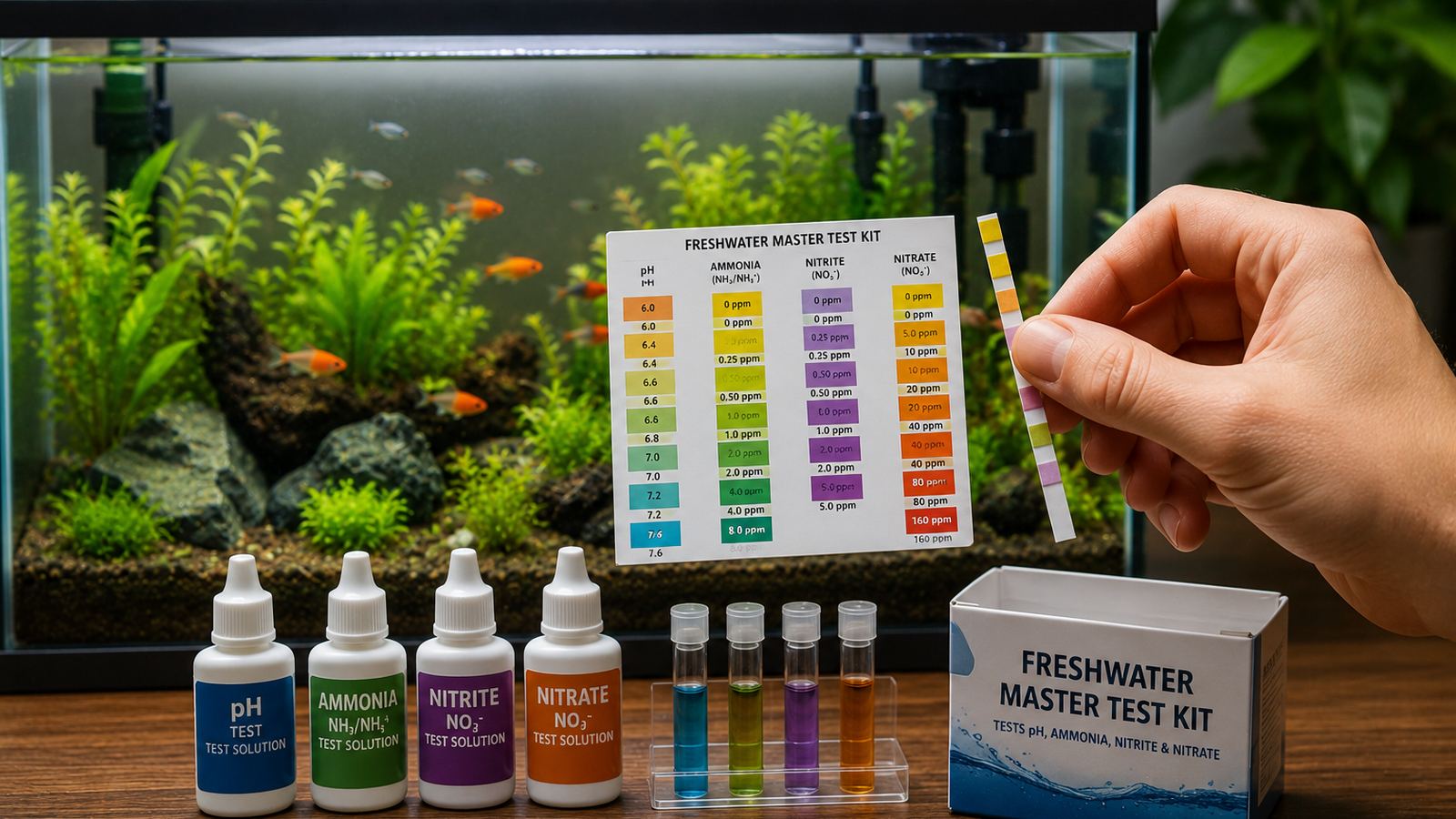
Do this before anything else, and do it with a liquid kit rather than strips. Water quality causes more aquarium deaths than every disease combined, and the test takes ten minutes.
Test ammonia, nitrite, nitrate and pH, and check temperature against a thermometer that is not the heater’s own dial. Record the numbers rather than relying on memory.
Any detectable ammonia or nitrite is your answer until proven otherwise. Both are acutely toxic, both are common in new and disrupted tanks, and both cause exactly the symptoms most people mistake for disease. Respond with immediate water changes as described in the guide to lowering ammonia, nitrite and nitrate.
Very high nitrate, above roughly 80 ppm, is a chronic rather than acute problem but contributes to gradual losses and suppressed immunity. Temperature outside the species range, or swinging by more than a couple of degrees across a day, is a frequent and invisible cause.
If everything tests clean and stable, that is genuinely useful information, because it eliminates the most common category and moves you to step two.
Step 2: Characterise the pattern
How the deaths are distributed narrows the cause more effectively than any single test.
| Pattern | Most likely causes | Where to look next |
|---|---|---|
| All fish, all species, within hours | Toxin, temperature failure, chlorine, severe ammonia | Recent water change, aerosols, heater, source water |
| Several species over days | Water quality, contagious disease, oxygen depletion | Test results, gill movement, recent additions |
| One species only, others fine | Species-specific requirement, targeted aggression, species-specific parasite | Parameters versus that species’ needs; watch for bullying |
| One fish at a time over weeks | Chronic stress, internal parasite, slow water quality decline | Stocking level, nitrate trend, feeding competition |
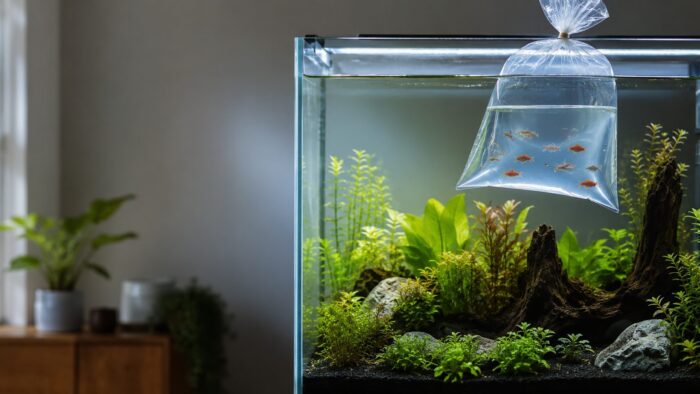
| Only new arrivals die | Acclimation, quarantine failure, shop stock quality | Acclimation method, source, transport time |
| Only the largest or smallest die | Aggression hierarchy, feeding competition | Observe feeding; check for chasing |
| Deaths after every water change | Source water, dechlorinator, temperature mismatch | Test tap water directly; check conditioner dosing |
| Deaths after filter maintenance | Bacterial colony destroyed by tap water rinse | Test ammonia and nitrite immediately |
Two rows in that table are worth reading carefully because they are so frequently missed. Deaths following every water change almost always point to the source water or the conditioner, not to the tank. And deaths following filter maintenance almost always mean the biological colony was rinsed away in chlorinated tap water, which produces an ammonia spike in a tank that had been stable for years. That is not a small thing: IFAS guidance notes any detectable ammonia signals a problem, that the un-ionised form is about a hundred times more toxic than ammonium, that high pH and temperature push the balance towards it, and that toxicity starts at 0.05 mg/L.
Step 3: Ask what changed
Aquariums are stable systems, and stable systems rarely fail without an input. Something almost always changed in the week or two before losses began, and identifying it usually explains everything.
- A new fish, plant, snail or piece of decor added without quarantine.
- A water change done with untreated water, or with a different conditioner or dosage.
- Filter media rinsed under a tap, replaced entirely, or the filter left off after maintenance.
- A new food, or a change in feeding amount or frequency.
- A medication or additive dosed into the tank.
- Heating or air conditioning turned on in the room, or a window left open.
- Painting, cleaning products, insect spray, air freshener or cooking fumes near the tank.
- A change in the water supply, including seasonal changes in municipal treatment.
- A tank move, rearrangement or substrate disturbance.
- A power cut, even a brief one, that stopped the filter or heater.
Aerosols deserve particular attention because they are so easily overlooked. Aquarium water exchanges gases with room air continuously, and insecticides, air fresheners and cleaning sprays used in the same room can enter the tank in quantities sufficient to kill. Deaths with no other explanation, particularly across all species at once, frequently trace to this.
Step 4: Check the equipment
Equipment faults are common and frequently invisible until you look deliberately.
Check the heater against an independent thermometer. Heaters fail in two ways: stuck off, which chills the tank, and stuck on, which cooks it. Both are common, and the built-in dial gives no warning. A heater that reads correctly but cycles the tank by several degrees across a day is also a genuine problem.
Check the filter is actually running at full flow. A partly blocked intake, a fouled impeller or an air-locked canister all reduce flow substantially without stopping it, which reduces both filtration and oxygenation. The guide to filter media covers maintenance without disrupting the colony.
Check for surface agitation. Oxygen enters at the surface, and a tank with a still surface and a heavy bioload can deplete overnight, particularly in a warm room or a heavily planted tank where plants consume oxygen after dark. Fish gasping at the surface in the early morning specifically is close to diagnostic for this. Low oxygen also compounds any nitrite present: extension guidance on nitrite poisoning reports that fish surviving moderate exposure at seven parts per million dissolved oxygen may die at two, because nitrite has already converted part of their haemoglobin to methaemoglobin and they cannot carry the oxygen that remains.
Check for anything decomposing out of sight. A dead fish behind hardscape, under a filter intake or buried in substrate produces a sustained ammonia source that is invisible until you count heads carefully.
Check that nothing metallic or contaminated has entered the tank. Rusting equipment, a coin dropped in, or an ornament not intended for aquarium use can all leach toxins slowly.
Step 5: Examine the stocking and the fish
If water and equipment check out, the cause is usually in the stocking plan or in the fish themselves.
Count the fish and compare against tank capacity honestly, using the method in the guide to aquarium stocking. Overstocked tanks produce chronic low-level stress and oxygen competition that kills gradually rather than suddenly.
Watch feeding time closely. A fish that never reaches food will decline over weeks in a tank where everything looks fine. This is particularly common with bottom dwellers, as covered in the guide to feeding bottom dwellers and algae eaters.
Watch for aggression over a full evening rather than glancing at the tank. Much harassment happens when the room is quiet, and the aggressor often behaves differently when someone is standing in front of the glass.
Check compatibility against the framework in the guide to aquarium fish compatibility. A species-specific pattern of losses frequently means one species is in the wrong water, the wrong temperature, or a group too small to be secure.
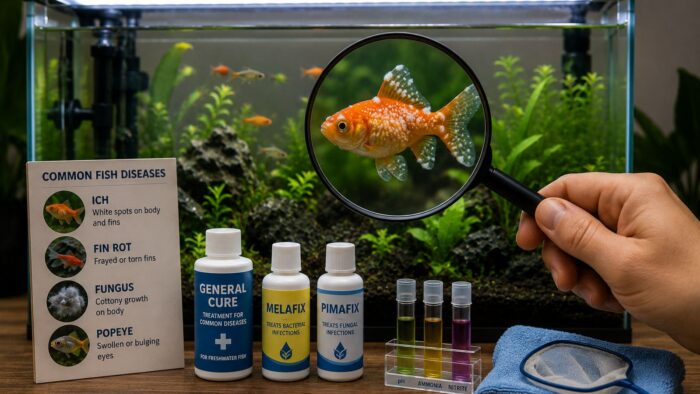
Finally, examine the fish themselves under bright light for visible signs, and consult the guide to common aquarium diseases. Note that disease is genuinely last on this list, because it is a less common cause than everything above it and because most disease is secondary to something above it anyway.
Questions about unexplained fish deaths
All my fish died overnight. What could do that?
Sudden total loss points to an acute event: a heater stuck on or off, chlorine from an untreated water change, an aerosol or cleaning product in the room, a power cut that stopped the filter, or a large ammonia release from something decomposing. Test the water immediately and check the heater before anything else.
My water tests perfect but fish keep dying. What am I missing?
Check the test kit itself first, since expired reagents give confidently wrong results, and shake the nitrate reagent thoroughly. Then check temperature stability across a full day rather than at one moment, verify dissolved oxygen by observing early-morning behaviour, and look for aggression outside viewing hours.
Is it normal to lose some fish when starting out?
It is common, but it is not inevitable and it is not something to accept. Early losses almost always trace to an uncycled tank or to adding fish too quickly. A properly cycled tank stocked gradually should not lose fish routinely.
Should I do a big water change if fish are dying?
Usually yes, provided the replacement water is dechlorinated and temperature-matched. A large change dilutes almost every acute problem, including toxins, ammonia and nitrite. The exception is when a fish has been in very poor water for a long period, where a series of moderate changes is gentler than one dramatic one.
Can I take a water sample to a shop instead of testing at home?
It is better than not testing, but it delays diagnosis and you have no control over their kit’s condition or method. A liquid master test kit costs less than a few fish and lets you test immediately, which matters when ammonia is involved.
Work the sequence rather than guessing
The order matters more than any individual step. Test water, characterise the pattern, identify what changed, check the equipment, then examine stocking and the fish. Working through those five in sequence identifies the cause in most cases within an hour.
Resist the impulse to medicate first. Most fish deaths are environmental, medication does not address environmental causes, and many medications make an already stressed tank worse by damaging the biological filter. Find the cause, then decide whether treatment is part of the answer.
Sources
- Francis-Floyd, R., Watson, C., Petty, D. and Pouder, D. B. Ammonia in Aquatic Systems, FA16. UF/IFAS Extension. PDF – un-ionised ammonia, the pH and temperature effect, toxicity from 0.05 mg/L.
- Chappell, J. A. Nitrite Poisoning or “Brown Blood” Disease, FSA9000. Auburn University Extension. PDF – the methaemoglobin mechanism and its interaction with dissolved oxygen.