The most useful thing to understand about aquarium fish disease is that most of it is not primarily about pathogens. Ich, fin rot, fungus and the rest are usually present or nearby all the time, and healthy fish in stable water resist them. Outbreaks happen when something else has already gone wrong.
This guide is the hub for fish health on the site. It covers how to read the early signs, how to work out whether you are looking at a water problem or a disease, when treatment is appropriate, and the handful of habits that prevent most problems entirely.
Why healthy tanks stay healthy
An aquarium is a closed system in which fish live continuously in their own diluted waste. What keeps them healthy is not sterility but stability: consistent water chemistry, appropriate temperature, adequate space, correct diet and low stress.
Fish have an immune system, a mucus coat and a stress response much like any vertebrate, and all three are affected by their environment. Chronic exposure to low-level ammonia, frequent temperature swings, persistent harassment by a tankmate, or a diet that does not suit the species all suppress immune function. A fish in that state gets sick from organisms that a healthy fish in the same tank ignores.
This is why the same advice appears throughout the site regardless of the specific problem. Stable parameters, regular water changes, correct stocking and appropriate diet are not general wellness advice, they are the actual mechanism by which disease is prevented.
It is also why medicating without addressing the cause so often fails. Treating an ich outbreak while a heater is cycling wildly clears the parasite temporarily and the outbreak recurs, because the underlying stressor is still present.
Reading the early warning signs
Fish are prey animals and conceal weakness. By the time a fish looks obviously ill, the problem is usually well advanced. The earliest signals are behavioural, and they appear days before anything visible.
| Sign | Most likely causes | First thing to check |
|---|---|---|
| Refusing food | Water quality, internal parasite, stress, early infection | Ammonia, nitrite and temperature |
| Clamped fins held tight to body | Water quality, parasite, chill | Test water; check heater against a separate thermometer |
| Hiding when previously visible | Harassment, water quality, illness | Watch for chasing; test water |
| Gasping at the surface | Low oxygen, gill damage, ammonia or nitrite | Test immediately; increase aeration |
| Flashing or scraping on decor | External parasite, irritant, high nitrate | Look closely for spots or dust under a torch |
| Rapid gill movement | Gill parasites, ammonia, low oxygen, high temperature | Test water; check temperature |
| Sitting on the substrate | Advanced stress, swim bladder issue, chill | Test water; observe for other signs |
| Faded or dull colour | Stress from any source | Review water, tankmates and lighting |
| Stringy white waste | Internal parasite or bacterial gut infection | Observe feeding; consider isolation |
| Weight loss despite eating | Internal parasite, competition at feeding time | Watch whether the fish actually reaches food |
The pattern worth noticing is how many entries begin with checking the water. That is not laziness in the table, it reflects genuine probability: water quality problems present as almost every symptom on that list and are far more common than the specific diseases they mimic.
Working out what you are dealing with
A structured approach saves both fish and money, because the wrong treatment costs days and often makes things worse.
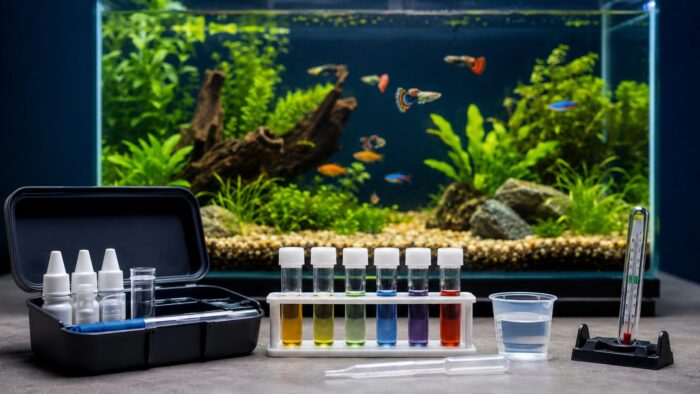
Start with the tank rather than the fish. Test ammonia, nitrite, nitrate and temperature. If any is out of range, that is your working diagnosis until proven otherwise, and correcting it is the treatment. The guide to lowering ammonia, nitrite and nitrate covers the response.
Then ask how many fish are affected. One fish with symptoms in an otherwise normal tank suggests an individual problem: injury, age, bullying or an internal issue. Multiple fish across species suggests an environmental cause or a contagious condition.
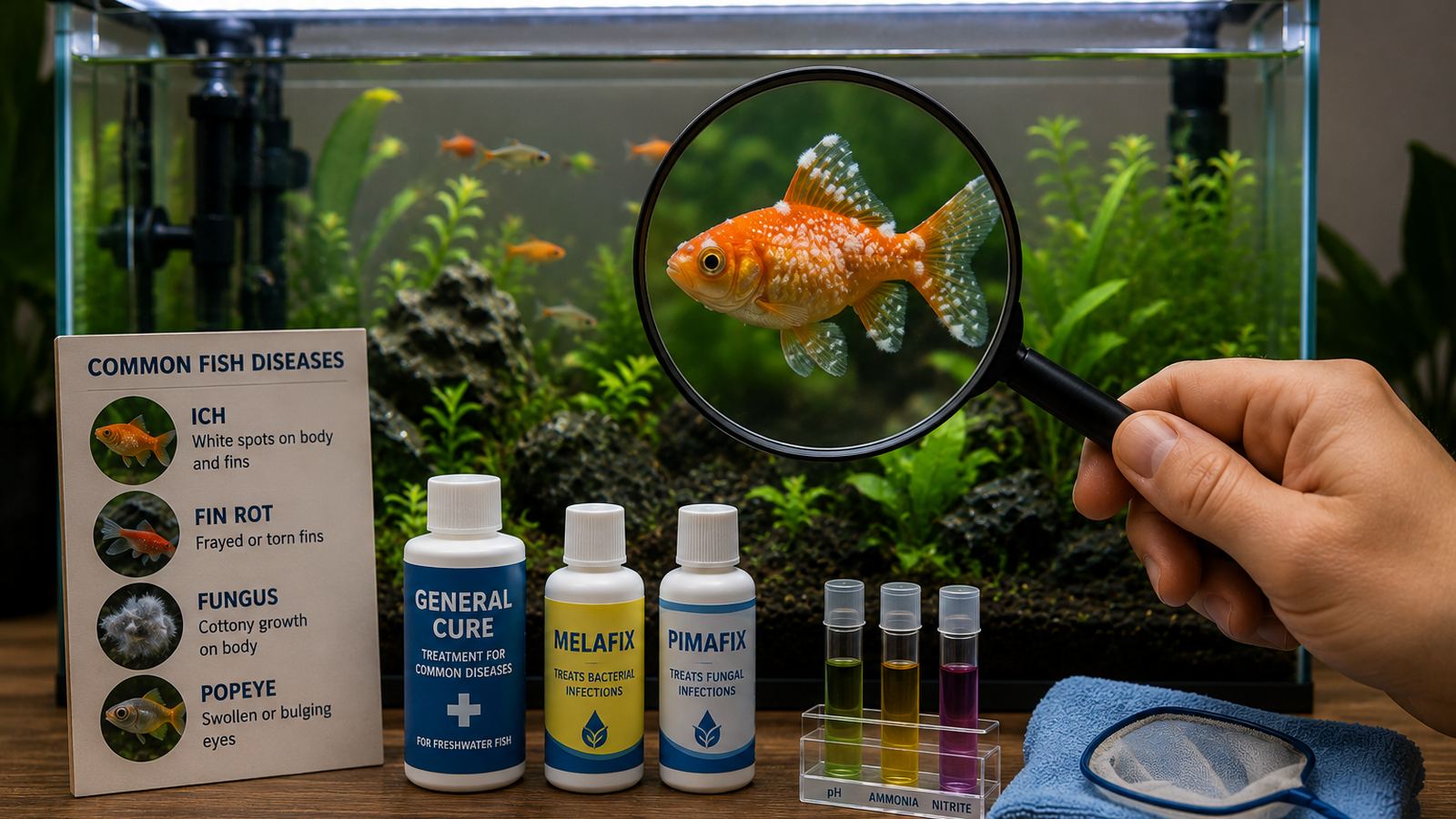
Then look for visible signs under good light. Distinct white spots, fine gold dust, cotton-like tufts, ragged fin edges, swelling and protruding eyes each point in different directions, and the guide to common aquarium diseases covers identification in detail.
Finally, ask what changed. Nearly every outbreak follows something: a new fish added without quarantine, a filter cleaned too thoroughly, a water change missed, a heater failing, a new food. The trigger usually explains more than the symptom does.
For a full step-by-step version of this process, the guide to why are my fish dying walks through the diagnostic sequence in order.
When to treat and when not to
Medication has a real place, but it is used far more often than it should be, and the collateral damage is underappreciated.
Most aquarium medications affect the biological filter. Antibacterials in particular can kill nitrifying bacteria, producing an ammonia spike in the middle of a disease outbreak. Many are also toxic to invertebrates, and copper permanently contaminates rock and substrate – the IFAS fact sheet on Amyloodinium puts therapeutic copper at 0.2 mg/L free Cu2+ and states it “will kill all invertebrates present in the system”. An ammonia spike mid-outbreak is its own emergency: un-ionised ammonia is toxic from 0.05 mg/L and lethal at 2.0 mg/L.
The reasonable position is to treat when you have a specific identification and the condition will not resolve by correcting husbandry. Ich, velvet, confirmed bacterial infections that are progressing, and internal parasites all warrant treatment. The published protocols are specific: freshwater ich is only vulnerable in its free-swimming stage and needs repeated treatments timed to water temperature, marine white spot needs three to six weeks at 24-27 °C, and velvet divides in as little as three to five days. Ragged fins in a tank with elevated nitrate usually do not, because correcting the water resolves it.
Where treatment is needed, treat in a hospital tank rather than the display wherever possible. This protects invertebrates, avoids dosing healthy fish, keeps the display’s biological filter intact, and lets you use a much smaller volume of medication accurately.
Two cautions apply generally. Complete the full course even after symptoms disappear, because many parasites have life stages that are not vulnerable to treatment and reappear if the course is cut short. And never combine medications unless a manufacturer explicitly supports it, since interactions are common and frequently lethal.
The prevention that actually matters
Four habits prevent the overwhelming majority of aquarium disease, and they are all unglamorous.
Quarantine every new fish for four weeks in a separate tank. This is the single highest-value habit in fishkeeping, and it is skipped more often than any other. The guide to quarantining new aquarium fish covers the setup, which is inexpensive.
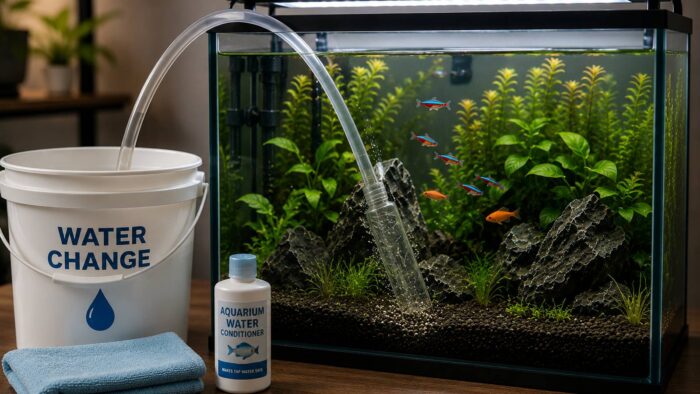
Keep water stable with regular partial water changes rather than occasional large interventions. The guide to doing a proper water change covers technique, and aquarium water parameters covers targets.
Stock appropriately. Overstocked tanks have higher waste loads, more competition and more aggression, all of which suppress immune function. The guide to aquarium stocking covers judging capacity, and fish compatibility covers avoiding combinations that cause chronic stress.
Feed a varied, appropriate diet in correct portions. Underfed fish lose condition and overfed tanks accumulate waste, and both routes end in disease. The guide to what to feed your fish covers matching diet to species.
Beyond those four, one piece of equipment discipline matters: verify the heater against a separate thermometer regularly. Heater failure, particularly a heater stuck on or drifting cold, is a common trigger for outbreaks and is invisible without an independent check.
Fish health questions
Should I add aquarium salt as a general tonic?
Not routinely. Salt has legitimate uses, including supporting fish with nitrite poisoning and treating some external parasites, but it is not a general health additive and it is harmful to many soft-water species, scaleless fish and live plants. Use it for a specific reason at a specific dose.
Can I treat the whole tank as a precaution?
Generally no. Prophylactic medication of a display exposes healthy fish and invertebrates, risks the biological filter, and encourages resistance. The exception is marine quarantine, where prophylactic treatment is common because reef displays cannot be treated at all.
How do I know if a fish is suffering enough to euthanise?
Persistent inability to swim normally, complete refusal to feed over an extended period, severe body deformity from advanced disease, and open ulceration that is progressing despite treatment are all reasonable grounds. Clove oil is the standard humane method. It is a difficult judgement, and it is reasonable to seek advice from an experienced keeper or an aquatic vet.
Do UV sterilisers prevent disease?
They reduce free-swimming parasites and bacteria in the water column, which helps during an outbreak, but they do nothing about parasites attached to fish or encysted in the substrate. They are a useful supplement in some systems and not a substitute for quarantine.
My fish died suddenly with no symptoms. What happened?
Sudden death without warning most often indicates an acute water quality event, a temperature failure, a toxin entering the tank, or an internal problem that was never visible. Test the water immediately, check the heater, and consider anything recently added, including aerosols and cleaning products used near the tank.
Fix the environment before reaching for medication
Fish health is mostly water management. Stable parameters, correct stocking, appropriate diet and quarantine of new arrivals prevent most of what the medication shelf is designed to treat, and correcting husbandry resolves a large share of what still appears.
When something does go wrong, test first, identify before treating, treat in a hospital tank where possible, and always ask what changed in the days before. The specific disease guides linked above cover identification and treatment for each condition in detail.
Sources
- Francis-Floyd, R. et al. Ammonia in Aquatic Systems, FA16. UF/IFAS Extension. PDF
- Francis-Floyd, R. and Reed, P. Ichthyophthirius multifiliis (White Spot) Infections in Fish, CIR920. UF/IFAS Extension. PDF
- Yanong, R. P. E. Cryptocaryon irritans Infections in Fish, FA164. UF/IFAS Extension. PDF
- Reed, P. and Francis-Floyd, R. Amyloodinium Infections of Marine Fish, VM-90. UF College of Veterinary Medicine. PDF