Water conditioner is the additive almost every fishkeeper buys and one of the least understood. Most people know it removes chlorine. Fewer know why chloramine changes the calculation, why some conditioners register as ammonia on a test kit, or why the shelf of specialised additives beside it mostly solves problems a well-maintained tank does not have.
This guide covers what these products actually do, which ones matter, and how to use them correctly.
What is actually in tap water
Municipal water is treated to be safe for people, which is a different standard from being safe for fish. Three components matter.
Chlorine is added as a disinfectant. It damages gill tissue directly and kills the nitrifying bacteria in your filter at concentrations well below those used in drinking water. It is volatile and dissipates from standing water over roughly 24 hours.
Chloramine is chlorine bonded to ammonia, used increasingly by water suppliers because it is more stable and persists further through the distribution network. That stability is precisely the problem: chloramine does not evaporate from standing water and can persist for days. Many suppliers switched to chloramine without publicising it, which is why the old advice about letting water stand overnight is now frequently wrong.
Heavy metals, particularly copper from household plumbing, leach into water sitting in pipes. Copper is toxic to invertebrates at very low concentrations and to fish at higher ones. Running the tap for a minute before collecting water reduces this considerably.
Water suppliers publish treatment information, and a quick check of whether your supplier uses chlorine or chloramine is worth doing once. Either way, a conditioner rated for chloramine handles both, so buying one is the simple answer.
What conditioners actually do
Products vary more than the shelf suggests, and the differences matter in specific situations.
| Type | What it neutralises | Best for | Limitation |
|---|---|---|---|
| Basic dechlorinator (sodium thiosulphate) | Chlorine only | Areas using chlorine, not chloramine | Leaves ammonia behind if the supply uses chloramine |
| Chloramine-rated conditioner | Chlorine and the ammonia released from chloramine | Almost all keepers; the default choice | Bound ammonia may still register on test kits |
| Conditioner with metal binder | Chlorine, chloramine, copper and heavy metals | Old plumbing, well water, shrimp tanks | Marginally more expensive |
| Conditioner with slime coat additive | Chlorine, chloramine, plus a protective colloid | Fish transport, handling, minor injury | The slime coat claim is weakly evidenced |
| Ammonia detoxifier | Ammonia specifically, temporarily | Emergencies and fish-in cycling | Temporary only; does not remove ammonia from the system |
A chloramine-rated conditioner is the correct default for virtually everyone. It costs marginally more than a basic dechlorinator and covers both scenarios, which removes the need to know what your supplier does.
One point causes recurring confusion. When a conditioner breaks the chloramine bond, ammonia is released, and the conditioner converts it to a non-toxic bound form. That bound ammonia is harmless to fish but still registers on most liquid test kits, which read total ammonia. A test taken shortly after a water change in a chloramine area can therefore show ammonia in a perfectly healthy tank. Test before the change rather than after, and do not panic at a post-change reading.
Using conditioner correctly
The technique is simple but a few habits make a real difference.
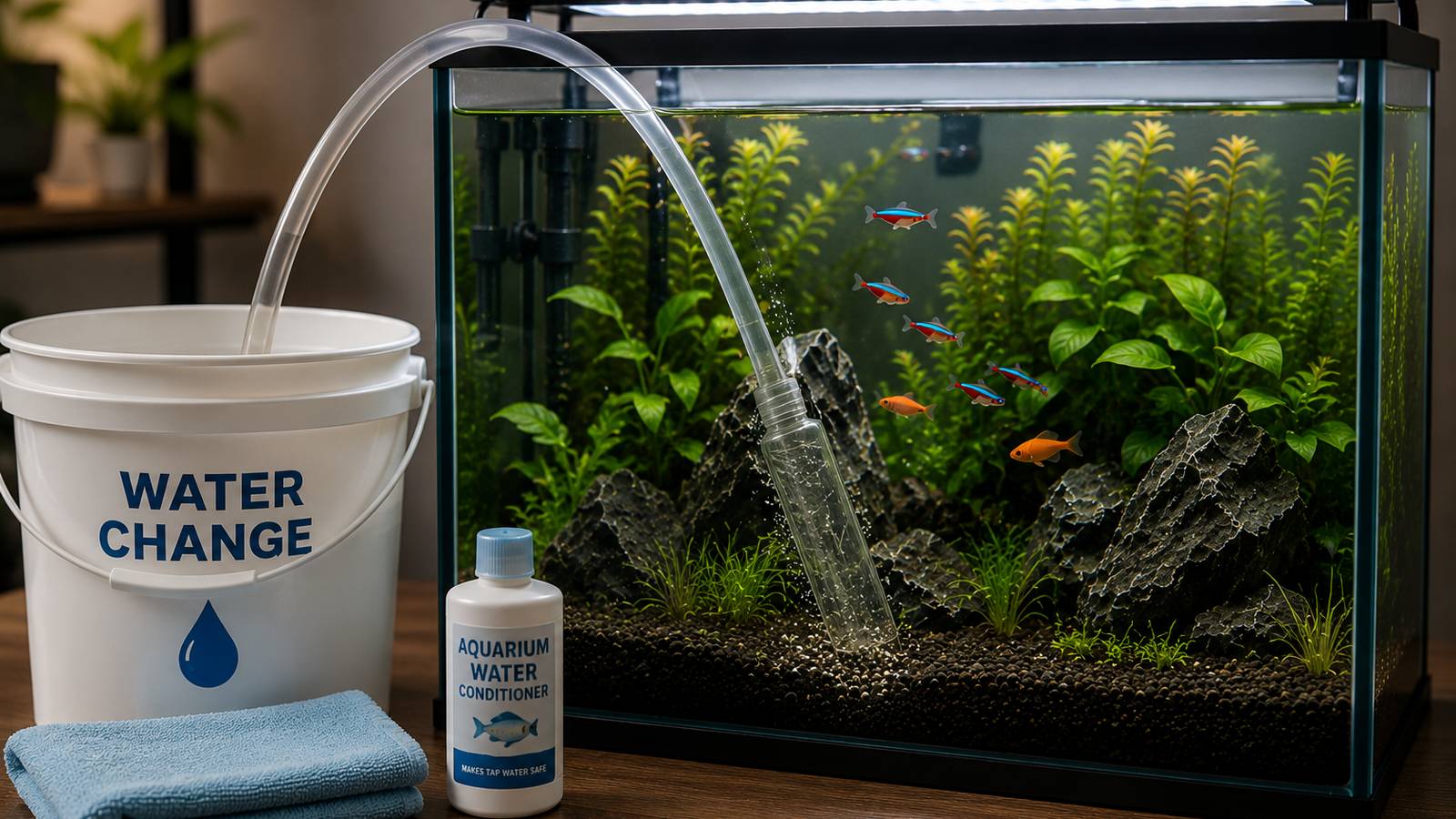
Treat the replacement water before it goes into the tank, in a bucket or container. Dosing the tank directly and then adding untreated water exposes fish and filter bacteria to chlorine for the period before it mixes, which in a large water change is long enough to matter.
Dose for the volume of new water, not the whole tank, unless the label specifies otherwise. Some products recommend dosing for total volume in specific circumstances such as chloramine emergencies; the label is authoritative.
Overdosing moderately is generally safe with mainstream conditioners, and a slight excess is a reasonable precaution when you are unsure of the exact volume. Substantial overdosing is not harmless, however, since thiosulphate consumes oxygen, and several times the recommended dose in a heavily stocked tank can cause oxygen stress.
Conditioner works essentially instantly, so there is no need to let treated water stand. Adding it as you fill the bucket and stirring briefly is sufficient.
Keep the bottle sealed and out of direct sunlight, and replace it every couple of years. Conditioners do degrade, and an old bottle that no longer works produces exactly the kind of unexplained losses covered in the guide to why are my fish dying.
The additives you probably do not need
The shelf beside the conditioner is largely aimed at problems that better husbandry prevents, and several products cause more trouble than they solve.
pH adjusters are the clearest example. Products that raise or lower pH work briefly and then the water’s natural buffering pulls it back, producing exactly the swings that harm fish. Stability matters far more than hitting a target number, and most community fish adapt to a wide pH range. If your water is genuinely extreme, blending with RO water or choosing suitable species is far more stable than dosing. The guide to aquarium water parameters covers this in detail.
General tonics and stress coat products have limited evidence behind them. There is a reasonable case for using a slime-coat conditioner during transport or after handling, but routine dosing addresses nothing.
Bottled bacteria has a genuine but narrow use: seeding a new filter or recovering after a colony crash. Quality varies enormously between brands and it does not make cycling instant. It is not something an established tank needs.
Algae control chemicals treat the symptom while the cause continues. Excess light and nutrients cause algae, and the guide to why your aquarium has algae covers addressing that directly.
Clarifiers make cloudy water clear by clumping particles for the filter to catch. Cloudy water in a new tank is a harmless bacterial bloom that resolves by itself, so this is usually cosmetic intervention in a process that needed none.
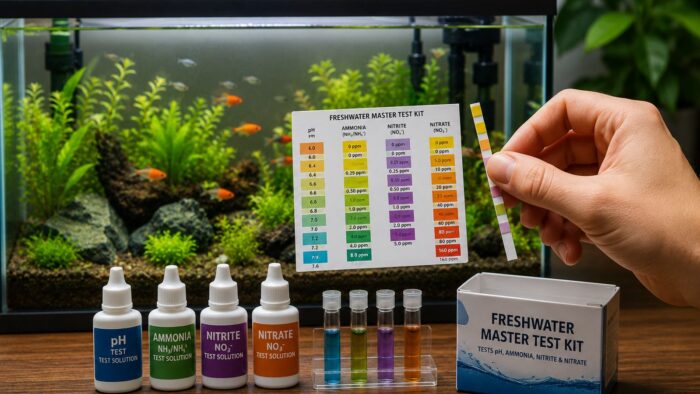
What is genuinely worth having beyond conditioner: a liquid test kit, and in specific situations an ammonia detoxifier kept for emergencies. That is close to the whole list for a freshwater community tank.
Water conditioner questions
Can I just let tap water sit overnight instead of using conditioner?
Only if your supply uses chlorine rather than chloramine, and many now use chloramine, which does not dissipate. Standing water also does nothing about heavy metals. Conditioner is inexpensive and removes the guesswork.
Why does my tank show ammonia right after a water change?
In chloramine areas, the conditioner breaks chloramine into chlorine and ammonia, neutralises both, but leaves the ammonia in a bound form that most test kits still detect. It is not harmful. Test before water changes rather than after to get a meaningful reading.
Do I need conditioner if I use RO water?
No. Reverse osmosis removes chlorine, chloramine and metals, so no conditioner is needed. RO water does need remineralising for freshwater tanks, since it also removes the minerals fish and plants require.
Is well water safe without conditioner?
It has no chlorine, but it frequently carries other problems: high iron, high hardness, nitrate from agricultural runoff, or low oxygen. Test well water thoroughly before using it, and consider a conditioner with a metal binder.
Can I use too much water conditioner?
Moderate overdosing is generally safe, and slight excess is a reasonable precaution. Large overdoses are not harmless, since the active ingredient consumes oxygen, which matters in warm, heavily stocked tanks. Follow the label and err only slightly on the generous side.
A chloramine-rated conditioner covers almost everything
Buy one chloramine-rated water conditioner, treat replacement water in the bucket before it enters the tank, dose for the new water volume, and replace the bottle every couple of years. That covers the entire requirement for the great majority of freshwater and marine tanks.
Most of the rest of the additive shelf addresses problems that regular water changes, appropriate stocking and correct feeding prevent. Spend on a good test kit instead, since knowing what your water is doing is worth more than any product designed to change it.