Aquascaping sits at the point where aquarium keeping becomes design. The biology still has to work, but the arrangement of hardscape, plants and open space determines whether a tank looks like a considered composition or a collection of things placed in water.
This guide is the hub for planted tank design on the site. It covers the styles worth knowing, the design principles that make layouts work, and the practical decisions about substrate, light, carbon and plant selection that determine whether the scape survives its first six months.
The three styles worth knowing
Almost every aquascape descends from one of three traditions, and knowing which you are attempting makes every subsequent decision easier.
| Style | Character | Hardscape | Plant approach | Difficulty |
|---|---|---|---|---|
| Nature aquarium | Naturalistic landscapes suggesting terrestrial scenery | Wood and stone as the structural core | Layered planting; often carpets and mosses | Moderate to high |
| Iwagumi | Minimalist stone-only compositions | Odd numbers of stones, one dominant | Usually a single carpeting species | High; unforgiving of error |
| Dutch | Terraced beds of contrasting stem plants | Little or no visible hardscape | Dense stem plant groups, heavily pruned | High; demands constant maintenance |
| Jungle | Dense, overgrown, low-maintenance abundance | Optional wood | Large, fast-growing species left to fill | Low; forgiving |
| Biotope | Faithful recreation of a specific habitat | Materials from the target habitat | Only species from that region | Moderate; requires research |
| Walstad or low-tech | Soil-substrate, heavily planted, minimal equipment | Optional | Fast growers, no CO2, minimal fertiliser | Low to moderate |
For a first attempt, jungle and low-tech styles are far more forgiving than iwagumi or Dutch. Both hide mistakes, tolerate irregular maintenance, and produce good results with undemanding plants. Iwagumi in particular is deceptively difficult: with only stones and a carpet, every error in proportion is visible, and carpeting plants are among the most demanding species in the hobby.
The detailed treatment of composition, including the rule of thirds, golden ratio and depth techniques, is in the guide to aquascaping layout principles.
Hardscape: the structure everything else hangs on
The single most useful principle in aquascaping is that hardscape decides the layout and plants decorate it. A scape with weak structure does not become strong when plants grow in; it becomes an overgrown scape with weak structure.
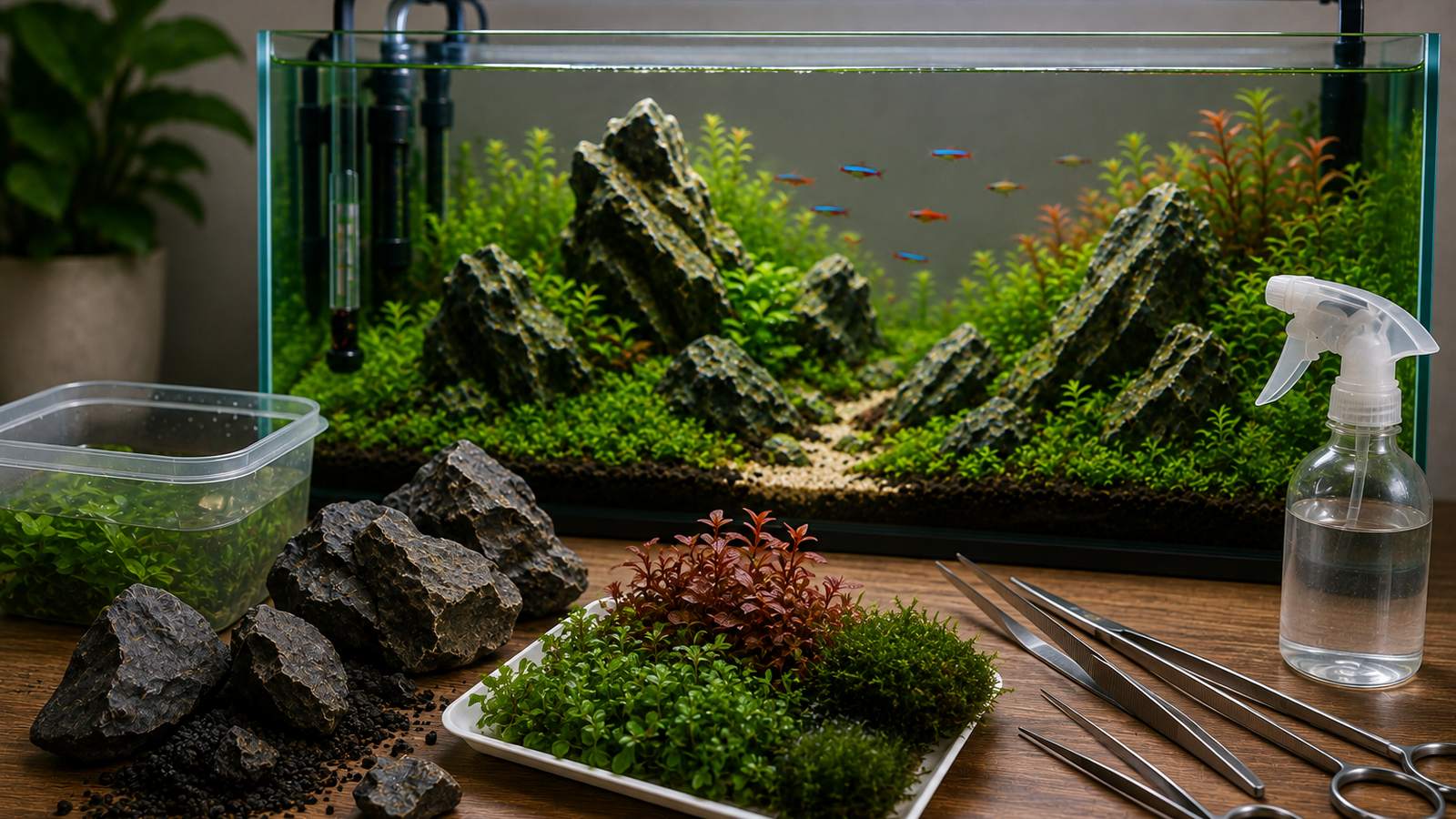
Build the hardscape dry, in the empty tank, before any substrate or water. Expect to rebuild it several times. Professional aquascapers routinely spend hours on an arrangement that takes minutes to plant, and photographing each attempt on a phone makes comparison far easier than memory does.
Work with odd numbers, particularly three, five or seven main pieces, and give one piece clear dominance. Symmetry reads as artificial, and equal-sized pieces compete for attention.
Place large stones directly on the base glass, ideally on a thin foam pad, before substrate goes in. Rock resting on gravel settles and shifts, and a heavy stone that slumps against the glass can crack a panel. Selection, safety testing and preparation of materials is covered in the guide to aquarium hardscape.
Leave a service gap of at least an inch between hardscape and glass on all sides. Without it you cannot reach algae, siphons will not fit, and detritus collects where nothing can remove it.
Substrate, light and carbon
These three decisions determine which plants will succeed, and they need to be made together rather than separately.
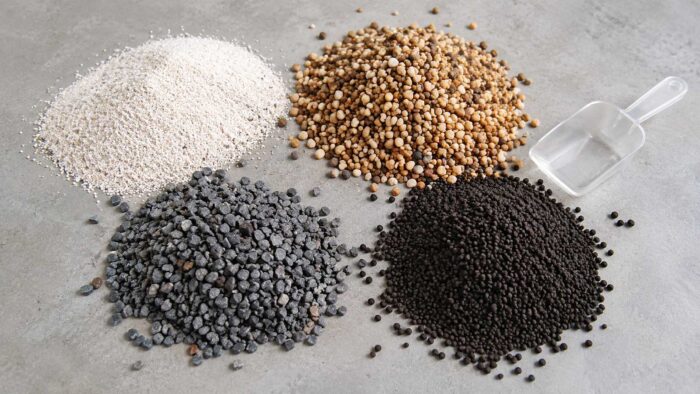
Substrate choice depends on the planting plan. Inert sand or fine gravel with root tabs suits rosette plants like swords and crypts and costs very little. Aquasoil provides nutrients throughout and is the standard choice for demanding scapes, but it leaches ammonia initially, lowers pH, and breaks down over a few years. The full comparison is in the guide to choosing the right aquarium substrate.
Lighting should be matched to plant demand rather than maximised. More light does not produce better plants; it produces faster growth that demands correspondingly more nutrients and carbon, and any shortfall shows up as algae. Most beginner planted-tank problems are excess light rather than insufficient light. The guide to aquarium lighting covers matching output to plant type.
Carbon is the third leg. Injected CO2 accelerates growth substantially and is required for demanding carpets and red stems, but it is not needed for a healthy planted tank and it adds cost, complexity and genuine risk if overdosed. The honest position is that CO2 should be added when light and nutrients are already adequate and plants remain carbon-limited, not at the start. The guide to CO2 in planted aquariums covers when it is justified.
The practical rule is to decide these three as a set. Low light, no CO2 and root tabs is a coherent system. High light, no CO2 and no fertiliser is not, and it produces algae reliably.
Choosing and placing plants
Plant selection should follow from the light and carbon decision, not precede it. The most common failure in a first scape is buying demanding plants for a low-tech setup.
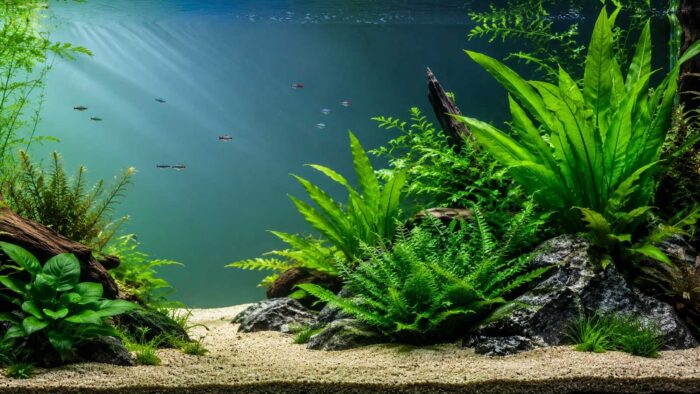
For low-tech tanks, anubias, java fern, cryptocoryne, vallisneria, java moss, bucephalandra and hornwort are all reliable. The guide to best aquarium plants for beginners and the guide to aquatic plants for low-light tanks cover these in detail.
Place plants by growth habit rather than by height alone. Foreground species should stay short without constant trimming, midground species should have interesting form since they occupy the visual centre, and background species should be fast enough to fill space and tall enough to hide equipment.
Plant in groups rather than singly. A single stem of five different species reads as clutter; five stems each of three species reads as composition. This is the plant equivalent of the odd-numbers rule in hardscape.
Plant densely from the start. A sparsely planted new tank has surplus light and nutrients with nothing consuming them, which is precisely the condition algae exploits. Adding a large mass of fast-growing stems at setup, even if they are not part of the final vision, stabilises the tank through its most vulnerable months and can be removed later.
Maintaining a scape as it grows
An aquascape is not finished when it is planted. It reaches its intended appearance somewhere between two and six months in, and it will keep changing after that.
Prune regularly rather than occasionally. Stem plants respond to trimming by branching, which produces the dense growth that makes Dutch and nature scapes work. Left alone they grow leggy, shade what is below them, and eventually collapse.
Trim from the top for stems, replanting the healthy tops and discarding the older bases, which is how most aquascapers maintain a bed indefinitely. For rosette plants like swords and crypts, remove old leaves at the base rather than cutting them short.
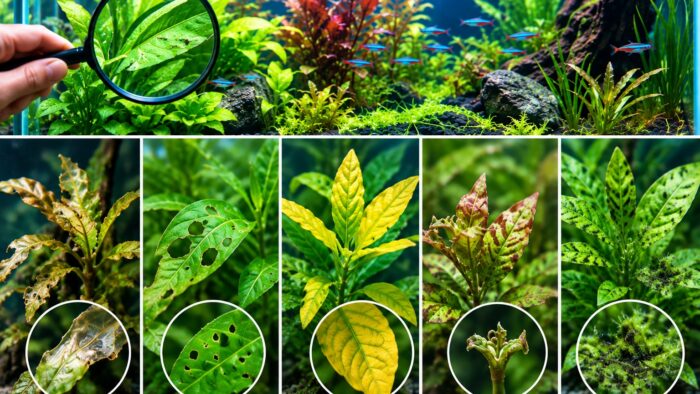
Expect the first two months to include an algae phase. Diatoms in the first weeks and some green algae as the tank finds balance are normal. Resist the impulse to add chemicals or strip the tank; shortening the photoperiod and increasing plant mass addresses the cause. The guide to why your aquarium has algae covers identification.
Keep water changes frequent in the first month, particularly with aquasoil, which releases ammonia as it settles. Twice weekly changes of 30 to 50 percent are standard practice in a new high-tech scape.
Accept that scapes have a lifespan. Aquasoil exhausts, hardscape becomes obscured by growth, and slow-growing plants eventually dominate. Most competition scapes are rebuilt within a year or two, and treating a layout as a phase rather than a permanent installation makes the hobby considerably more enjoyable.
Aquascaping questions
Do I need CO2 to aquascape?
No. Excellent low-tech scapes are made with anubias, ferns, crypts and mosses, and they are far more forgiving. CO2 becomes necessary only for demanding species, particularly carpeting plants and red stems, and it should be added when everything else is already right rather than at the start.
How long before an aquascape looks finished?
Typically two to six months. Stem plants fill in within weeks, mosses and rhizome plants take considerably longer, and carpets can take months. Photographs of finished scapes represent months of growth and pruning, which is worth remembering when comparing your first week to them.
What is the most common beginner aquascaping mistake?
Overfilling the tank. Beginner scapes typically use too many hardscape pieces of similar size, place the focal point centrally, and leave no negative space. The second most common is buying plants that do not match the available light.
Can I aquascape a tank that already has fish?
Yes, though it constrains the options. Substrate changes are disruptive and best done in stages, hardscape can usually be added or rearranged in one session, and plants can be added at any time. Avoid doing everything at once, since a major rearrangement plus a substrate change is a significant disturbance to the biological filter.
How do I stop my scape being overtaken by algae?
Plant densely from day one, keep the photoperiod to six to eight hours, and make sure nutrients and carbon match the light level rather than falling behind it. Algae appears where light exceeds what the plants can use, so the fix is usually less light or more plants rather than any treatment.
Structure first, then plants that match your equipment
A good aquascape comes from a small number of decisions made in the right order: choose a style you can maintain, build hardscape with a clear focal point and genuine negative space, then match substrate, light and carbon into a coherent system, and only then choose plants that suit it.
Plant densely at the start, prune regularly, and treat the first two months of algae as a normal phase rather than a failure. The detailed guides linked above cover each stage, and the guide to aquascaping layout principles is the right place to start on composition.