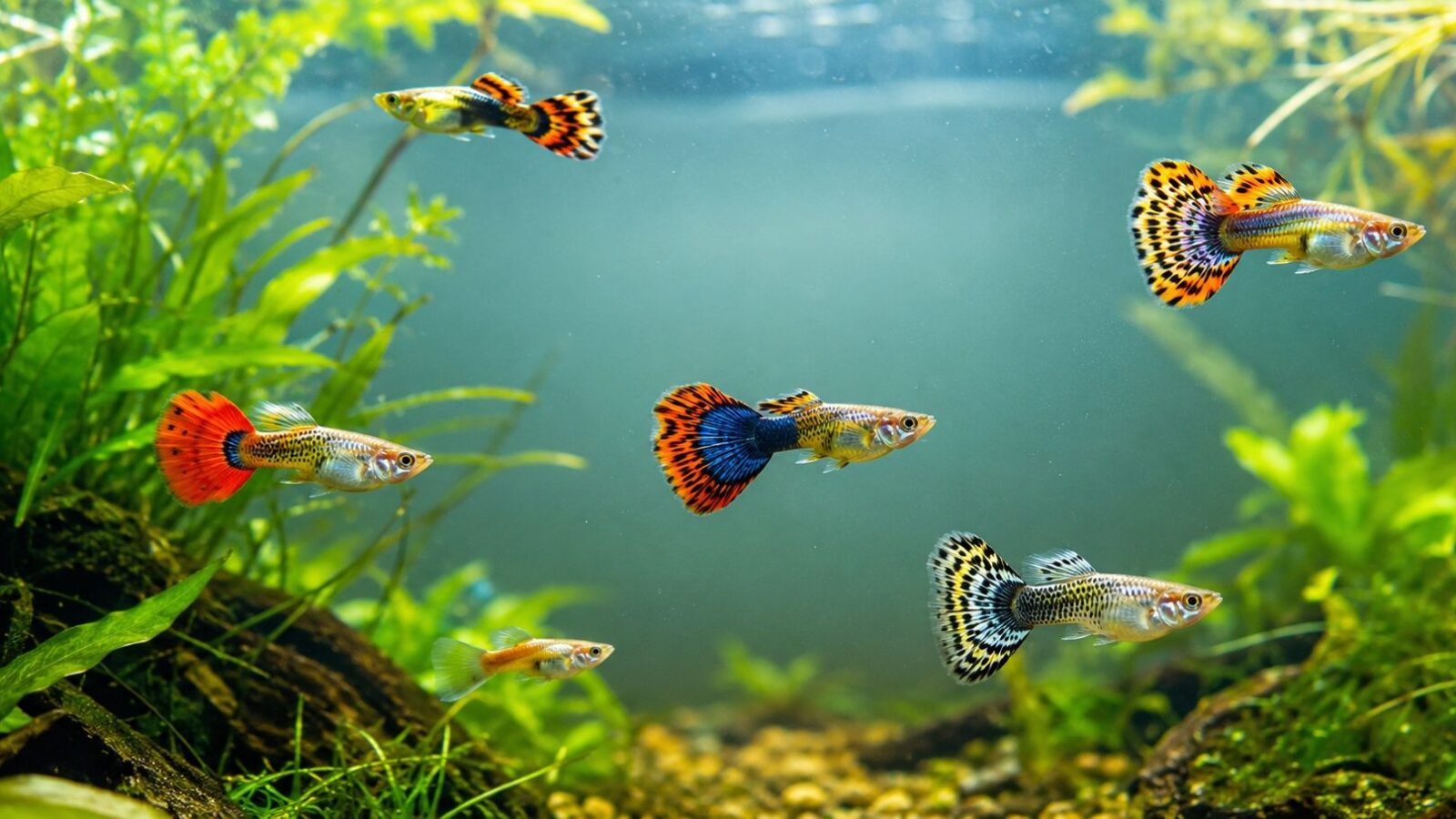
Guppies are usually someone’s first fish, and for good reason. They are inexpensive, tolerant of a wide range of conditions, endlessly varied in colour, and active enough to be interesting in a small tank. They are also livebearers that breed readily without any intervention, which is either the main attraction or the main problem depending on how much planning went into the purchase.
The two things that catch people out are population growth and the surprisingly high rate of health problems in modern fancy strains. Both are manageable once you know what you are dealing with.
Water and tank requirements
Guppies are frequently described as tolerant of anything, which is nearly true and slightly misleading. They tolerate a wide range, but they thrive in a fairly specific one, and the mismatch explains a lot of unexplained losses.
| Requirement | Recommendation | Notes |
|---|---|---|
| Adult size | Males 1.5 in, females 2.5 in | Females are larger and plainer |
| Minimum tank | 10 gallons for a trio, 20 preferred | Population growth makes larger tanks easier |
| Temperature | 74 to 80 F | Lower end extends lifespan; higher end speeds breeding |
| pH | 7.0 to 8.0 | Prefers alkaline; struggles in soft acidic water |
| Hardness | 8 to 20 dGH | Hard water species; soft water causes long-term problems |
| Sex ratio | 1 male to 2 or 3 females | Prevents constant harassment of individual females |
| Lifespan | 1 to 3 years | Fancy strains often shorter |
| Diet | Quality flake, micro pellets, frozen brine and daphnia | Some vegetable content improves digestion |
The hardness requirement is the one most often missed. Guppies are hard-water fish, and keepers in soft-water areas frequently struggle with them while assuming they simply bought weak stock. If your tap water is soft, either choose species that suit it or raise hardness deliberately with crushed coral in the filter, which is more stable than dosing chemicals. Test your source water first, following the guide to aquarium water parameters.
A planted tank suits guppies well. Dense planting gives fry somewhere to hide, gives harassed females somewhere to retreat, and improves water quality. Floating plants in particular are useful, since guppies are surface-oriented and the cover reduces stress.
The male to female ratio problem
Male guppies court almost continuously and do not stop when the female is uninterested. In a tank with one male and one female, that female is pursued all day, which causes measurable stress, reduced feeding and shortened lifespan.
The standard remedy is to keep at least two and preferably three females per male, spreading the attention. This works, but it also guarantees fry. A group of one male and three females will produce a hundred or more offspring within a few months.
The alternative that many experienced keepers prefer is an all-male group. Males are the colourful sex, a group of six or more spreads any aggression, and there is no population to manage. It requires buying carefully, since females often arrive already pregnant and juvenile guppies are easy to sex incorrectly, but it solves both problems at once.
All-female groups also work and are the calmest option, though the fish are noticeably plainer. Be aware that any female bought from a mixed shop tank should be assumed pregnant.
Breeding, whether or not you intended it
Guppies are ovoviviparous: eggs develop internally and the female gives birth to free-swimming fry. No intervention is required and no special conditions are needed. If you have a male and a female, you will have fry.
Gestation runs roughly 21 to 30 days depending on temperature, producing 20 to 50 fry per drop, and a female can drop every four to six weeks. Critically, females store sperm and can produce several broods from a single mating over the following months. Separating the sexes after purchase does not stop the first few batches.
Fry are born fully formed and start eating immediately. They need finely crushed food, powdered fry food or baby brine shrimp several times a day, and frequent small water changes to handle the feeding load.
Survival rate is the variable you control. In a bare tank with adults, most fry are eaten within hours, which keeps the population stable. In a densely planted tank with floating cover and moss, a large proportion survive, and the population grows rapidly. Decide which outcome you want before setting the tank up.
If you want to raise fry deliberately, a separate rearing tank produces far better results than a breeding trap. Traps are cramped and stressful for the pregnant female, and confinement often causes premature delivery. A better approach is a well-planted tank where the female drops naturally and fry are moved out afterwards, or a dedicated fry tank stocked from the main tank.
Population control
This is the practical problem that catches nearly everyone. Three guppies become thirty within a few months, and thirty guppies produce enough waste to overwhelm a small tank.
The workable options are limited and worth deciding on in advance.
- Keep a single-sex group. The cleanest solution, and all-male groups keep the colour.
- Keep a fish that eats fry. Angelfish, dwarf cichlids and larger gouramis all reduce survival substantially in a mixed tank, though this only works if the tank suits both species.
- Reduce cover. A sparsely decorated tank sees most fry eaten by the adults themselves.
- Arrange an outlet in advance. Some local shops accept surplus guppies; many do not, so confirm before relying on it.
- Run a second tank. This works but tends to accelerate rather than solve the problem.
What does not work is hoping the population self-limits at a comfortable level. It self-limits when the water quality degrades enough to kill fish, which is not an acceptable control method. Monitor stocking against the method in the guide to aquarium stocking and act before the tank is over capacity.
Health problems in modern strains
Guppies have a reputation for hardiness that comes from older, less selectively bred stock. Modern fancy strains, bred intensively for colour and fin extension, are noticeably more fragile, and several common problems are genetic rather than environmental.
Fin and tail deterioration in fancy long-finned males is common and often mistaken for fin rot. Genuine fin rot has a ragged, whitening edge and follows poor water quality. Genetic fin weakness in heavily bred strains shows as gradual splitting without inflammation and does not respond to water quality improvements.
Wasting despite normal feeding usually indicates internal parasites, which are widespread in commercially farmed guppies. Fish that eat normally but grow progressively thinner, sometimes with pale, stringy waste, are the typical presentation.
Sudden losses shortly after purchase are usually the combination of intensive farming conditions, long transport chains and unfamiliar water chemistry. Quarantining new arrivals for four weeks, as covered in the guide to quarantining new fish, catches most of this before it enters the display.
The most useful preventive measure is buying well. Locally bred guppies from a hobbyist or a specialist shop are consistently hardier than mass-produced imports, adapt faster to local water, and cost only marginally more. If losses have been persistent despite good water quality, the source is usually the variable worth changing.
General disease identification is covered in the guide to common aquarium diseases.
Guppy keeping questions
How can I tell if a guppy is pregnant?
Look for a dark triangular patch near the rear of the abdomen, called the gravid spot, which darkens as the pregnancy progresses. The abdomen also becomes noticeably squared off rather than rounded in the final days. Assume any female from a mixed shop tank is already pregnant.
Can guppies live with bettas?
Sometimes, but it is unpredictable. Male bettas frequently target colourful, long-finned fish, and fancy male guppies fit that description precisely. Female guppies in a well-planted tank are a safer combination, though the pairing still requires a backup plan.
Do guppies need a heater?
In most homes, yes. They need 74 to 80 F held steadily, and room temperature fluctuates more than expected overnight. Guppies survive cooler water but become far more prone to disease at the lower end.
Why are my guppies losing colour?
Check water quality first, since stress fades colour quickly in this species. Persistent dullness in an otherwise healthy tank is often diet-related and improves with frozen foods and some vegetable content, or it may simply be a strain with less colour stability than the parent stock.
How many guppies can I keep in a 10 gallon?
A trio of one male and two females, or a group of five or six males, is realistic for a 10 gallon. The constraint is not the adults but the fry, which is why an all-male group is the more sustainable choice at this size.
Decide on population control before buying
Guppies are genuinely easy fish provided two decisions are made in advance: matching them to hard, alkaline water rather than assuming they will adapt, and deciding what happens to the fry before the first batch arrives.
Buy locally bred stock where possible, keep either a single-sex group or a properly weighted ratio, quarantine new arrivals, and the species lives up to its reputation. Skip those steps and the same fish develops a reputation for dying for no apparent reason.