The old one inch per gallon rule has killed a lot of fish. It treats a slim 3 inch tetra and a heavy bodied 3 inch goldfish as equals, which they are not. A better question is not how many fish fit, but how much waste your filter and water changes can process without the numbers creeping up.
Stocking is really a balance between the waste your fish produce and the capacity of your system to remove it. Once you think in those terms, the right number for your tank becomes much clearer.
Why the inch per gallon rule fails
Length tells you almost nothing about waste output. A fish twice as long can be six to eight times heavier, and body mass drives ammonia production. The rule also ignores activity level, adult size, and territory. A single fancy goldfish can pollute a tank faster than a dozen small rasboras. Use the rule as a loose ceiling for tiny community fish only, and ignore it entirely for larger species.
What actually limits stocking
Five factors set the real limit, and the tightest one wins.
- Bioload. Total waste from all your fish. This is what your filter and bacteria must keep up with.
- Filtration capacity. A filter rated well above your tank volume buys you headroom.
- Oxygen and surface area. A long, shallow tank holds more fish than a tall, narrow one of the same volume because gas exchange happens at the surface.
- Adult size. Stock for the fish your animals will become, not the juveniles in the store.
- Territory and temperament. Some species need space and will fight when crowded, regardless of water quality.
A method that actually works
Forget formulas and let the water tell you the truth. Stock to roughly half of what your gut estimate suggests, then test nitrate weekly. If a 25 percent weekly water change keeps nitrate under about 20 to 40 ppm, your tank is comfortable and you have room to add a little more. If nitrate climbs past that despite regular changes, you are overstocked and the fish are paying for it. Your test kit is the honest referee here.
Rough starting points by tank size
These assume good filtration, weekly water changes, and small community fish around 1 to 2 inches as adults.
- 10 gallons: one small species, such as a group of six to eight nano fish.
- 20 gallons: a modest community of two or three small species, kept in proper groups.
- 40 gallons and up: room for a centerpiece fish plus a couple of schooling groups.
Always confirm the adult size and social needs of each species first. Our roundup of beginner freshwater fish lists good options and their group requirements.
Respect schooling and territory needs
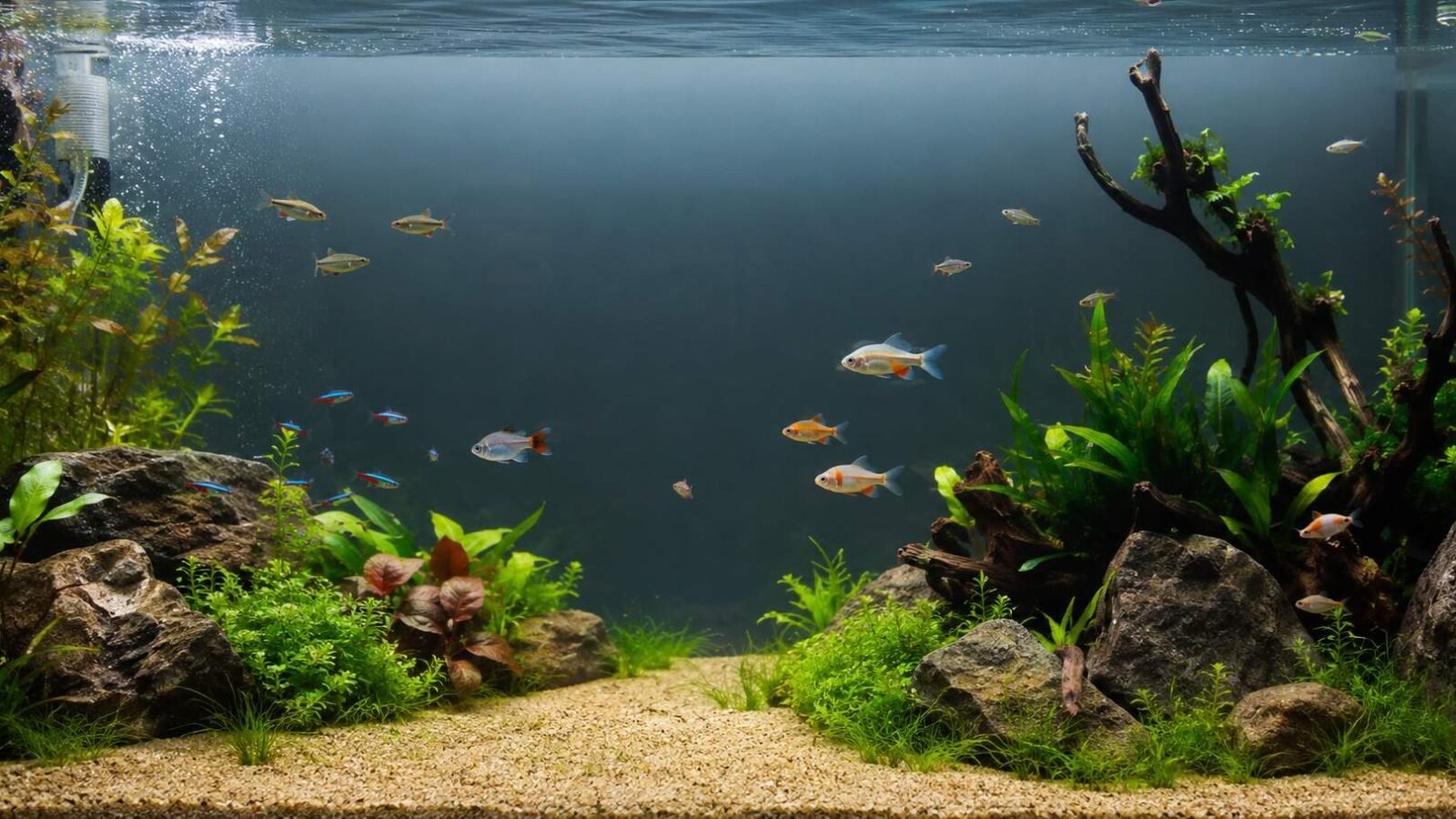
Stocking is not only about numbers. Many popular fish are shoaling species that turn nervous and nippy in groups smaller than six. Others claim a patch of the tank and defend it. A correctly stocked tank keeps social species in proper groups and gives territorial fish enough space to spread out. Crowding calm fish makes them aggressive, and isolating schooling fish makes them stressed.
Signs you have overstocked
Your fish and your test kit will warn you. Watch for nitrate that stays high despite water changes, fish gasping near the surface in the morning, frequent disease outbreaks, and rising aggression at feeding time. A new tank also needs time to mature, so add fish gradually after the cycle finishes rather than all at once.
Leave capacity for growth and missed maintenance
An overstocked aquarium can look stable for weeks because the filter and maintenance routine are temporarily keeping up. The weakness appears after growth, a missed water change, or a filter problem. Leaving spare capacity makes the system more resilient and gives fish room to reach adult size.
Stocking is an animal-welfare decision
Stocking affects water quality, territorial pressure, access to food, and the ability to perform natural behaviour. Plan around adult size and social needs, and leave enough capacity for growth, maintenance delays, and equipment problems.
Stocking questions that need more than a formula
Is the one inch per gallon rule ever useful?
Only as a rough ceiling for very small community fish. It breaks down completely for goldfish, cichlids, and any heavy bodied species.
How long should I wait between adding fish?
One to two weeks. That gap lets your bacteria colony grow to match the new waste load before you add more.
Can a bigger filter let me keep more fish?
It helps, but it does not remove every limit. Oxygen, territory, and adult size still cap how many fish a tank can hold comfortably.
Stock for adult size and real maintenance capacity
Stock for waste, not for length. Start at half your estimate, watch your nitrate, and add fish slowly while the readings stay low. A lightly stocked tank is calmer, cleaner, and far more forgiving than a crowded one, and your fish will show the difference.