Cloudy water is the most common reason a new aquarium owner goes looking for help, and it is also one of the few aquarium problems that diagnoses itself. The colour of the cloud and the moment it appeared tell you what is happening, and each cause has a different fix. Treating all cloudiness the same way is why it so often comes back.
This guide works through the five things that actually make aquarium water cloudy, how to tell them apart, and what to do in each case. It also covers the responses that make the problem worse, because several of the standard reactions to cloudy water set the tank back by weeks.
Diagnose the cloud by colour and timing
Before you change anything, look at the tank in daylight against a white background and note two things: what colour the water is, and when the cloudiness started relative to what you last did. Those two facts narrow it to one cause in most cases.
| Appearance | When it usually starts | Cause | What to do | Typical time to clear |
|---|---|---|---|---|
| Milky white or grey, evenly spread | Days three to ten of a new tank, or after a filter clean | Bacterial bloom | Test ammonia and nitrite, feed lightly, wait | 3 to 10 days |
| Fine, gritty haze | Immediately after filling or replanting | Substrate and decor dust | Mechanical filtration, fine filter floss | 2 to 48 hours |
| Green, from a faint tinge to pea soup | Any time, often after a light or nutrient change | Free floating algae | Blackout or UV clarifier, then fix light and nutrients | 3 to 7 days |
| Yellow or tea brown, water still clear | Days to weeks after adding wood or leaves | Tannins | Activated carbon or resin, or accept it | 1 to 4 weeks |
| White haze returning after each water change | Established tank, recurring | Organic load or mineral precipitation | Reduce feeding, review maintenance routine | Depends on the cause |
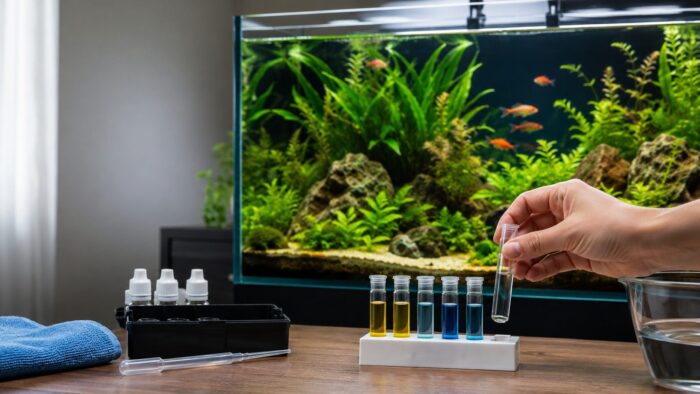
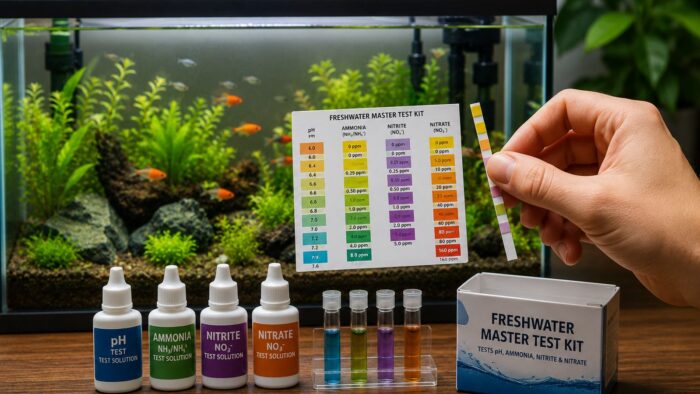
Whatever the colour, run an ammonia and nitrite test before acting. The cloudiness itself does not harm fish. A cloudy tank that also reads ammonia is a different situation and needs the response in our guide to lowering ammonia, nitrite and nitrate.
White or grey haze: a bacterial bloom
This is the classic new tank cloud. Water that looked fine on day two turns milky around day four or five, thick enough that the back glass goes soft focus. It is a population explosion of heterotrophic bacteria, which feed on dissolved organic matter rather than ammonia, and they reproduce fast enough to cloud the water column within hours.
The trigger is a surplus of dissolved organics with nothing yet in place to compete for them: a new tank, a heavy first feeding, a dead snail, or an uncured piece of wood. It also appears in established tanks after a filter has been over cleaned or a large amount of substrate has been disturbed.
A bloom is self limiting. Once the food source is used up the population crashes and the water clears, usually within three to ten days. The useful actions are small: feed lightly or skip a day, remove anything decomposing, and leave the filter alone. If the tank is still cycling, follow it through as described in our guide to cycling your first aquarium, and if you have fish in there already, our page on new tank syndrome covers the water changes that keep them safe while it settles.
One correction worth making, because it drives a lot of bad advice: the beneficial bacteria that run your nitrogen cycle live on surfaces in the filter and substrate, not floating in the water. A water change does not remove your cycle. It also does not end a bloom, because the bacteria multiply back to fill the space within a day.
Cloudy from the first hour: substrate dust
If the water clouded the moment you filled the tank, or straight after you rearranged plants, this is suspended fine particles rather than anything biological. Gravel and sand carry a dust coating from packing and handling, and clay based plant substrates shed fines for longer than anyone expects.
The fix is mechanical. A fine filter floss or polishing pad in the filter will pull out particles that standard sponge media passes straight through, and most tanks clear within a few hours. Rinsing substrate thoroughly before it goes in prevents the problem entirely, which is covered in our guide to choosing aquarium substrate.
Sand is the exception that catches people out. Very fine sand stays suspended for a day or more and can find its way into impellers, so it is worth switching the filter off while it settles and running the floss afterwards. Our guide to filter media explains which layer does what.
Green water: free floating algae
Green water is single celled algae multiplying in the water column, and it behaves differently from every other kind of cloudiness. It does not clear on its own, and it barely responds to water changes, because the remaining cells repopulate the tank in a day or two.
It needs two things at once: light and nutrients. In practice that means direct sunlight on the tank, a photoperiod running longer than eight hours, a light that is brighter than the plants can use, an ammonia spike, overfeeding, or fertiliser dosed beyond what the plants take up. Working out which applies is the actual fix, and our guide to why your aquarium has algae goes through the nutrient side in detail.
To clear an existing bloom, the two reliable methods are a full blackout for three days, with the tank wrapped so no light reaches it and no feeding during that period, or a UV clarifier run for a few days. Both kill the suspended cells. Neither prevents a return if the underlying cause stays in place, so reduce the photoperiod to six to eight hours on a timer, move the tank out of direct sun, and cut feeding back. Our page on aquarium lighting covers intensity and duration together.
Fish are not harmed by green water. It is unsightly rather than dangerous, and fry actually do well in it, which is why some breeders culture it deliberately.
Yellow or brown tint: tannins and organics
If the water is clear but tinted, like weak tea, you are looking at tannins leaching from driftwood, leaf litter or botanicals. They stain the water, lower pH slightly and carry mild antibacterial properties. Many soft water species look their best in it, and a tinted tank is not a problem tank.
If you want it gone, activated carbon or a synthetic organic resin in the filter strips it out within a week or two, and needs replacing as it exhausts. Boiling or soaking new wood before it goes in the tank removes the worst of the initial release. Either way the wood will stop leaching noticeably after a few months.
A yellow tint in a tank with no wood is a different signal. That is dissolved organic matter building up from waste and uneaten food, and it points at water change volume or frequency rather than decoration. The schedule in our guide to aquarium maintenance is the place to start. Brown dusting on glass and plants rather than in the water is diatoms, which is a surface algae with its own separate cause.
Cloudiness that returns every week
Recurring cloudiness in an established tank is the version worth taking seriously, because something is continuously feeding it. Four causes account for most cases.
The first is overfeeding. Food that is not eaten within a couple of minutes breaks down into exactly the dissolved organics that bacterial blooms run on. Our guide to how often to feed sets out realistic portions.
The second is filtration that is undersized or poorly maintained for the stocking level. A filter rated for the tank volume but not for the bioload in it will pass fine particles and leave organics in circulation. Our guide to aquarium filtration covers matching a filter to a stocked tank rather than to a number on the box.
The third is maintenance that disturbs too much at once. Deep cleaning the substrate across the whole tank and rinsing all the filter media in the same session removes a large share of the established bacterial surface and stirs months of accumulated mulm into the water. Clean half the substrate at a time, rinse media in used tank water, and stagger the jobs, as set out in our guide to cleaning an aquarium.
The fourth is mineral precipitation. In hard water, adding a buffer, a dechlorinator that reacts with high carbonate hardness, or top up water at a very different temperature can cause a brief white cloud that settles within the hour. It is harmless, and it is worth recognising so you do not go looking for a biological cause.
What makes cloudy water worse
Most cloudy water gets solved by doing less, not more. The following responses are common and all of them extend the problem.
Reaching for a water clarifier first. Flocculants clump fine particles so the filter can catch them, which works on dust and does nothing about the cause of a bloom. They can also clog filter media and reduce flow at the moment you need it most. Keep them for cosmetic clearing before guests arrive, not as a diagnosis.
Replacing all the filter media at once. This removes the bacterial colony the tank depends on and often triggers the bloom it was meant to cure. Replace one part at a time, weeks apart.
Doing enormous water changes in a cycling tank. The cycle is not in the water, so this does not reset it, but it does not clear a bloom either and it swings temperature and chemistry around fish that are already under stress. Change water because a test result calls for it, using the method in our water change guide.
Stopping feeding completely for a week. Feeding lightly helps, starving fish does not, and the organics driving a bloom usually came from the substrate and filter rather than todays pinch of flake.
Adding more bacterial supplement each day. One dose at setup is useful. Repeated dosing adds organic matter to a tank that already has a surplus of it.
Cloudy water questions
Is cloudy water harmful to my fish?
The cloudiness itself is not. Bacterial blooms, dust and green water are all harmless to fish in themselves. The risk is that the same conditions producing the cloud, particularly in a new or overfed tank, can also produce ammonia. Test rather than assume.
Should I use a water clarifier?
Only after you know the cause and have dealt with it. A clarifier is effective on suspended dust and largely pointless on a bacterial bloom, and overdosing can restrict flow through the filter.
How long does a bacterial bloom last?
Three to ten days in most tanks. If it is still there after two weeks, something is feeding it continuously: a dead fish or snail out of sight, a heavy feeding routine, or decaying plant matter under the substrate.
Will a bigger filter clear cloudy water?
A filter with fine mechanical media will clear particles faster, so it helps with dust. It will not stop a bloom, which is bacteria growing on dissolved compounds that pass straight through any mechanical media.
My water went cloudy right after a water change. Why?
Usually disturbed substrate or mulm stirred into the water column, and it settles within a day. If it happens every time, you are likely cleaning too deeply in one session or the tank is carrying a heavier organic load than the routine removes.
Test first, then treat the cause
Cloudy water is a symptom with five common causes, and the colour plus the timing separates them reliably. A white haze in a young tank needs patience. Dust needs filter floss. Green water needs a blackout and a look at lighting. A brown tint needs carbon or acceptance. Cloudiness that keeps coming back needs a change to feeding, filtration or maintenance.
The one step that applies in every case is to test the water before you treat it. A liquid test kit takes a few minutes and tells you whether you are looking at a cosmetic problem or a water quality one, and that answer decides everything you do next.