New tank syndrome is the name given to what happens when fish are added to an aquarium whose filter cannot yet process their waste. It is not a disease, it has no pathogen, and no medication treats it. It is ammonia and nitrite poisoning, and it is the single most common cause of death in first aquariums.
The good news is that it is both preventable and, once recognised, fixable. The bad news is that it usually goes unrecognised until fish are already dying, because the early signs look like ordinary settling-in behaviour. This guide covers how to spot it in the first days rather than the second week.
What is actually happening in the tank
Fish excrete ammonia continuously, through waste and directly across their gills. In an established aquarium this never accumulates, because two bacterial populations consume it: one group oxidises ammonia into nitrite, and a second converts nitrite into far less harmful nitrate.
Those colonies take weeks to grow. A brand-new tank has effectively none. When fish go in on day one, ammonia begins climbing immediately and nothing removes it. Within days it reaches concentrations that damage gill tissue. Around a week later the first bacterial group has grown enough to start converting ammonia into nitrite, so ammonia falls and everyone relaxes, but nitrite is also toxic and the second colony is still weeks behind. This produces the characteristic double peak that catches so many people out.
Ammonia damage is not simply a matter of concentration. Ammonia exists in two forms in water, and the toxic un-ionised form increases sharply as pH and temperature rise. This is why the same 1 ppm reading is far more dangerous in a warm tank at pH 8.2 than in a cooler tank at pH 6.8, and why a well-meant pH adjustment during a spike can kill fish that were coping.
Recognising it early
Symptoms follow a fairly reliable sequence, and the first three appear before any fish looks obviously ill.
| Stage | What you see | What it means |
|---|---|---|
| Days 1 to 3 | Fish hover near the filter outflow or at the surface | Seeking oxygen; early gill irritation |
| Days 2 to 5 | Reduced appetite, food ignored or spat out | Systemic stress; often mistaken for shyness |
| Days 3 to 7 | Sitting on the base, clamped fins, dulled colour | Ammonia beginning to damage gill tissue |
| Days 5 to 10 | Rapid gill movement, gasping, red or inflamed gills | Significant ammonia poisoning |
| Week 2 onward | Cloudy water, more fish affected, first deaths | Ammonia peak; nitrite now climbing |
| Weeks 2 to 4 | Fish lethargic despite ammonia now reading low | Nitrite poisoning; ammonia colony established, nitrite colony not |
| Weeks 3 to 6 | Gradual recovery, appetite returns | Both colonies established; tank cycling |
The stage that misleads people most is the fourth week. Ammonia reads zero, the water looks clear, and the tank appears to have recovered, but fish remain lethargic and occasional deaths continue. This is nitrite, and testing for ammonia alone will miss it entirely. Always test both.
One symptom deserves separate mention because it is specific. Nitrite binds to haemoglobin and prevents it carrying oxygen, which turns the blood and gills a brownish colour. Fish gasping at the surface in water that is well aerated, with gills that look brown rather than red, is close to diagnostic for nitrite poisoning.
What to do right now
If fish are already in the tank and testing confirms ammonia or nitrite, the response is straightforward and urgent.
- Test ammonia, nitrite and nitrate together with a liquid kit. Record the numbers so you can track the trend.
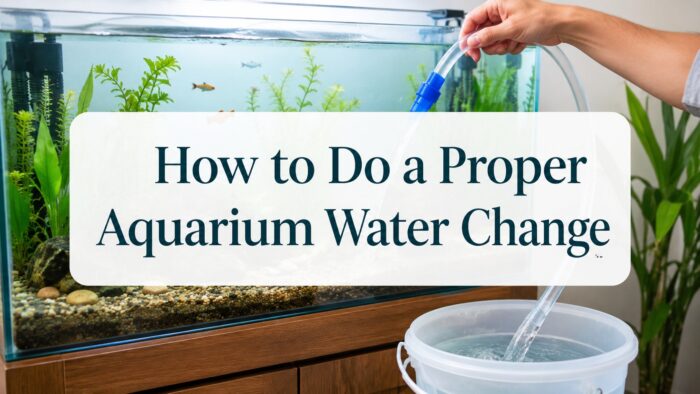
- Perform a water change large enough to bring ammonia and nitrite below 0.25 ppm. This often means 50 percent or more, and it may need repeating daily.
- Treat all replacement water with dechlorinator and match its temperature to the tank before it goes in.
- Stop feeding for one to two days, then feed very lightly. Every gram of food becomes ammonia.
- Add no further livestock until both readings hold at zero.
- Increase aeration. Fish with damaged gills benefit from higher dissolved oxygen, and an airstone costs almost nothing.
- Do not clean or replace the filter media. The colony you need most is growing on it.
- Test daily and change water whenever either reading exceeds 0.25 ppm.
Water changes are the only measure that actually removes ammonia from the system. Ammonia-binding conditioners convert it to a temporarily less toxic form and can help as a stopgap when a change is impossible, but they do not remove it and most still register on test kits, which makes readings harder to interpret.
The full triage sequence for each of the three nitrogen compounds is set out in the guide to lowering ammonia, nitrite and nitrate.
What makes new tank syndrome worse
Several instinctive responses make the situation worse, and they are common enough to be worth naming.
Do not replace or deep-clean the filter media. This is the most damaging single mistake, because it removes the bacterial colony that is slowly solving the problem. Rinse mechanical media in removed tank water if flow has dropped, and leave biological media alone entirely.
Do not add more fish because some have died and the tank looks empty. Every addition increases the ammonia load on a filter that is already overwhelmed.
Do not medicate. There is no pathogen. Many medications are also toxic to nitrifying bacteria, which extends the problem by weeks.
Do not chase pH. Lowering pH does reduce the proportion of ammonia in its toxic form, which is why the advice circulates, but sudden pH changes cause their own shock and low pH stalls the cycle. Stability is more valuable.
Do not do a complete water change and restart the tank. This resets any bacterial progress and puts the fish through the whole process again.
Preventing it next time
New tank syndrome is entirely avoidable, and the prevention is the same for every tank: establish the biological filter before livestock arrives.
A fishless cycle, dosing pure ammonia to about 2 ppm and waiting until the tank clears both ammonia and nitrite within 24 hours, removes the risk completely. It takes two to six weeks and requires five minutes a day. The full method is in the guide to cycling your first aquarium.
Where waiting is not possible, seeding the filter with mature media from an established, healthy tank is the only genuine shortcut. A squeeze of filter sponge or a cup of established gravel carries a living colony and can cut the timeline dramatically.
Three further habits reduce the risk of a recurrence in an established tank. Stock gradually rather than all at once, so the colony can scale to match. Feed conservatively, since food is the ultimate source of all ammonia. And never rinse biological media under a tap, because chlorine kills the colony and produces a sudden spike in a tank that had been stable for years.
It is also worth knowing that established tanks can develop the same symptoms. A filter left unplugged after maintenance, a course of antibiotics, a dead fish behind hardscape, or a large stocking addition can all crash a mature colony. The response is identical.
New tank syndrome questions
How long does new tank syndrome last?
Typically two to six weeks from when fish were added, matching the time the bacterial colonies need to establish. Warmer water and seeded media shorten it. Frequent water changes do not slow the cycle meaningfully, because the bacteria live on surfaces rather than in the water column.
Can fish recover from ammonia poisoning?
Often yes, if the exposure was short and moderate. Gill tissue regenerates, appetite returns and colour improves once readings are back to zero. Prolonged exposure causes permanent gill scarring, and affected fish frequently remain more susceptible to disease for the rest of their lives.
My water is cloudy. Is that new tank syndrome?
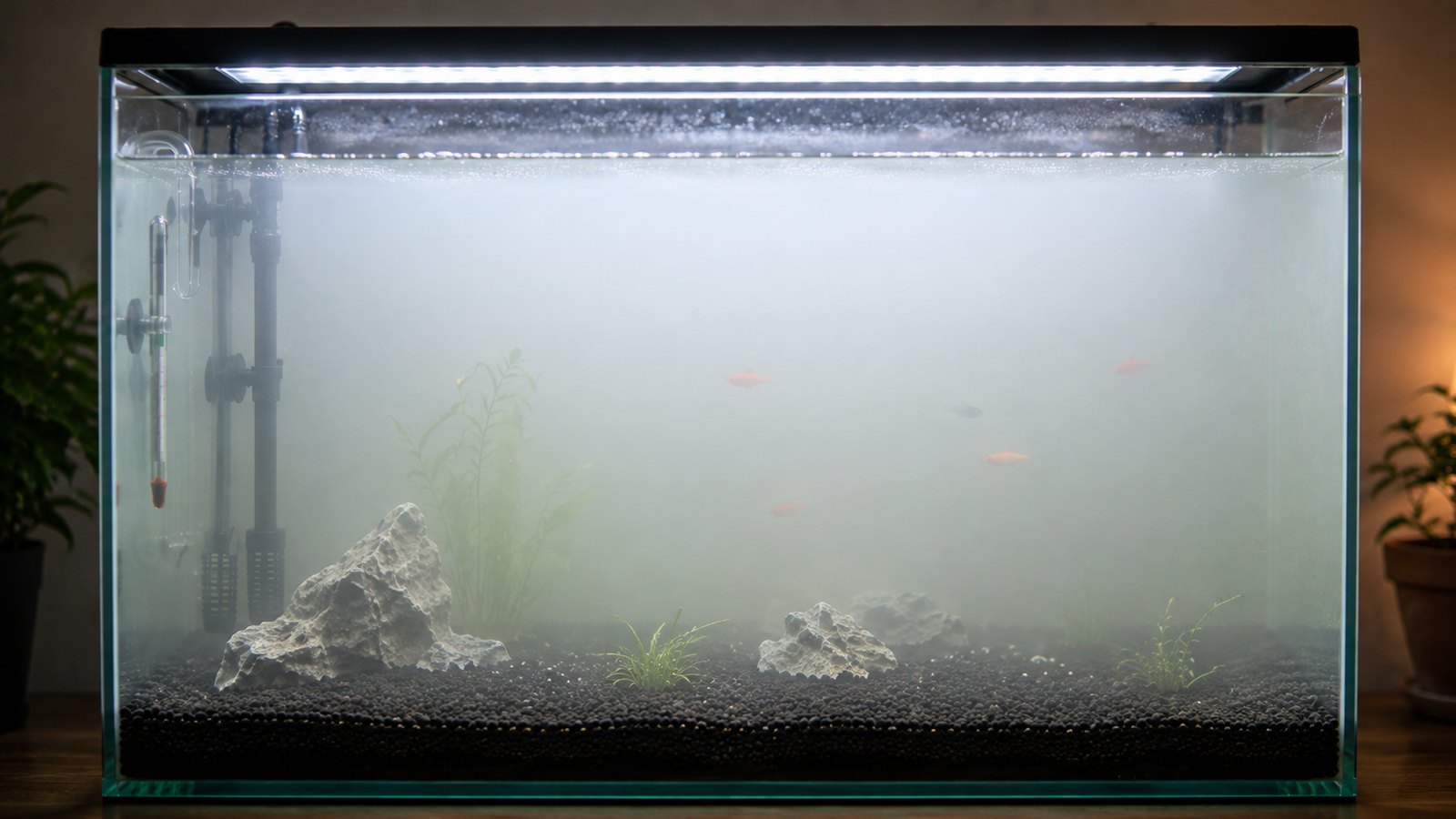
Cloudy water in a new tank is usually a harmless bacterial bloom, which clears by itself in a few days. It often coincides with new tank syndrome because both happen in young tanks, but cloudiness alone is not the diagnosis. Test ammonia and nitrite rather than judging by appearance.
Should I use bottled bacteria to fix it?
It can help, and some products have a reasonable track record. Treat it as an accelerator rather than a solution: continue testing and changing water as normal, and expect it to shorten the process rather than end it. Store-brand products with vague labelling are generally ineffective.
Is it safe to add plants during new tank syndrome?
Yes, and fast-growing species genuinely help by taking up ammonia directly. Hornwort, water sprite and floating plants are the most effective. They will not replace a biological filter, but they reduce the peak while it establishes.
Test both compounds and change water until they clear
New tank syndrome is a plumbing problem, not a medical one. Fish are being poisoned by their own waste because the biological filter is not yet built, and the only meaningful interventions are removing the toxin through water changes and reducing its production by feeding less.
Test ammonia and nitrite together, change water whenever either exceeds 0.25 ppm, leave the filter media alone, and stop adding livestock. Within a few weeks the colony catches up and the problem disappears permanently. Cycle the next tank before stocking it and the problem never appears at all.