Nano aquariums, generally those under about 10 gallons, are some of the most appealing tanks in the hobby. They fit on a desk, suit small spaces, and make beautiful planted or shrimp displays. They are also widely misunderstood as the easy beginner option, when in reality their small water volume makes them less forgiving than a larger tank. With the right approach, though, a nano tank can be a thriving, low-footprint slice of the underwater world. This guide covers how to set one up and keep it stable.
The appeal of a nano is real, but so is the discipline it demands. Going in with clear expectations is the difference between a jewel-box tank and a frustrating struggle.
Why nano tanks are harder than they look
It comes back to water volume. In a small tank, anything that goes wrong goes wrong quickly. A little overfeeding, a missed water change, or a warm afternoon can swing temperature and chemistry far faster than in a larger tank, as explained in the guide to choosing the right aquarium size. The small footprint also limits how many and which fish you can keep. None of this makes nano tanks unsuitable for beginners, but it does mean they reward consistency rather than offering a shortcut.
Setting up a nano tank
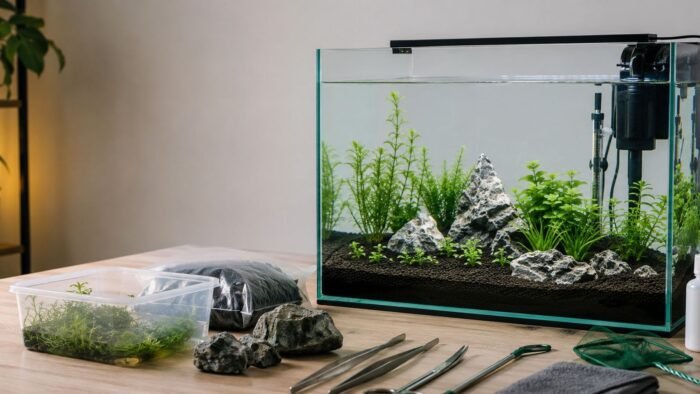
The essentials are the same as any tank, scaled down and chosen carefully.
- A small but quality filter with gentle, adjustable flow, often a sponge or small internal filter.
- A small heater if you keep tropical species, sized to the tank.
- A modest light suited to your plants.
- Substrate appropriate to your goals, whether inert sand or a plant-friendly base.
- A lid to reduce evaporation, which is proportionally faster in small tanks.
As with any aquarium, a nano must be fully cycled before adding livestock, and in a small tank that discipline matters even more.
What to keep in a nano tank
Stocking is where nano tanks shine or fail. The key is choosing small species and resisting the urge to overcrowd.
- A single betta, which suits a 5-gallon planted nano beautifully.
- A colony of dwarf shrimp such as cherry shrimp, ideal for nano life and covered in our cherry shrimp guide.
- A small school of nano fish like Endler’s livebearers or chili rasboras in a slightly larger nano.
- Snails, which add interest and help with algae and biofilm.
Avoid active or schooling fish that need more room, and never stock a nano to the limits you might attempt in a larger tank.
Popular nano tank ideas
Some of the most admired tanks in the hobby are nanos built around a single clear theme rather than a crowd of fish.
- A planted betta tank: a single betta in a lushly planted 5-gallon, a classic and rewarding nano.
- A dedicated shrimp tank: a colony of cherry shrimp in a heavily planted nano, where the shrimp become the main attraction.
- A nano aquascape: a small Iwagumi or nature-style scape focused on hardscape and plants, with few or no fish.
- A snail and biofilm tank: a low-maintenance planted nano centered on nerite snails and live plants.
Choosing a single focus suits the small scale far better than trying to cram a miniature community into a few gallons.
Maintenance for a stable nano
Small tanks reward small, frequent care. Plan on regular partial water changes, done gently and with temperature-matched water, since even a modest change is a large proportion of a nano’s volume. Feed lightly, top off evaporated water with fresh dechlorinated water rather than letting parameters concentrate, and keep an eye on the temperature, which a small heater should hold steady.
Benefits and limitations
The benefits of a nano are obvious: low cost, small footprint, modest water and electricity use, and the focused beauty of a tiny, well-designed scape. The limitations are the flip side of that small volume, namely faster swings, limited stocking, and less margin for error. A nano is a wonderful project for an attentive keeper and a frustrating one for a hands-off owner.
Common mistakes
- Treating a nano as the easy starter option and neglecting maintenance.
- Overstocking a tiny tank because it looks empty.
- Skipping the cycle in a small tank where ammonia spikes fast.
- Using a powerful filter that creates too much flow for a small space.
- Letting evaporation concentrate parameters instead of topping off.
A nano tank rewards close, consistent care
A nano tank is best approached as a deliberate, attentive hobby rather than a casual desk ornament. If you enjoy the small rituals of regular care, a nano can be one of the most rewarding tanks you keep. If you want something more forgiving, a larger tank is the gentler place to start. The keepers who succeed with nanos tend to be the ones who fell in love with the small scale itself, the careful planting, the tiny shrimp, the daily check-in, rather than those who chose a nano simply to save space or money. Approached as a craft, a few gallons of water can hold a remarkably complete and beautiful little world.
Nano-tank questions to consider before setup
What is the smallest practical aquarium?
Tanks down to around 3 to 5 gallons can work for a betta or shrimp, but smaller than that becomes very difficult to keep stable and is not recommended for beginners.
Do nano tanks need a filter and heater?
Yes for tropical setups. A gentle filter maintains the cycle and a small heater holds temperature. Coldwater shrimp-only nanos may manage without a heater in a stable room.
How many fish can a 5-gallon tank hold?
Very few. A single betta, a small shrimp colony, or a tiny group of the smallest nano fish is appropriate. A 5-gallon is not a community tank.
How often should I do water changes on a nano tank?
Small, frequent changes work best. A modest weekly change of around 20 to 30 percent, always with temperature-matched and dechlorinated water, keeps a nano stable. Because each change is a large share of the total volume, gentle and consistent beats large and occasional.
Can I keep a nano tank without a heater?
Only for coldwater or room-temperature setups like a cherry shrimp colony in a stable room. Tropical species such as a betta need a small heater to stay in their comfortable range.
Small tanks need disciplined routines
A nano aquarium can be a beautiful, space-saving display, but it demands consistency rather than offering ease. Cycle it fully, stock it sparingly with small species, feed lightly, and keep up small frequent water changes. Approach it as an attentive hobby and a nano rewards you with a jewel-box tank in the smallest of spaces.