Most community tank problems are not accidents. They are the predictable result of combinations that were never going to work: a fish that grows large enough to eat its tankmates, a nipper housed with long-finned species, or two territorial fish given one cave between them.
Compatibility charts are useful but blunt, because they reduce a complex judgement to a green or red square. This guide covers what actually determines whether two species can share a tank, and how to spot a combination heading for trouble before the damage is done.
The five factors that decide compatibility
A useful compatibility judgement runs through five checks in order. A combination has to pass all five, and failing any one of them is enough to rule it out.
Adult size relative to mouth size comes first. The practical rule is blunt: if a fish can fit another in its mouth, it will eventually try. This is not aggression, it is feeding behaviour, and no amount of feeding the predator prevents it. Angelfish and neon tetras are the classic example, since juvenile angels coexist with neons peacefully for months before the angels grow enough to change the relationship.
Temperament comes second, but the useful version is more specific than peaceful or aggressive. Ask whether the fish holds territory, whether it nips fins, whether it is boisterous enough to stress calmer species, and whether it becomes aggressive only when breeding. Many otherwise peaceful fish become genuinely dangerous while guarding eggs.
Water requirements come third and are non-negotiable. Two perfectly compatible temperaments in incompatible water is still a failed combination, because one species lives permanently at the edge of its tolerance. Temperature is the most common conflict, followed by hardness.
Territory and structure come fourth. Two territorial fish in a tank with one cave will fight regardless of volume. The same two fish in the same tank with broken sightlines and several caves often coexist. Layout is part of compatibility.
Activity level comes fifth and is underrated. Fast, boisterous shoals such as zebra danios stress slow, deliberate fish like bettas and gouramis, even without any aggression, simply by competing at feeding time and never settling.
Common combinations that fail
Certain pairings appear repeatedly in shops and repeatedly cause problems. Each fails on a specific one of the five checks.
| Combination | Fails on | What actually happens |
|---|---|---|
| Angelfish with neon tetras | Adult size | Peaceful for months, then the angels eat the tetras as they mature |
| Tiger barbs with bettas or angelfish | Temperament | Persistent fin-nipping leading to infection and stress |
| Goldfish with tropical community fish | Water requirements | Temperature compromise leaves one group chronically stressed |
| Bettas with fancy guppies | Temperament | Male bettas frequently attack similarly coloured, long-finned fish |
| Two male bettas | Territory | Fighting until one dies; no tank size resolves it |
| Common pleco in a community tank | Adult size | Reaches 18 inches, produces heavy waste, rasps at slow fish |
| Chinese algae eater with anything | Temperament with age | Becomes aggressive and rasps mucus from flat-bodied fish |
| African cichlids with community fish | Water and temperament | Hard alkaline water plus territorial aggression |
| Bala or iridescent shark in a home tank | Adult size | Reaches 14 to 40 inches and needs a shoal |
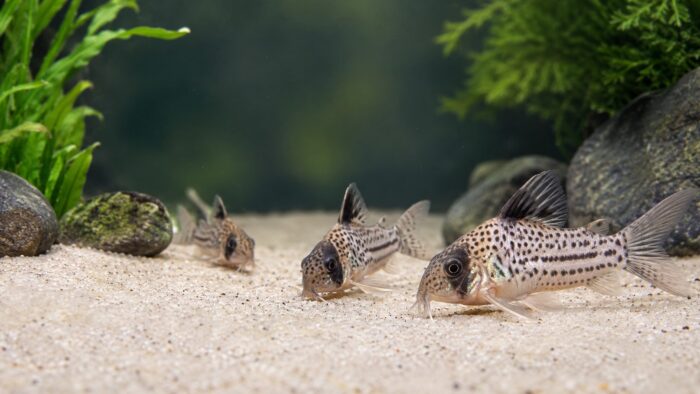
| Single corydoras or single tetra | Social needs | Chronic stress, hiding, shortened lifespan |
The pattern worth noticing is how many of these fail on adult size or on social needs rather than on aggression. Shops sell juveniles, and a fish that is peaceful at shop size is not necessarily peaceful at full size.
Combinations that reliably work
It is easier to build a community from known-good building blocks than to check every possible pairing. Three patterns cover most successful community tanks.
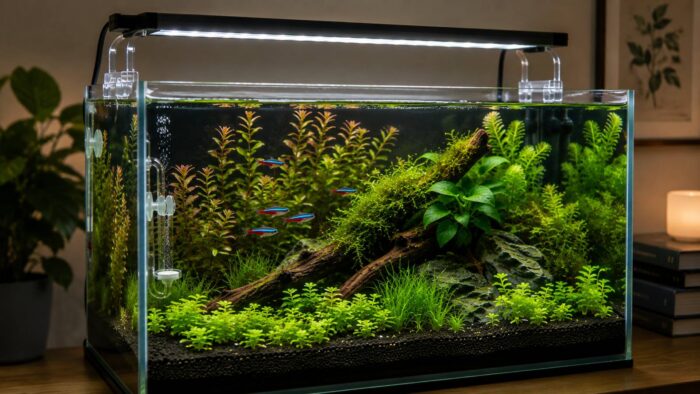
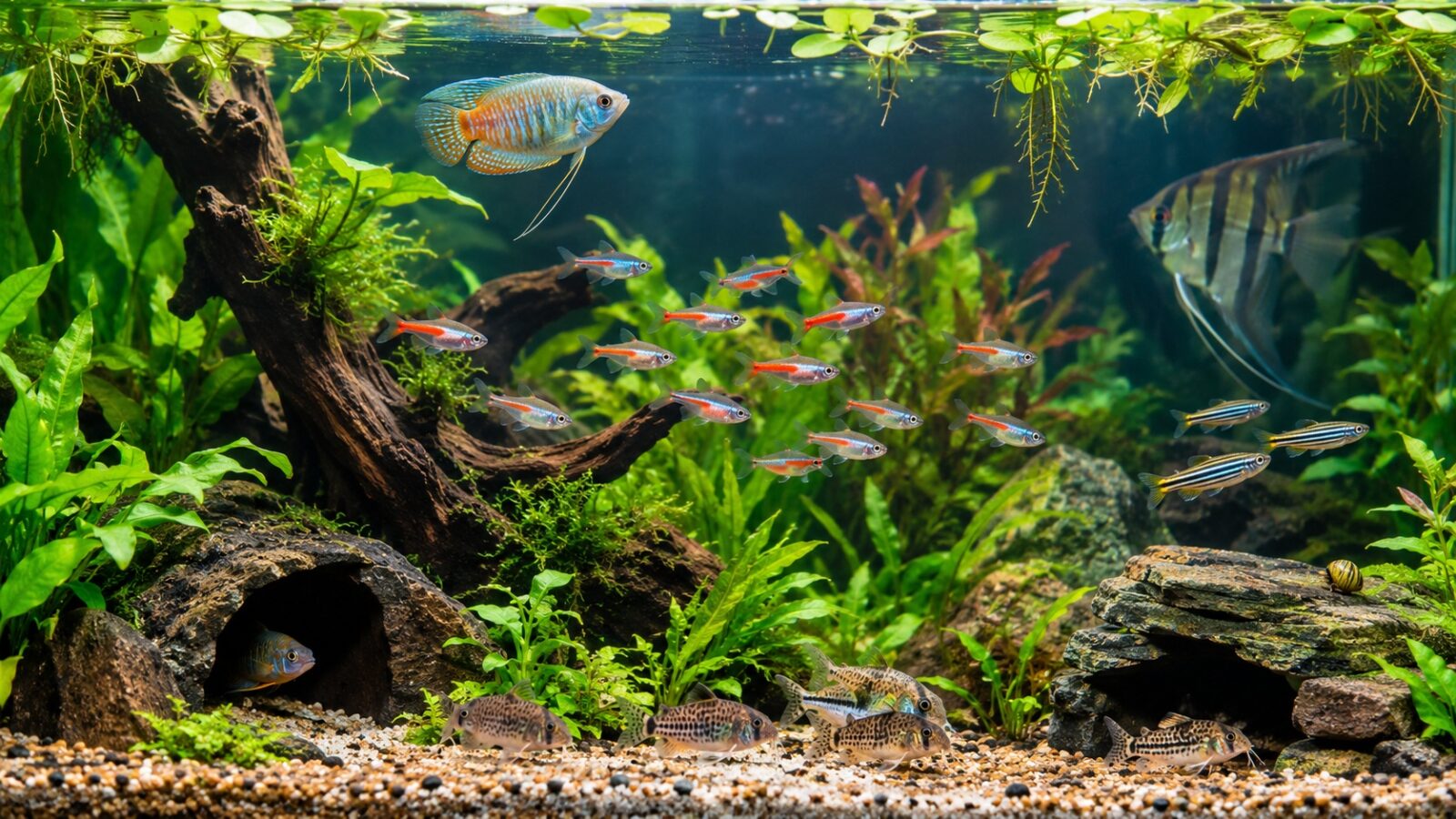
The layered community is the most common. One calm centrepiece such as a honey gourami or a pair of dwarf cichlids, one midwater shoal such as harlequin rasboras or rummynose tetras, and one bottom group such as corydoras. Each occupies a different level, none is large enough to eat another, and all suit the same water. Add amano shrimp or nerite snails if the centrepiece is small enough to ignore them.
The species tank is the second pattern and is underrated. A large shoal of one species, properly sized, is more interesting to watch than a mixed tank because the fish behave naturally rather than defensively. Twenty rummynose tetras in a planted 29-gallon is a genuinely striking display.
The biotope-style grouping is the third. Fish from the same region generally share water requirements and have evolved alongside each other, so a South American community of tetras, corydoras and a ram pair works well, as does a Southeast Asian community of rasboras, kuhli loaches and a gourami.
Whichever pattern you use, check the total load against the method in the guide to aquarium stocking before buying, and add the fish in batches as described in the guide to aquarium setup for beginners.
Using tank layout to improve compatibility
A significant proportion of compatibility problems are solvable with hardscape rather than rehoming, because aggression is usually about resources and sightlines rather than personality.
Break the line of sight across the tank. A single tall plant cluster or a piece of wood in the middle prevents a territorial fish from patrolling the whole tank at once, which dramatically reduces chasing. Fish that cannot see each other constantly do not compete constantly.
Provide more caves and shelters than territorial fish. If two fish want caves, provide four. Surplus resources remove the reason to fight over them.
Add floating plants for surface-dwelling and shy species. Bettas, gouramis and hatchetfish all behave more naturally with surface cover, and dimmer light reduces stress across most community species.
Use dither fish deliberately. A shoal of small, active midwater fish signals to shy or territorial species that no predator is present, which counterintuitively makes a nervous fish more visible and less aggressive. This technique works particularly well with dwarf cichlids.
Finally, when introducing a new fish into an established territorial community, rearrange the hardscape first. Resetting existing territories puts every fish on equal footing and prevents the newcomer from being treated as an intruder into a fully claimed tank.
Reading early warning signs
Incompatible combinations rarely announce themselves with an obvious fight. The signals are usually subtler and appear over days or weeks.
Watch for a fish that consistently occupies one corner, particularly one that had previously used the whole tank. Persistent hiding by a fish that used to be visible almost always means it is being harassed.
Look at fins under good light. Small nicks and splits in trailing fins indicate nipping long before the damage is obvious, and fin damage is the entry point for most bacterial infections.
Note which fish eat and which do not. A fish that never reaches food at feeding time is being outcompeted, and in a mixed community that will show as gradual weight loss long before anything looks dramatic.
Check for chasing that does not stop. Brief chases are normal social behaviour in many species. Sustained pursuit, particularly one fish repeatedly driving another away from the whole tank, is not, and it will end badly if left.
If the signs appear, act early. Adding cover, increasing the group size of the harassed species, or rearranging hardscape resolves many cases. Where one fish is consistently the aggressor and the layout is already good, rehoming that fish is usually the honest answer.
Fish compatibility questions
Can I trust the compatibility charts in shops?
Treat them as a rough filter rather than an answer. Most charts assume adequate tank size, correct group sizes and a well-structured layout, none of which are guaranteed. They also tend to mark combinations as compatible when they work at juvenile size but not at adult size.
Will a bigger tank fix aggression?
Sometimes, but not reliably. More volume helps where the issue is crowding or overlapping territories. It does nothing where the issue is predation, fin-nipping or a species that requires a group it does not have. Two male bettas will fight in any tank.
Can I keep just one fish of a shoaling species?
It will survive, but poorly. Shoaling species rely on the group for security, and a single individual typically hides, feeds badly, colours down and lives a shorter life. If space only allows one group, keep that group properly rather than keeping single fish of several species.
Do fish get used to each other over time?
Established communities often do settle, and fish raised together from a young age generally coexist better than fish introduced as adults. But this does not override the fundamental checks: a predator does not learn to stop eating tankmates, and a fish in the wrong temperature does not adapt to it.
What should I do if a new fish is being bullied?
Add cover and sightline breaks first, since this resolves many cases within days. Increasing the shoal size of the harassed species is the next step. If one individual is consistently the aggressor and conditions are otherwise good, separating that fish is usually necessary.
Check size, temperament, water and territory before buying
Compatibility is a set of specific checks rather than a general impression. Will either fish be large enough to eat the other at adult size, does either nip fins or hold territory, do they want the same water, and does the layout give territorial species somewhere to retreat.
A combination that passes all four is very likely to work. One that fails any of them will cause problems eventually, no matter how peaceful it looks in the first month. Plan the stocking list on paper, verify adult sizes rather than shop sizes, and build the layout to support the fish you intend to keep.