Aquarium maintenance has a reputation for being time-consuming, which is mostly a consequence of doing it irregularly. A tank maintained weekly needs twenty to thirty minutes. The same tank left for two months needs a long, disruptive session that stresses the fish and often destabilises the biological filter.
This guide sets out a complete schedule by frequency, with realistic timings, and explains the sequencing rule that prevents routine maintenance from causing the problems it is meant to prevent.
The full schedule
This schedule suits a typical stocked freshwater community tank. Heavily stocked tanks, marine tanks and high-tech planted tanks need more; lightly stocked planted tanks need less.
| Frequency | Task | Why | Time |
|---|---|---|---|
| Daily | Count fish and observe behaviour | Catches illness and losses within hours | 1 minute |
| Daily | Confirm heater light cycling and filter flowing | Equipment failure is silent otherwise | 30 seconds |
| Daily | Feed appropriately and remove uneaten food | Uneaten food is the main ammonia source | 2 minutes |
| Daily | Top up evaporation (marine tanks) | Salinity rises as water evaporates | 1 minute |
| Weekly | 20 to 30 percent water change | Exports nitrate, replaces minerals | 15 minutes |
| Weekly | Vacuum one third of the substrate | Removes detritus before it mineralises | 10 minutes |
| Weekly | Clean front and side glass | Keeps light and visibility consistent | 3 minutes |
| Weekly | Test parameters (new tanks); monthly once stable | Catches problems before symptoms appear | 5 minutes |
| Fortnightly | Rinse mechanical media in removed tank water | Restores flow without harming bacteria | 5 minutes |
| Monthly | Trim and replant plants, remove dead leaves | Prevents shading and decay | 10 minutes |
| Monthly | Check flow rate against normal | Declining flow signals impeller build-up | 2 minutes |
| Monthly | Inspect cords, plugs and drip loops | Electrical safety around water | 3 minutes |
| Quarterly | Clean impeller, intake tube and hoses | Restores full filter performance | 20 minutes |
| Quarterly | Replace worn mechanical media | Floss and pads degrade with use | 5 minutes |
| Twice yearly | Verify heater against a separate thermometer | Heater dials drift before failing | 5 minutes |
| Twice yearly | Replace airline and airstones | Airline hardens and airstones clog | 10 minutes |
| Annually | Inspect silicone seams and stand for movement | Catches structural problems early | 10 minutes |
| Annually | Replace heater preventively after 3 to 5 years | Failure is far costlier than replacement | 10 minutes |
Total commitment for a typical tank works out at roughly two minutes a day, half an hour a week, and an hour or two spread across the rest of the year.
The sequencing rule
This is the part of maintenance that beginners most often get wrong, and it causes more crashed tanks than neglect does.
The bacterial colony that keeps a tank safe lives on surfaces: filter media primarily, then substrate, hardscape and glass. Every maintenance task removes some of it. A water change removes almost none, since the bacteria are not in the water column. Vacuuming the substrate removes a small amount. Rinsing filter media removes more. Replacing filter media removes a great deal.
Individually, a tank absorbs any of these comfortably. Combined, they can drop the colony below what the bioload requires, producing an ammonia spike in a tank that has been stable for years. This is why a keeper who finally does a thorough clean-up frequently finds the tank in worse condition a week later.
The rule is therefore to separate disruptive tasks by at least several days. Do the water change and glass cleaning together; they are compatible. Do filter maintenance on a different day. Do substrate vacuuming in rotating sections so no single session strips the whole base. Never replace all filter media at once, and when media must be replaced, do it in stages across several weeks so bacteria can colonise the new material before the old is removed.
The same principle applies to any large change: rearranging hardscape, changing substrate, adding a large batch of fish. Space them out.
Doing each task correctly
Technique matters as much as frequency for several of these.
Water changes should use dechlorinated, temperature-matched water. Treat the replacement water in the bucket before it enters the tank rather than dosing the tank directly, as covered in the guide to water conditioners and dechlorinators. The full method is in the guide to doing a proper water change.
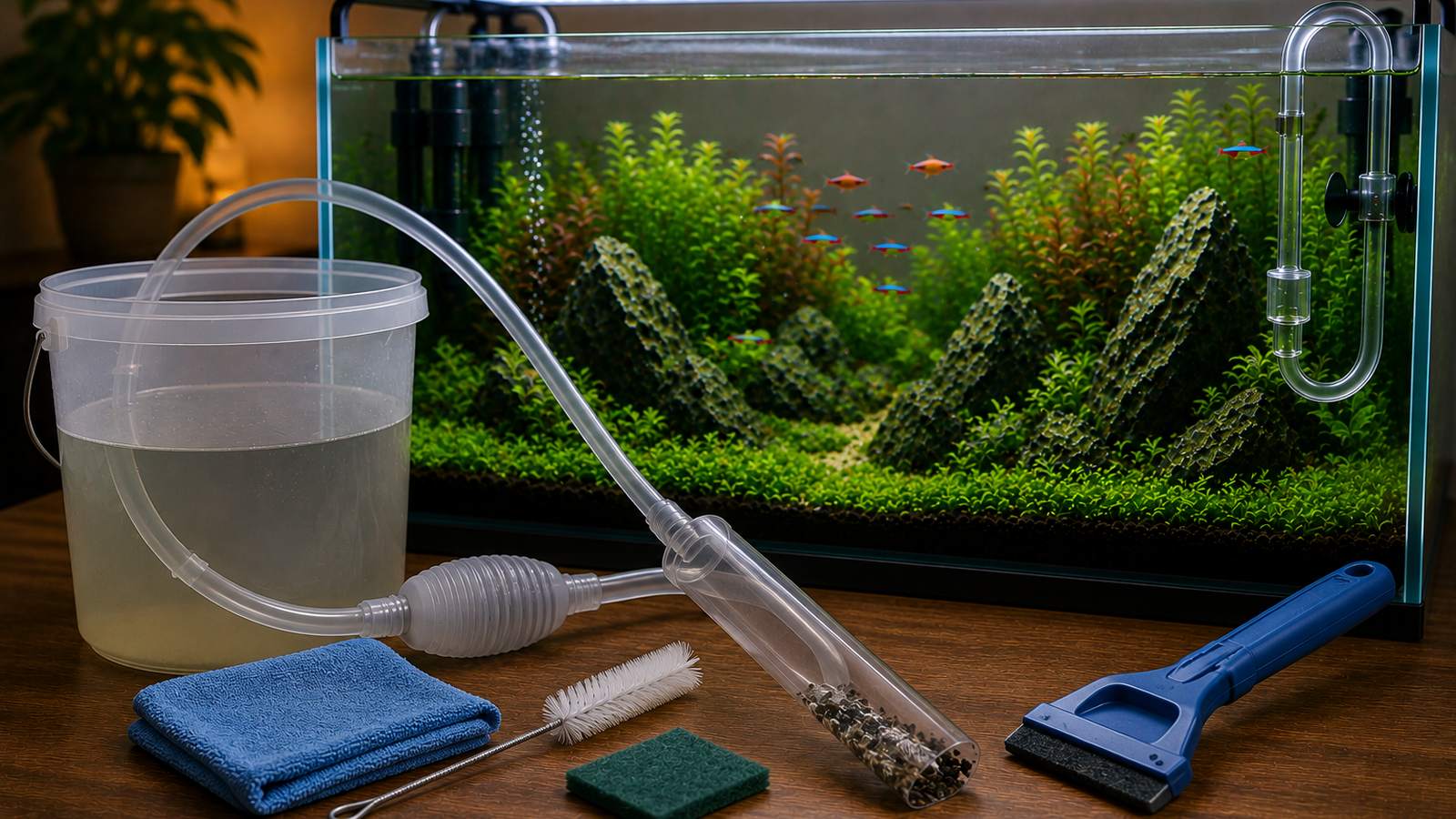
Substrate vacuuming should push the siphon into the gravel to lift detritus, then release so the substrate falls back. In planted tanks, hover over the surface rather than digging, since disturbing root systems does more harm than the trapped detritus does.
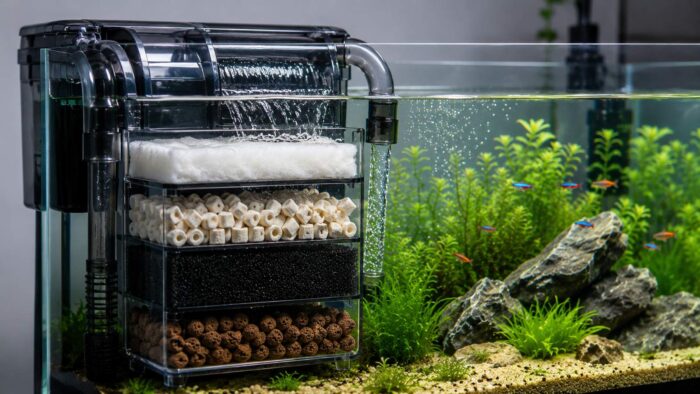
Filter media rinsing should always use water removed from the tank during the water change, in a bucket. Tap water chlorine kills the colony. Squeeze sponges gently rather than scrubbing, and aim to restore flow rather than to make the media look clean. Grey, slightly dirty media is working media.
Glass cleaning is best done before the water change so debris is siphoned out. Use a dedicated algae pad or scraper, and never anything that has touched detergent.
Plant trimming should remove old leaves at the base for rosette plants and cut stems from the top for stem plants, replanting healthy tops. Removed material should leave the tank rather than decompose in it.
A fuller treatment of what not to clean, which matters as much as what to clean, is in the guide to cleaning your aquarium without stressing your fish.
Adjusting the schedule to your tank
The schedule above is a starting point rather than a rule, and several factors legitimately shift it.
Stocking level is the largest variable. A heavily stocked tank may need two water changes a week or a larger single change. The practical measurement is the nitrate slope: test immediately after a water change and again seven days later. Under 10 ppm difference is comfortable, 10 to 20 is a working tank, and above 20 means the schedule is not keeping up.
Planting changes things in the opposite direction. A heavily planted, lightly stocked tank exports nitrogen through plant growth and may hold acceptable parameters on a fortnightly change. High-tech planted tanks, conversely, often need larger weekly changes to reset dosed nutrients.
Marine tanks need daily evaporation top-up, which freshwater tanks do not, and more frequent parameter testing. The rhythm is covered in the guide to saltwater aquariums.
New tanks need more frequent testing for the first three months, since that is when instability is most likely and least visible.
Whatever schedule you settle on, consistency matters more than the specific interval. A reliable fortnightly change beats an intended weekly change that happens monthly, because the tank stabilises around whatever actually happens rather than around the plan.
Maintenance schedule questions
Can I skip a week if the tank looks fine?
Occasionally, without much consequence, particularly in a lightly stocked planted tank. The risk is that occasional becomes habitual, and nitrate accumulates gradually enough that the tank looks fine long after parameters have drifted. If skipping regularly, test to confirm rather than judging by appearance.
Should I turn equipment off during a water change?
Turn off the heater if the water level will drop below it, since a heater exposed to air can crack or overheat. Turn off the filter if the intake will be exposed. Modern heaters are often safe to run dry briefly, but there is no benefit to risking it.
How much substrate should I vacuum at once?
About a third of the base each week, rotating so the whole tank is covered monthly. Vacuuming everything in one session removes too much of the bacterial population living in the substrate and stirs up more detritus than the filter can handle.
Do planted tanks need less maintenance?
Less water changing, often, because plants export nitrogen. More pruning, though, and high-tech planted tanks typically need larger water changes to manage dosed nutrients. The overall time commitment is similar, distributed differently.
What happens if I have not maintained the tank in months?
Do not fix it all at once. Start with a 25 percent water change, wait several days, do another, and continue over two to three weeks rather than performing a single massive change. A very large change on a neglected tank shifts parameters abruptly, which can be more harmful than the accumulated nitrate.
Small and regular beats large and occasional
A working maintenance schedule is short and frequent: a two-minute daily check, a half-hour weekly session covering the water change, a section of substrate and the glass, and a handful of quarterly and annual equipment tasks.
The sequencing rule matters as much as the schedule. Keep the water change and the filter clean on separate days, vacuum in rotating sections, and never replace all media at once. Done that way, maintenance is a routine that prevents problems rather than an intervention that causes them.