Aquarium equipment is sold on features and bought on price, and both are poor guides. What actually matters is whether each piece does its job reliably, whether it is sized correctly for the tank, and whether you will maintain it on schedule.
This guide is the hub for equipment and maintenance on the site. It covers what each item does, how to size it, which purchases genuinely matter, and the routine that keeps everything working.
The four systems that matter
Strip away the accessories and an aquarium needs four things to work: something to process waste, something to hold temperature, something to move water, and something to light it.
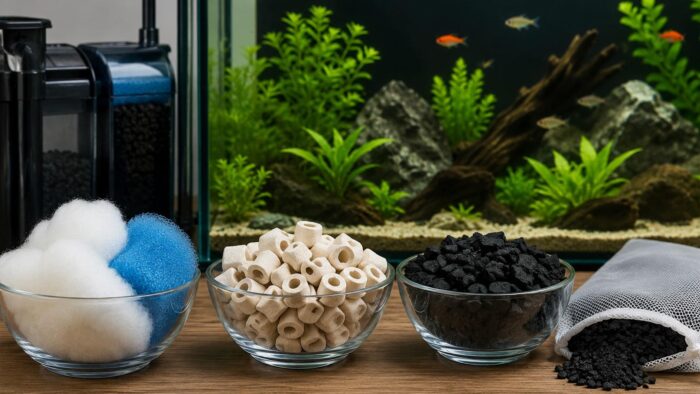
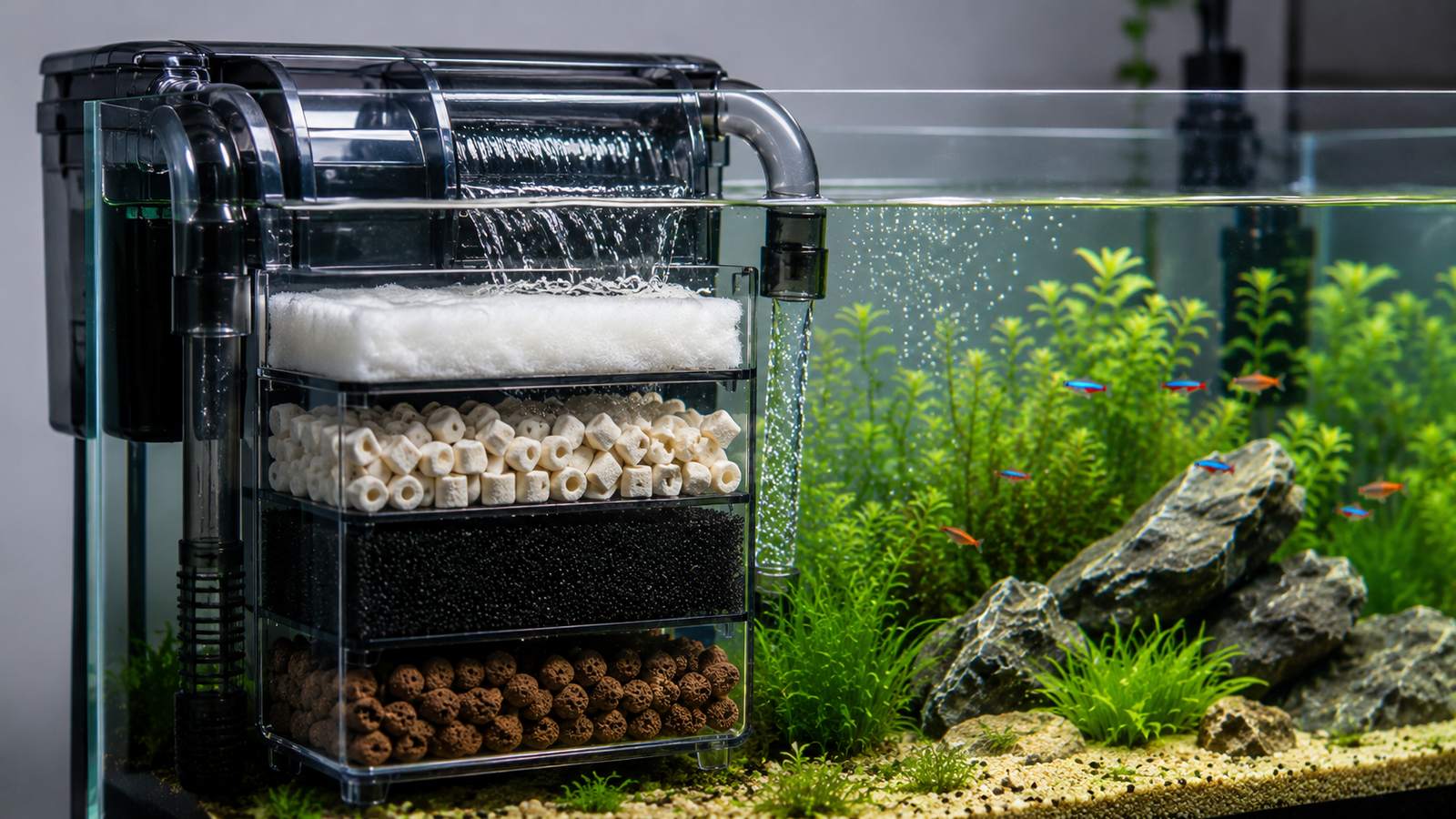
Filtration is the most important and the most misunderstood. A filter does three jobs: mechanical, trapping particles; biological, housing the bacteria that process ammonia; and chemical, adsorbing dissolved compounds. Biological is the one that keeps fish alive. The guide to aquarium filtration compares hang-on-back, canister, sponge and sump designs, and filter media covers what to put inside.
Heating matters less for the temperature itself than for its stability. Most tropical fish tolerate a range but not swings. Size at roughly 3 to 5 watts per gallon adjusted for room temperature, and consider two smaller heaters rather than one large one so a single failure is not catastrophic. The guide to choosing an aquarium heater covers sizing.
Flow is often provided by the filter alone in freshwater tanks, which is usually adequate. Marine and reef tanks need substantially more, and dedicated powerheads become necessary. The purpose is to eliminate dead zones where detritus settles and oxygen drops.
Lighting is a plant and coral requirement more than a viewing one. Excess light causes far more problems than insufficient light in freshwater tanks. The guide to aquarium lighting covers matching output to plant demand.
Sizing equipment correctly
Undersized equipment is the most common false economy in the hobby, because a unit running constantly at its maximum fails sooner and leaves no margin when conditions change.
| Tank | Filter turnover | Heater (average room) | Notes |
|---|---|---|---|
| 10 gallon | 40 to 60 GPH | 50 W | Sponge or small internal filter is often sufficient |
| 20 gallon | 80 to 120 GPH | 75 W | Hang-on-back is the practical choice |
| 29 gallon | 120 to 175 GPH | 100 W | Hang-on-back or small canister |
| 40 gallon | 160 to 240 GPH | 150 W | Consider two smaller heaters |
| 55 gallon | 220 to 330 GPH | 200 W | Canister or two hang-on-backs; two heaters advised |
| 75 gallon | 300 to 450 GPH | 300 W | Canister or sump; two heaters strongly advised |
| 125 gallon | 500 to 750 GPH | 2 x 200 W | Sump or dual canisters; controller worth considering |
Filter turnover of four to six times tank volume per hour is a reasonable target for a community tank, and more for heavily stocked or marine setups. Note that rated flow assumes clean media and no head height, so real-world flow is typically well below the box figure. Sizing up compensates for this.
Two heaters rather than one is worth emphasising. A single heater stuck in the on position can raise a tank by ten degrees or more, which is frequently fatal. Two heaters each sized for roughly half the requirement means a stuck-on unit cannot overheat the tank alone and a failed unit does not leave it cold.
What to buy and what to skip
The equipment shelf contains a great deal that solves problems most tanks do not have.
Worth buying: a filter with reusable media rather than disposable cartridges, an adjustable heater with a guard, a separate thermometer, a timer for the light, a liquid test kit, a gravel vacuum sized to the tank, and two dedicated buckets.
Worth buying eventually, when a specific need appears: an air pump and sponge filter for quarantine, a second heater for redundancy, an automatic top-off for marine tanks, and a UV steriliser if green water is a recurring problem.
Usually skippable: chemical filtration running permanently, automatic feeders for daily use unless schedules demand it, undergravel filters, decorative bubble features, and most water treatment additives beyond a chloramine-rated conditioner, as covered in the guide to water conditioners and dechlorinators.
For marine tanks specifically, the priority order differs, and the guide to saltwater aquarium equipment covers which items are genuinely essential versus which are convenience upgrades.
The general principle is to buy equipment that solves a problem you have measured rather than one a product description suggested. Reactors, dosing pumps and controllers all have genuine uses and all get bought years before they are needed.
The maintenance routine
Consistent small maintenance prevents nearly everything that a deep clean is meant to fix, and takes less total time.
| Frequency | Task | Time |
|---|---|---|
| Daily | Observe fish, count heads, confirm heater and filter running | 1 to 2 minutes |
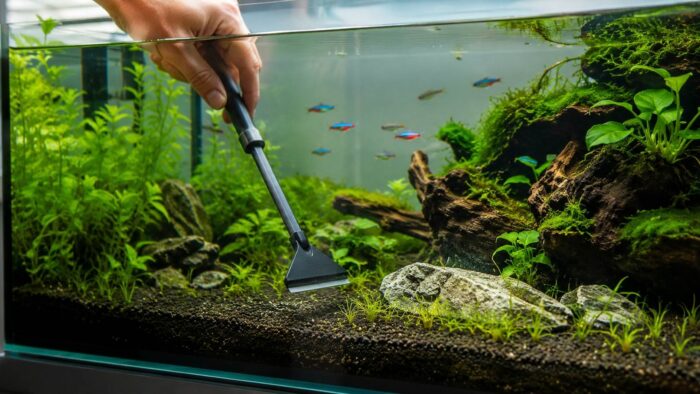
| Weekly | 20 to 30 percent water change, vacuum a third of the substrate, clean front glass | 20 to 30 minutes |
| Weekly | Test parameters in new tanks; monthly once established | 5 minutes |
| Fortnightly | Rinse mechanical media in removed tank water | 5 minutes |
| Monthly | Trim plants, check flow rate, inspect cords and drip loops | 15 minutes |
| Quarterly | Clean impeller and intake tube, replace worn mechanical media | 20 minutes |
| Twice yearly | Verify heater accuracy, replace airline, check seals and silicone | 15 minutes |
The critical rule is separation. Never do a large water change and a filter clean on the same day, and never replace media in the same week you disturb the substrate. Each disturbs part of the bacterial population, and a tank absorbs any one comfortably but not all at once.
The single most valuable habit is the weekly water change, covered in the guide to doing a proper water change. The second is knowing what not to clean, covered in the guide to cleaning without stressing your fish. A fuller breakdown of the schedule is in the guide to the aquarium maintenance schedule.
Equipment failure and how to prepare for it
Equipment fails, usually without warning, and the difference between an inconvenience and a loss is what you prepared in advance.
Heaters fail in two directions. Stuck off chills the tank slowly, which is survivable if noticed. Stuck on can raise the temperature past lethal within hours. Two heaters plus an independent thermometer covers both, and a temperature alarm is inexpensive insurance for a valuable tank.
Filters fail more gracefully but the consequence compounds. A stopped filter loses its bacterial colony within hours as oxygen depletes in the media. If a filter has been off for more than an hour, rinse the media in tank water before restarting rather than pushing decomposed material into the tank.
Power cuts affect everything at once. For short outages, the main risk is oxygen; a battery air pump is a worthwhile purchase for anyone in an area with unreliable supply. For longer outages, insulating the tank with blankets slows heat loss considerably.
Keep a small emergency kit: a spare heater, a battery air pump, a spare airline and airstone, dechlorinator, and for marine tanks a sealed container of pre-mixed saltwater. None of it is expensive and all of it is useless if bought after the fact.
Finally, check equipment deliberately rather than glancing at it. Confirm the heater light cycles, confirm flow is at full strength rather than merely present, and inspect cords and drip loops periodically. Most equipment gives warning signs before failing outright, but only to someone looking for them.
Equipment and maintenance questions
How often should I replace filter media?
Mechanical media such as floss when it stops recovering after rinsing, typically every few weeks. Chemical media on its label schedule, usually monthly. Biological media almost never, and when it must be replaced, do so in stages across several weeks so the colony can migrate.
Can I run two filters on one tank?
Yes, and it provides useful redundancy, since a failure leaves you with half a colony rather than none. It does not increase the bioload the tank supports, because the colony sizes itself to available food rather than available surface, but it is worthwhile insurance.
Is an air pump necessary?
Not usually in a freshwater tank with adequate surface agitation from the filter. It becomes valuable in heavily stocked tanks, in warm weather when oxygen solubility falls, during medication, and as emergency equipment during power cuts.
How do I know if my filter flow has dropped?
Compare against how it looked when new, and check the impeller first, since impeller build-up and a partly blocked intake cause most flow loss. Both clean in a few minutes. Reduced flow means reduced filtration and reduced oxygenation, so it is worth checking monthly.
How long does aquarium equipment last?
Heaters typically three to five years and should be replaced preventively. Filter motors five to ten years with impeller cleaning. LED lights last years but lose output gradually. Tank silicone can last decades but is worth inspecting annually for lifting or crazing.
Size generously, maintain consistently, prepare for failure
Aquarium equipment comes down to four systems, and getting each one right means choosing a unit sized above the minimum, understanding what it actually does, and servicing it on a schedule that never disturbs more than one part of the tank at a time.
The maintenance rhythm matters more than any individual purchase. Twenty to thirty minutes a week, spread across small tasks, keeps a tank stable indefinitely and makes the deep cleans that damage biological filtration unnecessary. Keep a small emergency kit, verify the heater independently, and most equipment problems become routine rather than serious.