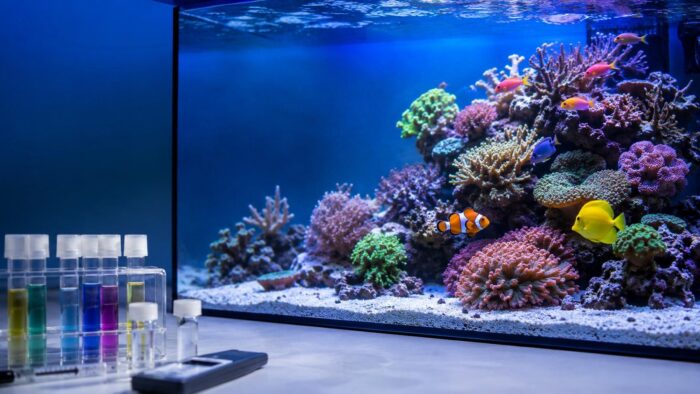
A reef aquarium usually costs more to establish and maintain than a comparable freshwater tank because lighting, circulation, source water, salinity measurement, and livestock requirements are more specialised. The exact budget varies widely by country, tank size, and whether equipment is bought new or used. This guide focuses on the items that affect stability rather than a fixed price.
Why reef is harder than freshwater
- Salinity adds a variable. As water evaporates, salt stays behind and concentration rises, so you constantly top off with fresh water to hold it steady.
- Corals demand stable lighting, flow, and water chemistry at a level freshwater fish simply do not.
- Marine fish are more often wild-caught, arrive stressed, and need careful quarantine.
- Equipment costs more. A capable LED, skimmer, return pump, heater, and RODI unit can reach $1,000 before you buy a single animal.
Tank size: bigger is easier
This reverses freshwater intuition. Larger volumes are more forgiving because temperature, salinity, and chemistry drift more slowly in more water. Sensible minimums:
- Fish only: 20 gallons.
- Soft coral and LPS reef: 30 gallons.
- SPS, the small-polyp stony corals: 40 gallons or more.
Reefs under 20 gallons are possible but punishing for a first attempt, so we suggest not starting smaller than 20.
The equipment list
Tank and stand
Glass or acrylic both work. All-in-one tanks such as the Innovative Marine, Waterbox, or Red Sea Reefer Nano hide filtration in a rear chamber and cut down on plumbing complexity for a first build.
Lighting
Choose a reef-rated LED that provides suitable coverage and controllable intensity for the corals you plan to keep. Compare the fixture’s coverage, mounting height, warranty, and availability of replacement parts rather than relying on brand alone.
Flow
A powerhead moving 20 to 40 times the tank volume per hour keeps water and nutrients circulating. Programmable wavemakers help eliminate stagnant zones where detritus and algae settle.
Heater
Use two smaller submersible heaters rather than one large one. A single heater stuck in the on position can cook a whole tank within hours; two share the load and add redundancy.
Salt mix and a refractometer
Reef Crystals, Red Sea, and Instant Ocean are all proven mixes. Measure salinity with a refractometer, not a swing-arm hydrometer, which is less reliable when poorly calibrated for marine work. Target a specific gravity of 1.024 to 1.026.
RODI water
Test the source water before deciding whether tap water is suitable. Purified RO or RODI water is often the safer choice when tap water contains measurable nitrate, phosphate, copper, silicate, or highly variable hardness. Water can be produced at home or purchased from a reputable aquarium supplier.
Protein skimmer
A skimmer strips dissolved organics before they break down. On tanks of 30 gallons and up it is close to essential. On a nano under 20 gallons, disciplined weekly water changes can stand in for one.
Live rock versus dry rock
Both work as the biological foundation. Live rock arrives seeded with bacteria, copepods, and the occasional hitchhiker, good or bad. Dry rock is sterile, cheaper, and carries no pest risk. For a first reef we suggest mostly dry rock with a small piece of quality live rock to seed bacteria.
Cycling a marine tank
The biology is the same nitrogen cycle as freshwater, just slower, usually four to eight weeks. Live rock kept wet through transport speeds things up, while dry rock alone can take eight to twelve weeks. Dose ammonia or use bottled bacteria as needed and confirm the cycle the same way you would in freshwater.
First livestock: the hardiness ladder
Add animals in this order, with weeks between steps:
- Cleanup crew first, including hermit crabs and snails such as nassarius, cerith, and astrea, plus one or two emerald crabs.
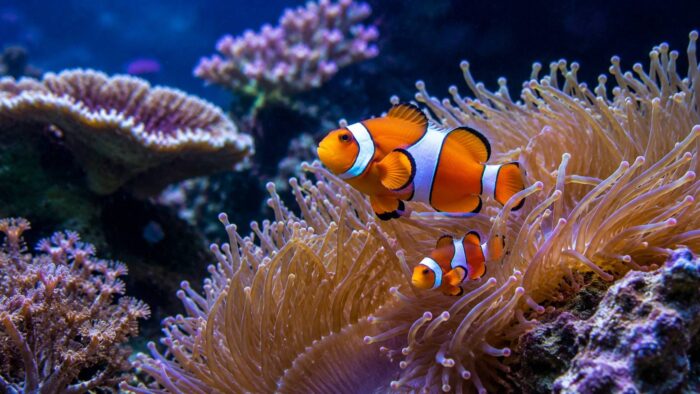
- First fish, a clownfish. Aquacultured ocellaris or percula are ideal, bought as a pair so they bond.
- Second fish, a goby such as a yellow watchman or hi-fin red-banded.
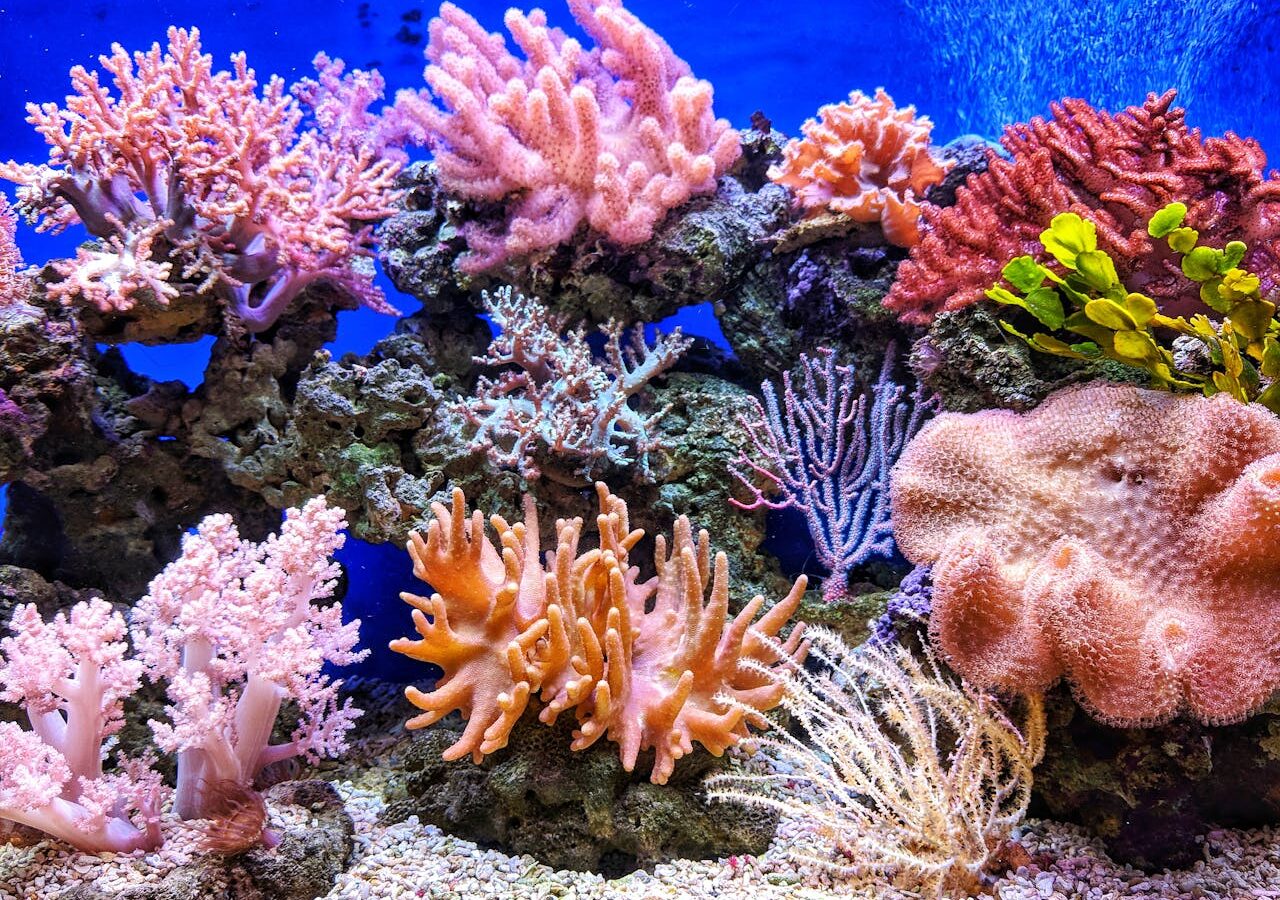
- First corals, soft corals like zoanthids, mushrooms, and leathers. Watch for hitchhiking Aiptasia, a pest anemone.
- LPS corals next, such as torch, hammer, frogspawn, and duncan.
- SPS corals last, if at all, since they need very stable chemistry.
For specifics on which fish forgive a young reef, see the guide to the best saltwater fish for beginners, and read the dedicated clownfish care guide before pairing your first pair.
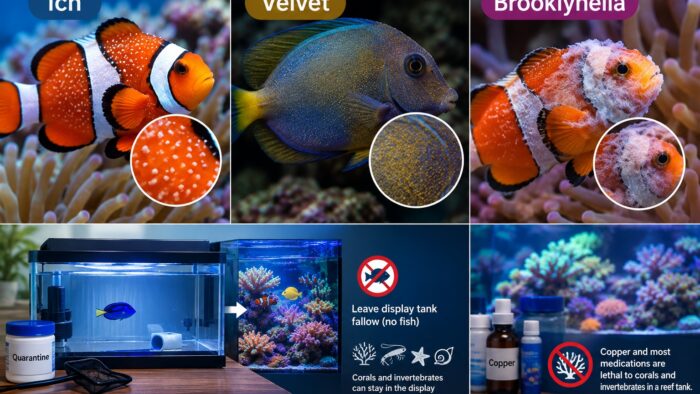
The one thing not to skip is a plan for illness. Marine parasites progress far faster than freshwater ones, and the guide to ich, velvet and brooklynella is worth reading before you need it rather than during an outbreak.
What to skip in year one
- Tangs, most of which need 75 to 125 gallon minimums.
- Anemones, frequently wild-caught and prone to dying in the first six months.
- Mandarin gobies, which eat live copepods almost exclusively and starve in immature tanks.
- Most angelfish, which nip corals.
- Acropora and other SPS, too sensitive for young water chemistry.
Corals in particular need acclimating to light as well as to water, and the guide to reef lighting and photoperiod explains how to ramp a new fixture in without bleaching them.
Acclimating marine fish and corals
Follow the seller’s acclimation instructions and compare temperature and salinity before transfer. A slow drip can help when salinity differs and the transport water is still clean, but prolonged acclimation may be harmful after a long shipment because ammonia can become more toxic once the bag is opened. Quarantine new fish before they enter the display.
Weekly maintenance minimums
- A 10 percent water change with fresh saltwater.
- Glass cleaning with a magnet scraper.
- Emptying the skimmer cup.
- Checking salinity and temperature.
- Topping off with fresh RODI to replace evaporated water.
Monthly, test alkalinity, calcium, and magnesium. Quarterly, replace or rinse filter media and vacuum the substrate more deeply.
Where first reef tanks fail
- Starting too small, where tiny errors become large swings.
- Adding corals before water chemistry is stable.
- Using a hydrometer instead of a refractometer.
- Topping off with saltwater instead of fresh water, which steadily raises salinity.
Let the reef mature before adding complexity
The reefkeepers who succeed are the ones who treat the first six months as a chemistry exercise, not a shopping spree. Build the system, get it stable, and let it run before you reach for the eye-catching corals. Strong filtration and flow make stability much easier to maintain.
First-reef questions that come up often
How much does a first reef really cost?
Costs vary too much by region and equipment choice for one reliable total. Build a complete budget that includes the tank, stand, light, circulation, heater, salinity instrument, source water, salt, test kits, maintenance supplies, quarantine equipment, and ongoing electricity before buying livestock.
Can I keep corals without a skimmer?
On a small nano, yes, if you commit to frequent water changes. On larger tanks a skimmer makes nutrient control far easier.
How long before I can add coral?
Plan on six to eight weeks of cycling, then several more months before the most sensitive corals.
Build stability before livestock variety
Budget realistically, expect six to eight weeks of cycling, and resist adding sensitive livestock for three to six months. If you cannot commit to weekly water changes for years, a reef is not the right project yet. If you can, it becomes the most beautiful tank you will ever own.