Neon tetras are among the most recognisable aquarium fish in the world and among the most frequently killed. They are cheap, widely stocked, and marketed as a beginner species, which puts them into exactly the environment they handle worst: a brand-new tank with unstable water.
In a mature, stable aquarium a neon tetra shoal is hardy, long-lived and genuinely striking. The difference between those two outcomes is almost entirely about tank maturity and shoal size rather than anything complicated.
Why neon tetras die in new tanks
The reputation for fragility is mostly a reputation for being bought too early. Neon tetras are commercially bred in enormous numbers under intensive conditions, and the fish reaching shops are frequently stressed, densely stocked, and less robust than wild or carefully bred stock. Put those fish into a tank that is still stabilising, and losses follow.
Three specific factors do most of the damage. Residual ammonia or nitrite in a recently cycled tank affects small-bodied fish faster than larger ones, and neons are among the smallest commonly stocked species. Parameter swings, particularly temperature and pH, hit them harder than hardier species like danios or platies. And the shock of moving from shop water to home water, without proper acclimation, compounds both.
The practical fix is patience. A tank that has been running with fish for three to six months has a large, stable bacterial colony, established biofilm, and buffered chemistry. Neons added at that point typically do very well. Neons added the week the cycle finished frequently do not.
Acclimate them carefully as well, following the method in the guide to acclimating new fish. Neons are sensitive to abrupt changes in both temperature and chemistry, and a rushed introduction accounts for a meaningful share of first-week losses.
Neon tetra tank requirements
Neons are small, but their requirements are driven by shoal size rather than individual size.
| Requirement | Recommendation | Notes |
|---|---|---|
| Adult size | 1.5 inches | Females are slightly deeper-bodied |
| Minimum shoal | 8, ideally 12 or more | Small groups cause chronic stress and faded colour |
| Minimum tank | 15 gallons for a proper shoal | 20 gallon long is better; length matters more than height |
| Temperature | 72 to 78 F | Stability matters more than the exact figure |
| pH | 6.0 to 7.5 | Tolerates neutral water; avoid swings |
| Hardness | 1 to 12 dGH | Prefers soft; adapts to moderate |
| Lifespan | 3 to 5 years | Often much shorter due to poor early conditions |
| Tank maturity | At least 3 months established | The single most important factor |
| Diet | Micro pellets, quality flake, frozen daphnia and brine | Small mouths; food must be sized appropriately |
Tank length matters more than volume for this species. Neons shoal by swimming laterally, and a long, shallow tank produces far better behaviour than a tall one of equal capacity. A 20-gallon long is close to ideal.
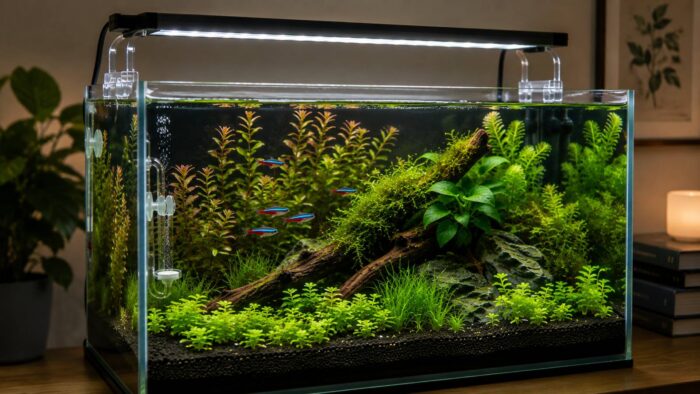
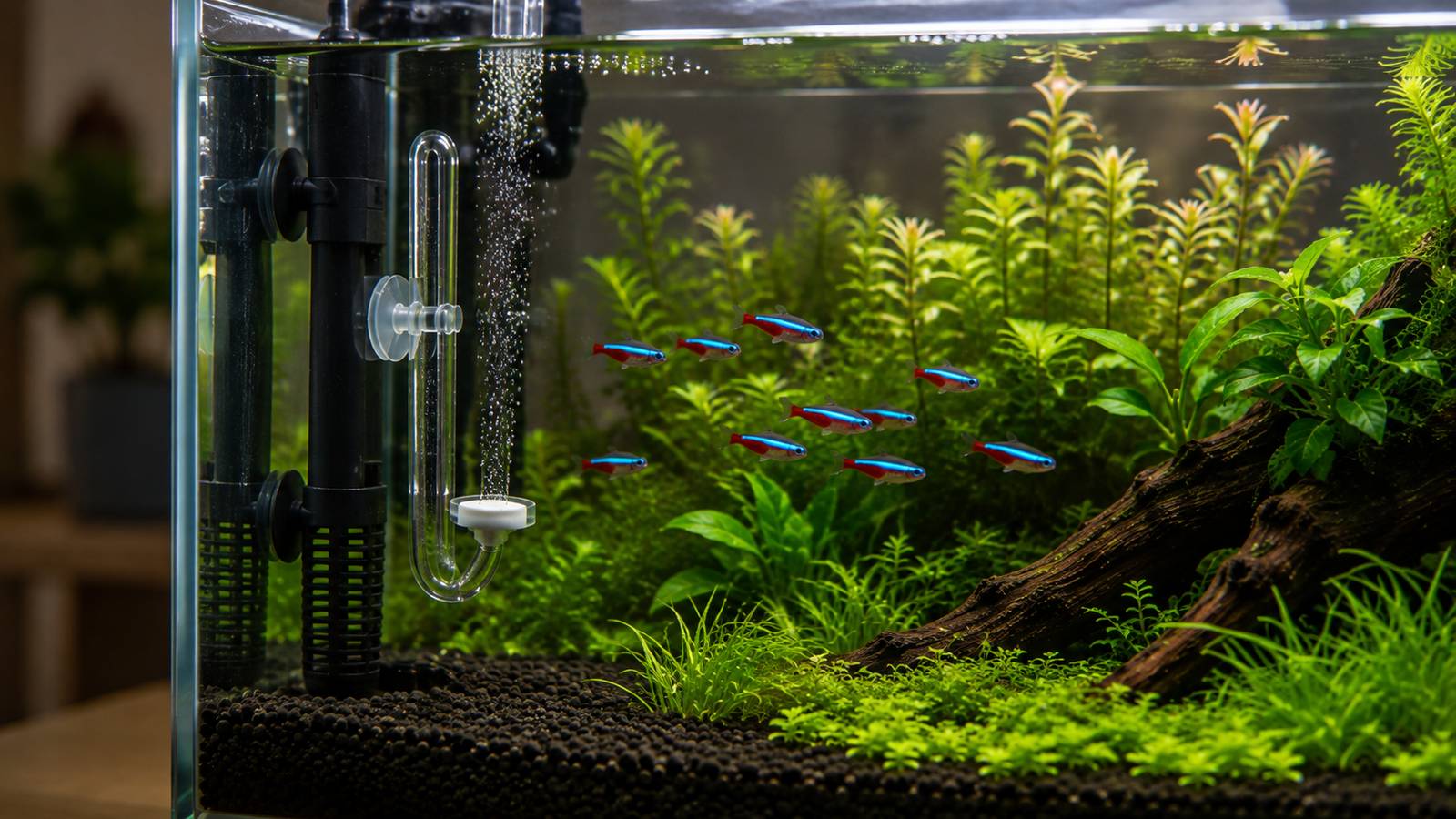
Setup should favour dark substrate, planted areas and some floating cover. Neons come from blackwater streams under dense canopy, and a bright, bare tank leaves them washed out and nervous. Their colour intensity is a reliable indicator of how comfortable they are: a stressed neon fades to near-grey, and a settled one shows the full blue and red stripe.
Feeding and daily care
Neons are micropredators in the wild, feeding on small invertebrates and larvae. In an aquarium they accept most prepared foods, but mouth size is the limiting factor. Standard community flake is often too large, and pellets sized for general community fish are frequently ignored entirely.
Use micro pellets, crushed quality flake, or foods specifically sized for small tetras. Supplement two or three times a week with frozen daphnia, cyclops or baby brine shrimp, which visibly improves colour and condition. Feed small amounts once or twice daily, following the portion guidance in the guide to how often to feed aquarium fish.
Watch feeding in a mixed community carefully. Neons are neither fast nor assertive, and in a tank with barbs, danios or larger tetras they frequently lose out. If the shoal looks thin while the rest of the tank looks well fed, the problem is competition rather than food quality.
Neon tetra tankmates
Neons work well with fish that share their water preferences and are too small to eat them, which excludes more community species than people expect.
Reliable companions include harlequin rasboras, other small tetras, corydoras, otocinclus, kuhli loaches, honey gouramis, dwarf cichlids such as rams, and amano shrimp. All share similar parameters and none will treat a neon as food.
Angelfish are the classic mistake. Juvenile angels and neons coexist peacefully, sometimes for a year, and then the angels reach a size where a neon fits comfortably in their mouth. This is not aggression and cannot be trained out. The same applies to any growing cichlid, larger gourami, or predatory fish.
Tiger barbs and serpae tetras are the second common error. Both are persistent nippers, and while neons do not have long fins, sustained harassment causes stress and shoal breakdown. The broader framework for judging these combinations is in the guide to aquarium fish compatibility.
Bettas are situational. Some individuals ignore a neon shoal entirely; others treat it as a target. If attempting it, the tank should be well planted with plenty of cover, and you should be prepared to separate them.
Neon tetra disease and other health problems
Neon tetra disease, caused by the parasite Pleistophora hyphessobryconis, is the condition most associated with the species and the one people most often misidentify.
The characteristic signs are a loss of colour in a specific patch rather than overall fading, usually starting mid-body along the blue stripe, followed by a lumpy or uneven body shape, difficulty swimming, and eventually spinal curvature. It progresses over days to weeks. There is no reliable treatment, and affected fish should be removed promptly because the parasite spreads when infected fish die and are eaten by tankmates.
The important distinction is from false neon tetra disease, a bacterial columnaris infection that looks similar in early stages but responds to treatment and improved water quality. Since the two are difficult to tell apart visually, the practical approach is to isolate any affected fish immediately and address water quality in the main tank while observing.
Most other neon health problems are not species-specific. Ich, fin rot and fungus all occur in neons for the same reasons they occur in any fish, and the guide to common aquarium diseases covers identification and response.
Prevention is dominated by two things. Quarantine every new arrival for four weeks, as described in the guide to quarantining new fish, because neon tetra disease usually enters a tank with new stock. And keep water quality stable, since a healthy neon in an established tank resists infections that overwhelm a stressed one.
Neon tetra questions
Why do my neon tetras keep dying one at a time?
Gradual, spaced-out losses usually indicate an underlying condition rather than an acute event: a tank that is not fully mature, chronic parameter instability, or neon tetra disease working through the shoal. Test ammonia, nitrite and nitrate first, check temperature stability over a full day, and examine remaining fish for patchy colour loss.
What is the difference between neon and cardinal tetras?
Cardinal tetras have a red stripe running the full length of the body, while neons have red only on the rear half. Cardinals are slightly larger, prefer warmer and softer water, and are generally hardier in mature tanks despite costing more. Many keepers find cardinals the better long-term choice.
Can neon tetras live alone or in pairs?
No. They are obligate shoaling fish and small groups produce chronic stress, faded colour, hiding and shortened lifespan. Eight is a working minimum and twelve or more looks and behaves considerably better.
Do neon tetras need a heater?
Yes in almost all homes. They need 72 to 78 F held steadily, and unheated room temperature fluctuates more than most people realise, particularly overnight. Temperature swings are one of the main stressors for this species.
How long should I wait before adding neons to a new tank?
At least three months after the cycle completes, and ideally longer. Use hardier species such as platies, danios or cherry barbs to establish the tank first. Adding neons to a freshly cycled aquarium is the most common reason they are considered fragile.
Mature water and a large shoal make neons hardy
Neon tetras are not a fragile species so much as a species commonly placed in the wrong conditions. In a tank that has been running for months, with stable temperature, soft to moderate water and a shoal of a dozen or more, they are undemanding and long-lived.
Give the tank time before adding them, buy the whole shoal at once rather than a few at a time, acclimate carefully, and quarantine new arrivals. Done that way, a neon shoal is one of the most reliable displays in freshwater fishkeeping.